






Key Points
- The Fed held rates at 3.75%–4.00% in a 10–2 vote, with two officials favouring a 25-basis-point increase.
- US Treasury yields near 5% provide support for the dollar, although the currency’s direction also depends on European rate expectations.
- The ECB’s 29 October policy decision is the next major catalyst for EURUSD.
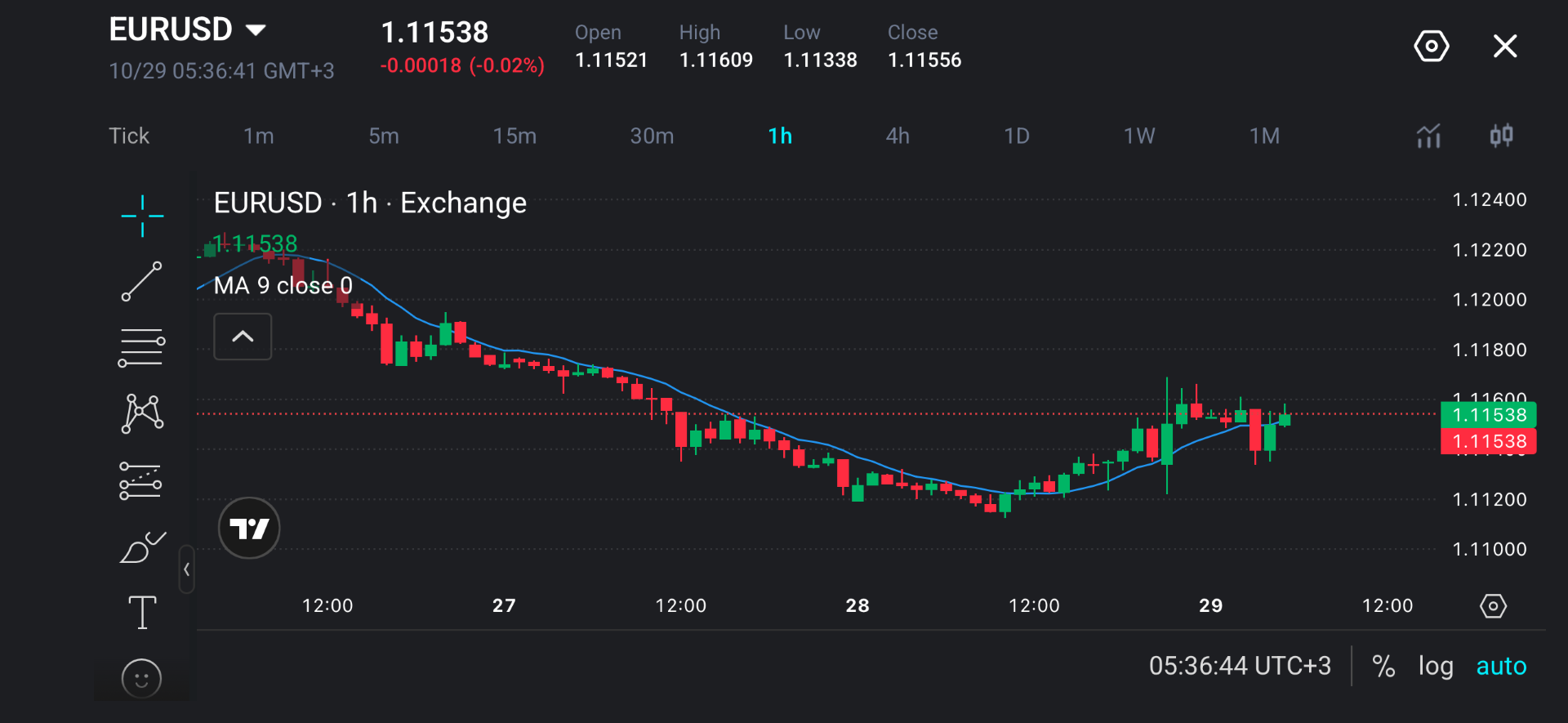
- The latest session shows EURUSD recovering to approximately 1.1154 after approaching the 1.1113 support zone.
- A sustained break below 1.1101 could extend the decline, while 1.1261 remains a broader resistance reference.
Market Move
EURUSD traded around 1.11538 in its most recent trading session, following a rebound from the 1.1113 support area. The recovery has brought the pair back towards its nine-period moving average, which has started to turn higher. However, price remains below earlier trading areas, around 1.1180–1.1200, which leaves the broader decline intact.
Recent candles show resistance developing around 1.1160–1.1170. A sustained move above this area would strengthen the recovery, while another rejection could bring 1.1133 and 1.1113 back into focus.
Why Traders Are Watching
The recent Fed decision has kept further tightening in focus. At its latest meeting, the Federal Reserve held its target range at 3.75%–4.00% on 28 October. This signalled strong economic expansion and elevated inflation. This combination supports a hawkish interpretation of the decision, although the Fed did not commit to a December hike.
The US 10-year Treasury yield continues supporting the dollar, hovering around 5.04% following the decision, while the two-year yield, which is particularly sensitive to policy expectations, was 4.78%.
Meanwhile, oil prices put inflation concerns in focus as Iran-related conflicts impact energy supplies. Another rise in oil prices could increase fuel and transport costs, slowing progress towards lower inflation. For the Fed, persistent energy pressure could strengthen the case for a rate hike. The euro area also faces exposure to higher energy import costs, which can squeeze household spending and business margins.
Key Trading Levels
| Level | Role | Significance |
| 1.1261 | Broader resistance | Upper reference |
| 1.1220–1.1230 | Higher resistance | Area around the earlier highs |
| 1.1180–1.1200 | Recovery resistance | Previous trading area during the decline. |
| 1.1160–1.1170 | Immediate resistance | Contains recent rebound highs and repeated upper wicks. |
| 1.1150–1.1155 | Immediate pivot | Current consolidation area near the nine-period moving average. |
| 1.1133–1.1140 | Initial support | Recent pullback area, including the low of 1.11338. |
| 1.1113 | Key support | Lower support reference near the recent trough. |
The immediate test is whether EURUSD can hold 1.1133–1.1140 and clear 1.1160–1.1170. That would create room for a recovery towards 1.1180–1.1200.
Below initial support, attention returns to 1.1113. A sustained break beneath 1.1100–1.1101 would suggest sellers have regained control. On the upside, 1.1261 remains a more distant reference that would require several nearer resistance zones to be cleared first.
Bullish and Bearish Setups
| Scenario | Confirmation / Trigger | Potential Levels |
| Bullish recovery | Hourly close above 1.1170, followed by a successful retest | 1.1180, then 1.1200 |
| Bullish extension | Sustained break above 1.1200 with higher lows | 1.1220–1.1230, then 1.1261 |
| Bearish rejection | Failure at 1.1160–1.1170, followed by an hourly close below 1.1133 | 1.1113, then 1.1101 |
| Bearish breakdown | Hourly close below 1.1100–1.1101 and a failed reclaim | 1.1080, then 1.1050 as round-number reference areas |
A bullish scenario could develop if EURUSD closes above 1.1170 and holds that level on a retest. This could support a recovery towards 1.1180, then 1.1200. A sustained break above 1.1200, accompanied by higher lows, could extend gains towards 1.1220–1.1230 and 1.1261.
A bearish scenario could develop if EURUSD rejects 1.1160–1.1170 and closes below 1.1133, bringing 1.1113 and 1.1101 into focus. A sustained break below 1.1100–1.1101, followed by a failed recovery above that zone, could expose the areas at 1.1080 and 1.1050.
Disclaimer
The price levels and market scenarios above reflect the author’s assessment at the time of writing. They do not represent financial advice or an official recommendation from VT Markets. Traders should conduct their own analysis and manage risk carefully.
EURUSD Prediction: Market Drivers
The ECB’s policy meeting concludes on 29 October, followed by a press conference. Traders will assess both the decision and the guidance on future policy.
The pair could rise if softer US inflation or employment data decreases expectations for further Fed tightening. Falling US yields, a more hawkish ECB message or easing energy pressures could also support the euro. On the other hand, greater emphasis on slowing growth could weigh on EURUSD, particularly if the Fed continues to signal limited room for easing. Higher oil prices or a comparatively cautious ECB outlook could also add pressure.
Upcoming US employment and inflation releases will be the next major market drivers as this will reinforce expectations on whether a December Fed hike becomes more likely.
Trade EURUSD with VT Markets
EURUSD is one of the world’s most actively traded forex pairs, offering traders exposure to changing expectations surrounding the European Central Bank, Federal Reserve, inflation, economic growth and global risk sentiment.
With VT Markets, traders can monitor EURUSD price movements, analyse technical trends and manage positions through platforms including MetaTrader 4, MetaTrader 5 and the VT Markets App.
Start a live trading account today and explore Forex pairs, gold and more.

Frequently Asked Questions
Why can a hawkish Fed weigh on EURUSD?
A hawkish Fed can raise expectations for higher US interest rates. This may increase demand for the dollar, pushing EURUSD lower if European rate expectations do not rise by a similar amount.
Did the Fed confirm a December rate hike?
No. The Fed held rates in October and said further information would guide its policy stance.
What is the main EURUSD support area?
The main support references are 1.1113 and 1.1100–1.1101. Holding this region would preserve the possibility of further stabilisation.
What would signal a stronger EURUSD recovery?
An hourly close above 1.1170, followed by a successful retest, would strengthen the immediate recovery. A sustained move above 1.1200 would improve the broader technical picture.
How could the ECB decision affect EURUSD?
Guidance that raises expectations for tighter European policy could support the euro. A message that lowers European rate expectations relative to the US could weigh on the pair.
Start trading now — click here to create your real VT Markets account.



