






Key Points
- Gold extended losses for a fourth consecutive session as higher oil prices fuelled inflation concerns.
- Uncertainty over US-Iran negotiations and tanker attacks kept energy supply risks in focus.
- The Federal Reserve is widely expected to hold rates steady next week, while a possible December hike remains a concern.
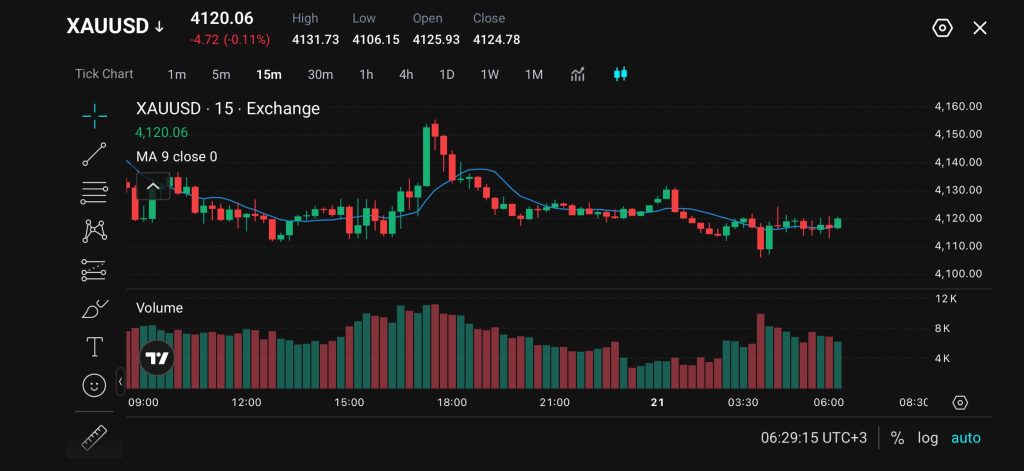
- The 15-minute chart shows gold near $4,120, with resistance at $4,130–$4,132 and support around $4,106–$4,110.
Gold fell towards $4,100 an ounce on Wednesday, extending losses for a fourth consecutive session as elevated oil prices reinforced inflation concerns and expectations for higher borrowing costs.
Oil resumed its climb after a diplomat dismissed reports that an agreement to end the US-Iran conflict was imminent, although negotiations remain underway. The uncertain outlook left gold under pressure as traders weighed the implications for monetary policy.
Why Traders Are Watching Gold
The main pressure on gold comes from the link between energy prices and interest-rate expectations.
Rising tensions in the Middle East and Eastern Europe, alongside increased attacks on tankers in the Strait of Hormuz, have heightened concerns over supply disruptions. Higher oil prices can raise transport and production costs, making inflation harder to contain.
That creates a challenge for bullion. Although gold can attract demand during periods of inflation and geopolitical uncertainty, it does not generate interest income. If central banks respond to persistent price pressures with higher rates, interest-bearing assets can become more competitive.
The Federal Reserve is widely expected to leave rates unchanged next week. However, markets continue to anticipate a possible increase in December, making the Fed’s guidance on inflation and future policy particularly relevant.
A decision to hold rates would therefore offer only part of the picture. Signals that further tightening remains possible could limit gold’s recovery, while a less restrictive message could ease some of the pressure.
US-Iran negotiations remain another potential catalyst. Progress could reduce energy supply concerns, while setbacks could keep oil prices elevated and complicate the inflation outlook.
Key Trading Levels
| Price Level | What Traders Are Watching |
| $4,150–$4,155 | Upper resistance around the earlier intraday high |
| $4,140 | Next recovery reference above immediate resistance |
| $4,130–$4,132 | Immediate resistance around the recent rebound high |
| $4,120 | Short-term pivot near the current trading area |
| $4,106–$4,110 | Immediate support around the recent swing low |
| $4,100 | Psychological downside reference |
Gold is consolidating near $4,120 after retreating from $4,150–$4,155. A sustained break above $4,132 could bring $4,140, followed by $4,150–$4,155, into focus.
On the downside, a move below $4,120 could lead to another test of $4,106–$4,110. A sustained break below $4,106 would expose $4,100, a psychological level not yet tested in the visible chart.
Bullish and Bearish Setups
| Setup | Trigger | Potential Market Reaction |
| Recovery Attempt | Hold above $4,120 after a 15-minute close above it | Gold may retest $4,130–$4,132 |
| Bullish Breakout | Sustained 15-minute break above $4,132 | A recovery could extend towards $4,140, then $4,150–$4,155 |
| Range Consolidation | Hold between $4,110 and $4,132 | Prices may continue to fluctuate within the recent range |
| Bearish Rejection | Fail near $4,130–$4,132 and slip below $4,120 | Gold could revisit $4,106–$4,110 |
| Bearish Breakdown | Sustained 15-minute break below $4,106 | Selling pressure could extend towards $4,100 |
The bullish case requires a sustained break above $4,132, with buyers holding that level on a retest.
The bearish case strengthens below $4,120, with further downside confirmation below $4,106. Without either move, consolidation remains the near-term outlook.
Disclaimer
The price levels and market scenarios above reflect the author’s interpretation of the supplied 15-minute chart at the time of writing and do not represent financial advice or an official recommendation from VT Markets. Traders should conduct their own analysis and manage risk carefully.
Explore Gold Trading with VT Markets
VT Markets provides access to gold CFDs through MetaTrader 4, MetaTrader 5 and the VT Markets app, allowing traders to speculate on rising or falling prices without owning physical bullion.
For access beyond traditional weekday sessions, explore XAUUSD247, which offers gold CFD trading including weekends, subject to product availability and trading conditions.
Learn more about trading gold with VT Markets.
What to Watch Next
The next catalyst will be whether developments in energy markets and central bank communication change expectations for borrowing costs.
Key factors include:
- Federal Reserve Meeting: The rate decision and guidance on the conditions that could justify further tightening.
- December Rate Expectations: Whether markets become more or less confident about another increase.
- Oil and Shipping Conditions: Changes in crude prices, tanker movements and disruption risks around the Strait of Hormuz.
- US-Iran Negotiations: Evidence of progress or setbacks in efforts to end the conflict.
- Treasury Yields and the US Dollar: Whether broader financial conditions reinforce or ease pressure on bullion.
A move outside the chart’s recent range would help clarify the immediate direction. How long that move lasts may depend on whether the broader policy outlook supports it.
Frequently Asked Questions
Why has gold fallen for four consecutive sessions?
Higher oil prices have increased inflation concerns and expectations for higher borrowing costs, putting pressure on non-interest-bearing gold.
Can geopolitical tensions push gold lower?
Yes. While tensions can encourage haven buying, disruptions that lift energy prices may also increase expectations for tighter monetary policy. That effect can outweigh support from haven demand.
Is the Federal Reserve expected to raise rates next week?
The Fed is widely expected to hold rates steady. Markets remain focused on a possible December increase and any guidance that changes that outlook.
What could change gold’s current outlook?
A shift in oil prices, progress in US-Iran negotiations or a change in Fed guidance could alter the balance between inflation concerns, interest-rate expectations and haven demand.
Start trading now — click here to create your real VT Markets account.



