





Key Takeaways
- A hedge fund is a pooled investment vehicle that uses complex strategies — including leverage, short positions, and derivatives — to pursue returns that are largely uncorrelated to the broader stock market.
- Global hedge fund industry AUM has climbed past $6 trillion in 2026, more than quadrupling since its 2009 financial-crisis trough.
- Unlike mutual funds, most hedge funds are restricted to accredited investors, institutional investors, and other high net worth investors rather than the general public.
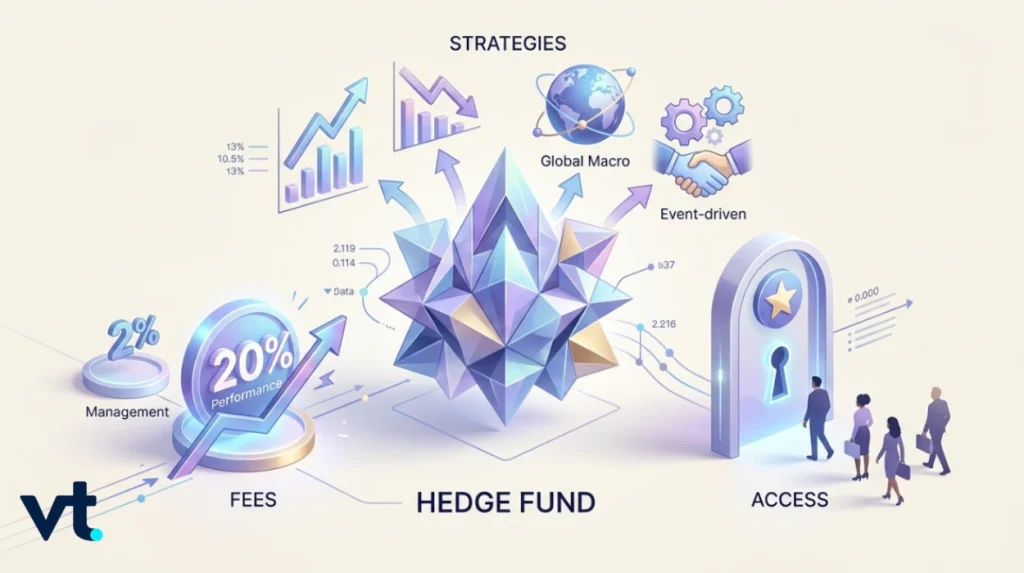
- Traditional hedge fund fee models follow a “2 and 20” structure — management fees around 1–2% of fund assets plus performance fees near 15–20% of profits — though fee compression is reshaping this in 2026.
- Hedge fund strategies range from global macro and long and short positions equity plays to distressed debt and quantitative, AI-driven models.
- Investing in hedge funds carries significant risk, lock up periods, and higher fees than mutual funds — important reminders for anyone weighing whether this alternative investment fits their investment goals.
Mention the term ‘hedge fund’ in casual conversation, and most people picture something out of a finance thriller — billion-dollar bets, secretive trading floors, and managers who seem to print money regardless of what the stock market is doing. The reality is both more structured and more fascinating than the stereotype.
In 2026, the global hedge fund industry oversees more capital than ever before, with total assets under management surpassing $5.7–6 trillion across thousands of investment funds worldwide. Yet despite this scale, most average investors will never put a single dollar into one — not because they don’t want to, but because regulation generally limits access to a specific class of wealthy investors and institutions.
This guide answers the question at the heart of it all: What is a hedge fund? How do hedging and hedge funds actually work in practice? And what should anyone curious about this corner of financial markets understand before going further?
What Is A Hedge Fund? The Core Definition
A hedge fund is a privately pooled investment vehicle that gathers capital from a limited group of investors and deploys it using a wide range of investment strategies — many of which are unavailable to traditional investments like a standard brokerage account. The name itself comes from the original purpose: to “hedge” against market downturns by holding both long and short positions simultaneously, theoretically allowing the fund manager to generate positive returns whether the broader market rises or falls.
A hedge fund manager — often called a portfolio manager or investment manager — runs the day-to-day decision-making, choosing which financial instruments to buy, sell short, or otherwise trade on behalf of the fund‘s investors.
Hedge Fund: What Makes It Different From a Typical Fund?
The defining feature of a hedge fund is flexibility. While most retail investment vehicles operate within strict guardrails, hedge funds employ speculative investment techniques — including using borrowed money (leverage), trading derivatives, and taking concentrated positions — that are simply off-limits to more conservative, publicly regulated structures.
Hedge Funds vs. Mutual Funds: What’s the Real Difference?
This distinction is one of the most common points of confusion for new investors, and understanding it is essential before going any further.
| Feature | Hedge Funds | Mutual Funds |
|---|---|---|
| Investor eligibility | Accredited investors, institutions, qualified purchasers | Open to the general public |
| Regulatory oversight | Limited SEC registration requirements | Heavily regulated, full public disclosure |
| Use of leverage | Common, often significant | Generally restricted or prohibited |
| Short selling | Frequently used as core strategy | Rare to nonexistent |
| Liquidity | Often subject to a lock up period | Daily redemption at net asset value |
| Typical fees | ~1.1%–2% management + 15–20% performance | ~0.5%–1% expense ratio, no performance fee |
| Minimum investment | Often $100,000 to several million | Often as low as $0–$1,000 |
Unlike hedge funds, mutual funds must publish detailed daily holdings and pricing, since they are designed for the average investor. Unlike mutual funds, hedge funds can hold concentrated, illiquid, or leveraged positions for extended periods without disclosing them publicly — a structural difference that explains much of the mystique (and the regulatory caution) surrounding them.
Who Can Actually Invest in Hedge Funds?
Eligibility is perhaps the single biggest barrier separating hedge funds from traditional investments. Under U.S. Regulation D, accredited investors must meet specific thresholds before they’re permitted to participate.
Accredited Investor Requirements in 2026
- Individual annual income exceeding $200,000 (or $300,000 combined with a spouse or spousal equivalent) in each of the past two years, with a reasonable expectation of the same this year
- Net worth exceeding $1 million, excluding the value of a primary residence
- Holding a Series 7, Series 65, or Series 82 professional securities licence in good standing
- Certain “knowledgeable employees” of the fund itself, including general partners and investment staff
These net worth and income thresholds have remained largely unchanged since 2010, even as inflation has quietly expanded the pool of qualifying accredited investors each year. For funds that charge performance fees directly, an even higher “qualified client” bar applies — recently adjusted in 2026 to require either $1.4 million in assets managed by the adviser or $2.7 million in net worth.
📝 Take Note: Many investors discover they technically qualify as accredited without realising it, simply by virtue of income or home equity. Qualifying, however, does not automatically mean hedge fund investing suits your risk tolerance or investment goals — it simply opens the door to consider it.
Institutional Investors Dominate the Capital Base
While individual accredited investors and family offices participate, institutional investors — pension funds, endowments, sovereign wealth funds, and insurance companies — now represent roughly 65–70% of all hedge fund capital. High-net-worth individuals and family offices contribute another 25–30%, while retail-adjacent participation remains in the single digits.
How Big Is the Hedge Fund Industry in 2026?
The scale of the modern hedge fund industry has grown dramatically since its post-financial-crisis low. Below is a snapshot of where things stand.
| Metric | 2026 Figure |
|---|---|
| Global hedge fund AUM | ~$5.7–6.06 trillion |
| AUM at 2009 post-crisis trough | ~$1.4 trillion |
| 2025 average annual return | ~10.5%–11.2% (second consecutive double-digit year) |
| North American share of global AUM | ~60–70% |
| Europe’s share of global AUM | ~20–25% |
| Asia-Pacific’s share of global AUM | ~13–14% |
| Institutional investor share of capital | ~65–70% |
| Projected market size by 2031 | ~$8.8 trillion |
The hedge fund market recorded its highest inflows in almost two decades entering 2026, a sharp reversal from the stagnant 2016–2023 period when annual outflows averaged roughly $30 billion. The turnaround has been driven by back-to-back double-digit return years and growing institutional appetite for diversification benefits that traditional investments alone can no longer reliably provide, given that stock-bond correlations have not always offered consistent downside protection in recent interest rates environments.
Multi-Strategy Platforms Lead the Pack
Multi-strategy hedge funds — platforms that run several different strategies under one roof — now represent the largest single category, holding around 27% of industry AUM in 2025. Quant multi strategy and global macro approaches were among the most favoured allocations heading into 2026, prized for delivering risk adjusted returns with comparatively low correlation to market indices.
Common Hedge Fund Strategies Explained
Hedge fund strategies vary enormously, and understanding the major categories helps explain why these funds behave so differently from mutual funds tracking a benchmark index.
- Long/short equity: Taking long and short positions in related securities or the same sector, aiming to profit from relative performance rather than overall market direction. This remains the most widely used core approach among equity hedge funds.
- Global macro: Betting on broad economic trends — currency movements, interest rates shifts, and geopolitical developments — across global financial markets.
- Event-driven: Capitalising on corporate events like mergers, bankruptcies, or restructurings, including distressed debt investing.
- Relative value / arbitrage: Exploiting pricing discrepancies between similar assets, often using significant leverage to magnify modest mispricings.
- Quantitative / systematic: Algorithm and AI-driven models that scan vast datasets to identify lucrative stocks or trading signals — a rapidly growing category, with roughly 86% of hedge fund managers now using generative AI in some capacity.
📝 Reminder: No single strategy guarantees positive returns in every environment. Even sophisticated hedge fund strategies can underperform during unusual market volatility or when correlations between asset classes break down unexpectedly — a precaution worth remembering before assuming any strategy is foolproof.
Hedge Fund Fees: Understanding “2 and 20”
One of the most distinctive features of the hedge fund world is its fee structure — historically far higher than what mutual funds typically charge.
The Traditional Fee Model
| Fee Type | Typical Range (2026) | What It Covers |
|---|---|---|
| Management fees | ~1.1%–2% of fund assets annually | Operational costs, salaries, overhead |
| Performance fees | ~15%–20% of profits | Predetermined percentage of the fund’s profits paid to the manager |
| Redemption fee | Varies by fund | Charged if investors withdraw early |
| Pass-through expenses | Can push effective fees to 5–10%+ at large platforms | Technology, data subscriptions, operational overhead |
This is sometimes referred to as the “2 and 20” model, though fee compression has been a defining theme of 2026: average management fees have drifted toward roughly 1.1%–1.4%, and many emerging managers now offer performance-only or founder-share structures simply to attract investors capital in a competitive fundraising environment. Interestingly, at the largest multi-strategy platforms, effective fees have actually risen due to pass-through expense models — meaning higher fees persist at scale even as smaller funds compete on price.
Why Investors Tolerate Higher Fees
The justification many institutional investors and accredited investors give is straightforward: if a fund manager can deliver consistent risk adjusted returns and genuine diversification benefits uncorrelated to the stock market, the higher fees may be worth paying relative to net asset value growth over time. Whether that trade-off holds for any particular trade, fund, or strategy is something every investor must evaluate individually.
Hedge Fund Risks: Important Reminders Before Investing
Investing in hedge funds is not a guaranteed path to outsized investment returns. Several structural factors deserve careful consideration — framed here not as dangers, but as practical precautions every prospective investor should weigh.
- Lock up period: Many hedge funds require capital to remain invested for a set period — often one to several years — before withdrawals exceeding this window are permitted. This is a key liquidity reminder for anyone who may need access to their original investment on short notice.
- Leverage amplifies both gains and losses: Because many hedge funds use borrowed money to scale positions, a relatively small adverse move can meaningfully affect the fund’s performance in either direction.
- Limited transparency: Unlike mutual funds, hedge funds are not required to disclose holdings publicly, which can make it harder for investors to fully assess the risk involved at any given moment.
- Higher fees can erode returns: Even strong gross performance can translate into more modest net investment returns once management fees and performance fees are deducted.
- Market risk remains real: Hedging strategies aim to mitigate risk, not eliminate it — a fund pursuing complex strategies can still experience meaningful drawdowns during periods of unusual market volatility.
⚠️ Caution: Before investing in hedge funds, it’s worth taking note that these investment vehicles are generally designed for investors who can tolerate illiquidity and potential losses without affecting their broader financial stability. Many investors use independent financial advice to confirm whether a fund’s strategy, fee structure, and lock up period genuinely align with their personal investment goals and risk tolerance.
How Hedge Fund Managers Actually Generate Returns
Understanding the mechanics behind hedge fund managers‘ decision-making helps demystify how these actively managed vehicles attempt to outperform passive market indices.
Long and Short Positions Working Together
A classic long/short approach might involve a fund manager taking a long position in a company they believe is undervalued, while simultaneously holding short positions in a weaker competitor within the same sector. If executed well, the fund profits from the spread between the two — regardless of whether the broader sector rises or falls. This is the original “hedge” the industry is named for.
Short Selling and Hedging Mechanics
Short selling involves borrowing shares and selling them with the intention of repurchasing them later at a lower stock price, profiting from the decline. Combined with traditional long positions, this allows funds to construct portfolios designed to mitigate risk from broad market swings while still expressing a view on individual securities.
Fixed Income and Credit Strategies
Beyond equities, many hedge funds allocate meaningfully to fixed income and credit markets, including distressed debt situations where a company’s bonds trade well below face value due to financial trouble. Skilled managers in this space aim to identify situations where recovery value exceeds the market’s pessimistic pricing.
Hedge Funds vs. Other Alternative Investments
Hedge funds are just one branch of the broader alternative investments universe, which also includes private equity, venture capital, and real assets. Here’s how hedge funds compare to other common categories high net worth investors consider.
| Vehicle | Liquidity | Typical Strategy Focus |
|---|---|---|
| Hedge funds | Periodic (subject to lock-ups) | Public markets, derivatives, leverage |
| Private equity | Very low (multi-year holds) | Direct ownership of private companies |
| Venture capital | Very low (5–10+ years) | Early-stage private companies |
| Mutual funds | Daily | Long-only public market exposure |
For investors seeking exposure to financial markets without committing to multi-year illiquidity, publicly tradeable instruments — currencies, indices, commodities, and individual equities — remain a far more accessible alternative, allowing more informed decisions to be made on a daily basis rather than locked in for years at a time.
Should You Consider Hedge Fund Exposure?
Whether hedge funds belong in a portfolio depends entirely on individual circumstances. A few practical questions worth asking:
- Do you meet the accredited investor or qualified purchaser thresholds required to invest in the first place?
- Can your broader financial plan tolerate a multi-year lock up period without needing that capital?
- Does the specific fund’s track record, fee structure, and strategy genuinely align with your investment goals and risk tolerance?
- Have you compared the fund’s historical risk adjusted returns against simpler, lower-cost alternative investments or public market strategies?
For the vast majority of retail-level traders and investors who don’t meet accreditation thresholds — or who simply prefer transparent, liquid markets — building trading strategy exposure directly in financial markets through forex, commodities, indices, and shares remains a practical way to pursue investment returns without the structural constraints that come with traditional hedge fund participation.
Explore Global Markets With VT Markets
While hedge funds remain limited to a narrow pool of accredited and institutional investors, the broader financial markets they trade in — currencies, indices, commodities, and shares — are far more accessible.
VT Markets provides access to a broad range of financial instruments through MetaTrader 4 (MT4) and MetaTrader 5 (MT5) — platforms built with the charting, execution speed, and reliability that disciplined trading demands, no accreditation required.
Access professional-grade trading tools including built-in calculators, advanced charting, and risk management features designed to support informed decisions and disciplined position sizing across all financial markets. Not ready to commit real capital? Practise your own trading strategy with simulated funds on a VT Markets demo account — a risk-free environment to build confidence before trading live.
For additional guidance, the Help Centre provides clear educational resources at every stage of your trading journey.
Open your account with VT Markets today and start trading global markets with the tools and infrastructure to plan, calculate, and execute with confidence.
Frequently Asked Questions (FAQs)
Q1: What is a hedge fund, in simple terms?
A hedge fund is a privately managed pool of capital that uses a wide range of investment strategies — including long and short positions, leverage, and derivatives — to try to generate returns regardless of overall stock market direction. Unlike mutual funds, hedge funds are generally restricted to accredited investors, institutional investors, and other qualifying participants, rather than being open to the general public. A hedge fund manager makes the day-to-day trading and allocation decisions on behalf of the fund’s investors.
Q2: How much money do you need to invest in a hedge fund?
Minimum investments vary widely, but many hedge funds require anywhere from $100,000 to several million dollars in committed capital. Beyond the dollar minimum, investors must also typically qualify as accredited investors — meaning a net worth exceeding $1 million (excluding primary residence) or individual income above $200,000 in each of the past two years. Institutional investors, such as pension funds and endowments, generally face no such personal wealth test and instead commit capital at a much larger scale.
Q3: What is the difference between hedge funds and mutual funds?
The core differences lie in eligibility, regulation, and strategy. Mutual funds are open to virtually any average investor, offer daily liquidity at net asset value, and are heavily regulated with mandatory disclosure. Hedge funds, by contrast, are restricted to accredited investors and institutions, often impose a lock up period before withdrawals are permitted, and can use leverage, short selling, and other speculative investment techniques that mutual funds typically cannot. Fee structures also differ significantly, with hedge funds commonly charging both management fees and performance fees.
Q4: Are hedge funds a good investment for everyday investors?
For most everyday or average investors, hedge funds are simply not accessible due to accredited investor requirements, and even for those who qualify, the combination of higher fees, illiquidity, and significant risk means they aren’t automatically a fit for every investment goals profile. Hedge funds can offer genuine diversification benefits and historically attractive risk adjusted returns for sophisticated, long-horizon capital — but they require investors to carefully weigh their own risk tolerance and liquidity needs first. Many investors instead choose to pursue exposure to financial markets through more liquid, transparent instruments.
Hedge Funds in Context
The modern hedge fund industry has grown into a multi-trillion-dollar pillar of global financial markets, increasingly embraced by institutional investors seeking diversification benefits that traditional investments alone haven’t always delivered in recent years. From global macro bets on interest rates to quantitative models scanning thousands of related securities for an edge, the range of hedge fund strategies reflects just how far the industry has evolved since its origins decades ago.
But scale and sophistication don’t eliminate the fundamentals every investor should keep in mind: higher fees, restricted access, illiquidity through a lock up period, and genuine market risk remain defining features of this alternative investment category. For the relatively small group of accredited investors and institutions who can access hedge funds, the decision should rest on careful due diligence — not the mystique that surrounds the word itself.
For everyone else, the same financial markets that hedge funds trade in — currencies, indices, commodities, and shares — remain open and accessible through regulated, transparent retail platforms, offering a different but equally legitimate path toward pursuing one’s own investment returns.
Disclaimer: This article is for general informational purposes only and does not constitute investment, legal, or financial advice. Hedge fund statistics, fee structures, and regulatory thresholds referenced are approximate, subject to change, and may vary by jurisdiction and individual fund. Past performance is not indicative of future results. Always consult a licensed financial advisor and conduct independent due diligence before making any investment decision. Trading CFDs and other leveraged products carries a high level of risk and may not be suitable for all investors.








