





Key Takeaways:
- MACD stands for Moving Average Convergence Divergence, a momentum indicator built from two moving averages.
- The macd indicator has three parts: the MACD line, the signal line, and the histogram.
- Default settings are 12, 26 and 9, and these are used across forex, indices, commodities and shares.
- It works best in trending markets and tends to give false signals when price moves sideways.
- On platforms such as VT Markets, you can apply it on MetaTrader 4 and MetaTrader 5 in just a few clicks.
If you have ever opened a price chart and felt overwhelmed by the lines and bars beneath it, you are not alone. One of those tools is the MACD, and it is among the most widely used momentum indicators in trading today. Many charting platforms even display the macd indicator by default, which tells you how trusted it has become.
In simple terms, MACD helps you see whether momentum is building or fading. It does this by comparing two moving averages of price. Once you understand what does the MACD tell you, you can read trend shifts earlier and time your entries and exits with more confidence. This guide breaks the MACD down step by step, with simple examples you can follow.
What Is the MACD Indicator?
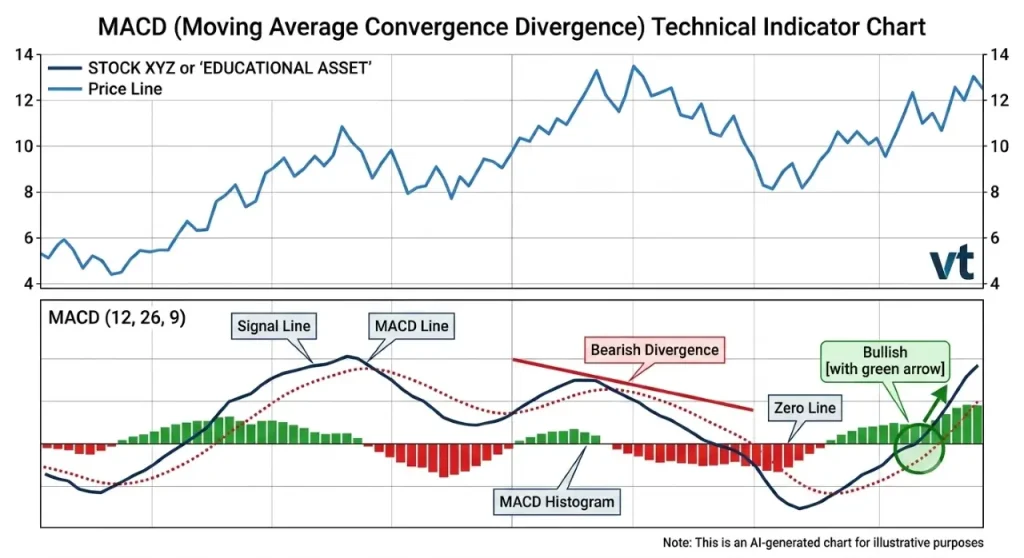
The indicator is a trend-following momentum indicator. It measures the relationship between two moving averages of an asset’s price, then plots the result so you can spot changes in direction and strength.
What does MACD stand for?
MACD stands for Moving Average Convergence Divergence. The name describes exactly what it tracks. When the two moving averages move apart, they diverge. When they move closer together, they converge. Those movements reveal whether momentum is speeding up or slowing down.
What is the macd indicator in simple terms?
Think of the macd indicator as a momentum speedometer. A standard moving average tells you the direction of a trend. This tool goes a step further. It tells you how fast that trend is gaining or losing strength.
In plain language, it answers three questions:
- Is the trend turning up or down?
- Is momentum getting stronger or weaker?
- Is the current move likely to continue or stall?
What are the three components?
The indicator has three working parts. Each one shows you something slightly different:
- Main line: The core line, calculated from two exponential moving averages.
- Signal line: A smoothed version of the main line that acts as a trigger.
- Histogram: Bars that measure the gap between the main line and the signal line.
Together, these three parts let you read momentum at a glance. We break down each one in the next section.
How Does MACD Work?
The indicator works by subtracting one moving average from another, then smoothing that result. The output moves above and below a central zero line, which is why it is often called an oscillator.
How is it calculated?
The calculation uses exponential moving averages, or EMAs. EMAs react faster to recent prices than simple moving averages, so they capture momentum shifts sooner. The full process has three steps:
- Calculate the 12-period EMA and the 26-period EMA of price.
- Subtract the 26-period EMA from the 12-period EMA to get the MACD line.
- Take a 9-period EMA of that line to get the signal line.
What is the MACD formula?
If you have ever wondered what is the MACD formula, here it is in its simplest form:
- MACD line = 12-period EMA − 26-period EMA
A worked example makes this clearer. Imagine an index where:
- 12-period EMA = 4,520
- 26-period EMA = 4,495
Then the line = 4,520 − 4,495 = +25. A positive value tells you short-term momentum is stronger than longer-term momentum, which leans bullish.
What is the signal line?
The signal line is a 9-period EMA of the main line. Because it averages that line, it moves more slowly and smoothly. Its job is to act as a trigger. When the faster line crosses the slower signal line, traders treat it as a potential signal to act.
What does the histogram show?
The histogram shows the distance between the two lines. It is the easiest part to read at a glance:
- Growing bars mean momentum is strengthening.
- Shrinking bars mean momentum is fading.
- Bars crossing zero mean the two lines have just crossed.
What are the default settings (12, 26, 9)?
Most platforms ship with the same defaults. The table below explains what each number controls.
| Setting | Period | What it controls |
| Fast EMA | 12 | Short-term momentum, reacts quickly |
| Slow EMA | 26 | Longer-term momentum, reacts slowly |
| Signal EMA | 9 | Smooths the main line into a trigger |
How to Read and Interpret the Indicator

Reading it comes down to four signals: crossovers, the zero line, the histogram, and divergence. Once you can spot these, the indicator becomes far less intimidating.
How do you read the macd indicator?
So, what does the MACD tell you on a live chart? Start by watching the two lines and the histogram together. Here is a simple reading checklist:
- The main line above the signal line suggests upward momentum.
- The main line below the signal line suggests downward momentum.
- A reading above zero confirms a broadly bullish backdrop.
- A reading below zero confirms a broadly bearish backdrop.
What is a crossover?
A crossover happens when the main line crosses the signal line. It is the most popular signal because it is easy to see and easy to act on. There are two types, explained next.
What is a bullish vs bearish crossover?
| Crossover type | What happens | What it suggests |
| Bullish crossover | Main line crosses above the signal line | Momentum is turning up; potential buy signal |
| Bearish crossover | Main line crosses below the signal line | Momentum is turning down; potential sell signal |
What does the zero line mean?
The zero line is the point where the 12-period and 26-period EMAs are equal. It acts as a momentum dividing line:
- A move above zero shows short-term momentum has overtaken the longer trend.
- A move below zero shows momentum has shifted to the downside.
- Crossovers above zero are often seen as stronger than those below it.
What is divergence?
Divergence is one of the most useful signals. It occurs when price and the indicator disagree:
- Regular bearish divergence: Price makes a higher high, but the indicator makes a lower high. Momentum is fading.
- Regular bullish divergence: Price makes a lower low, but the indicator makes a higher low. Selling pressure is easing.
- Hidden divergence: Signals trend continuation rather than reversal, and is favoured by trend-following traders.
Pro tip: Treat divergence as an early warning, not an instant trade. Wait for a crossover or a break in price structure to confirm it.
How to Use It in Trading
Knowing the theory is one thing. Using this tool in live markets is another. This section turns the signals into a practical, repeatable approach.
How do you trade using it?
A clean, beginner-friendly routine looks like this:
- Identify the wider trend on a higher time frame first.
- Wait for a crossover that points in the same direction as that trend.
- Confirm with the zero line and a growing histogram.
- Set a stop-loss before you enter, never after.
What are common trading strategies?
Three strategies cover most trader needs:
- Crossover strategy: Enter on a bullish or bearish crossover in the direction of the trend.
- Zero-line strategy: Trade only when the line crosses zero, filtering out weaker signals.
- Divergence strategy: Use divergence to anticipate reversals, then wait for confirmation.
What is the best setting for day trading?
There is no single perfect setting. Many day traders keep the default 12, 26, 9 because it balances speed and reliability. Some prefer a faster combination such as 5, 35, 5 for quicker signals, accepting more noise in return. Test any change on a demo account before risking capital.
Can it be used for forex, indices, and commodities?
Yes. Since the macd indicator only needs price data, it works on almost any market. That includes:
- Forex pairs such as EUR/USD and GBP/USD
- Stock indices such as the US 500 and US Tech 100
- Commodities such as gold and crude oil
- Individual shares and cryptocurrencies
On VT Markets, these markets are all available on MetaTrader 4 and MetaTrader 5, where it can be added to any chart in seconds.
What time frame works best?
It adapts to your trading style. The table below is a useful starting point.
| Trading style | Typical time frame | Why it suits the indicator |
| Scalping | 1 to 5 minutes | Fast signals, but more noise to filter |
| Day trading | 15 minutes to 1 hour | Balance of speed and reliability |
| Swing trading | 4 hours to daily | Cleaner signals, fewer false crossovers |
MACD vs Other Indicators
No single tool does everything. Comparing it with other popular indicators helps you understand where it fits best.
MACD vs RSI: what’s the difference?
Both measure momentum, but in different ways:
- MACD: tracks the relationship between two moving averages and is best for spotting trend shifts.
- RSI: measures the speed of price changes on a scale of 0 to 100 and flags overbought or oversold conditions.
Should you use it or moving averages?
A plain moving average shows direction. It shows direction and momentum at the same time, because it is built from moving averages but adds the histogram and signal line. For most traders, it gives a richer picture than a single moving average alone.
Can you combine it with RSI?
Yes, and this is a popular pairing. The two indicators confirm each other and reduce false signals:
- Use it to identify the trend and momentum direction.
- Use RSI to check whether the market is overbought or oversold.
- Act only when both line up, for higher-quality setups.
Is it a leading or lagging indicator?
It is mainly a lagging indicator, built from moving averages, so its signals appear after a move has begun. The exception is divergence, which can act as an early warning. Knowing this limitation is key to using it sensibly.
Limitations and Risks to Know
The indicator is powerful, but it is not a crystal ball. Understanding its weaknesses protects your capital just as much as understanding its strengths.
What are the limitations?
The main limitations are:
- It lags, so signals arrive after the move has started.
- It struggles in sideways markets, producing whipsaws.
- Settings that suit one market may not suit another.
- It does not measure how far a move might travel.
Why does it give false signals?
False signals usually appear when momentum is weak or choppy. In a range-bound market, the two lines cross repeatedly without any real trend developing. Each crossover looks like an opportunity but leads nowhere. This is why confirmation matters.
Is it reliable on its own?
The indicator is more reliable when combined with other tools. On its own it can mislead, especially in quiet markets. Most experienced traders pair it with support and resistance, volume, or a second indicator such as RSI before acting.
Does it work in ranging markets?
Not well. It is a trend-following tool, so it performs best when price is clearly moving in one direction. In a tight range, it generates frequent false crossovers. A practical fix is to apply a trend filter, and only take signals when a trend is present.
Pro tip: Before trading any signal, ask one question: is the market trending or ranging? If it is ranging, stand aside or wait for a breakout.
Frequently Asked Questions (FAQs)
Q1: What does MACD stand for?
MACD stands for Moving Average Convergence Divergence. It is a momentum indicator that compares two moving averages of price to reveal changes in trend direction and strength.
Q2: What is the MACD indicator used for?
It is used to identify trend direction, measure momentum, and spot potential entry and exit points through crossovers, the zero line, the histogram and divergence.
Q3: How is MACD calculated?
It is calculated by subtracting the 26-period EMA from the 12-period EMA to form the main line, then taking a 9-period EMA of that line to form the signal line. The histogram is the gap between the two.
Q4: What are the default MACD settings?
The default settings are 12, 26 and 9. The 12 and 26 control the fast and slow EMAs, while the 9 smooths the main line into the signal line.
Q5: What is a MACD crossover?
A crossover occurs when the main line crosses the signal line. A bullish crossover points up and suggests buying momentum, while a bearish crossover points down and suggests selling momentum.
Start Trading with MACD on VT Markets
The MACD is one of the most beginner-friendly momentum tools you can learn. It shows trend direction, momentum, and potential turning points, all from a single set of lines and bars. The key is to treat its signals as guidance, confirm them with other tools, and always manage your risk.
Whether you are watching for a clean crossover, a divergence, or a shift across the zero line, the macd indicator can sharpen your timing across forex, indices, commodities and shares. The next step is simple: practise applying it on live charts in a low-risk environment.
With VT Markets, you can add it to any chart on MetaTrader 4 and MetaTrader 5, test your strategy on a demo account, and trade with the confidence that good preparation brings. Trading can be easy when you have the right tools and the right partner.








