





CAC 40 Index Guide 2025: Complete Analysis of France’s Top Stock Market Benchmark
Key Takeaways
- The CAC 40 index tracks the 40 largest publicly traded companies on the Euronext Paris stock exchange
- As of September 2025, the CAC 40 trades around 7,667 EUR with a market capitalisation weighted methodology
- The index has a base value of 1,000 set on December 31, 1987
- Major sectors include luxury goods, banks, energy, and technology companies
- The index composition is reviewed quarterly by an independent Index Steering Committee
- Recent data shows the CAC 40 is up 1.07% compared to the same time last year
What is CAC 40? Understanding France’s Premier Stock Index
The CAC 40 represents the pinnacle of French equity markets, serving as the primary benchmark for France’s economic health and investment performance. CAC stands for “Cotation Assistée en Continu” (Continuous Assisted Trading), while the number 40 refers to the index’s composition of France’s 40 most significant publicly traded companies.
This capitalization weighted index operates through Euronext Paris, formerly known as the Paris Bourse, and serves as the cornerstone for investors seeking exposure to the French market. The CAC 40 index has become synonymous with French financial markets, offering a comprehensive view of the country’s economic landscape through its carefully selected constituents.
The Historical Foundation of the CAC Index
Base Value and Early Development
The CAC 40 established a base value of 1,000 on December 31, 1987, equivalent to a market capitalization of 370,437,433,957.70 French francs. This base point has served as the reference for all subsequent calculations and tracks the collective performance of France’s most valuable companies.
The CAC 40 Index reached its historical low in Jan 1988, providing important context for its long-term performance.
During its early years, the index underwent significant changes to better reflect market dynamics. On December 1, 2003, the index’s weighting system switched from being dependent on total market capitalisation to a free-float methodology, ensuring more accurate representation of tradeable shares.
Evolution Through Market Cycles
The CAC has experienced numerous market cycles since its inception. Historical data reveals that the CAC 40 reached a record high of 8,239.99 points and a record low of 1,441 points. In 1995, the year-end value amounted to 1,872 points, demonstrating substantial growth to reach 7,543.18 points by December 2023.
Current CAC 40 Performance in 2025
September 2025 Market Snapshot
France’s main stock market index, the FR40, fell to 7656 points on September 2, 2025, losing 0.68% from the previous session. Over the past month, the index has climbed 0.31% and is up 1.07% compared to the same time last year, according to recent trading data. This performance reflects the ongoing market dynamics affecting French equities.
Current trading data shows the CAC 40 at approximately 7,667.82 EUR, demonstrating resilience despite global market uncertainties. The index’s performance throughout August and September has shown mixed results, with investors closely monitoring economic indicators from France and the broader European Union.
Monthly Performance Analysis
| Month | Performance | Key Drivers |
|---|---|---|
| August 2025 | Mixed volatility | ECB policy decisions |
| September 2025 | -0.52% | Global market uncertainty |
| Year-to-date | +1.07% | Strong luxury sector performance |
Understanding the CAC 40 Index Composition
Major Companies and Sectors
Among the best-known elements of this stock market index, we find in particular the tickets of the LVMH, Michelin, Pernod-Ricard, Saint-Gobain, Sanofi or Société Générale, BNP Paribas, Carrefour, EssilorLuxottica, L’Oréal or Legrand groups. These companies represent various sectors that form the backbone of the French economy.
The current composition includes major players from:
Luxury Goods Sector:
- LVMH (largest component by market cap)
- Hermès International
- Kering
- L’Oréal
Financial Services (Banks):
- BNP Paribas
- Société Générale
- Crédit Agricole
Industrial & Consumer Goods:
- Saint-Gobain
- Michelin
- Carrefour
Index Weighting Methodology
The CAC 40 uses a capitalization weighted system, meaning larger companies by market value have greater influence on the index’s movements. The largest company of CAC 40 is currently the LVMH Moet Hennessy Louis Vuitton stock, the second largest is Hermès (Hermes International) and the smallest company is the Teleperformance SE stock.
This methodology ensures that the index accurately reflects the relative importance of each company within the French market, with changes in major companies’ share prices having proportionally greater impact on the overall index performance.
How the CAC 40 Stock Selection Process Works
Quarterly Review System
The CAC 40 index composition is reviewed quarterly by an independent Index Steering Committee (French: Conseil Scientifique). If any changes are made, they are effected a minimum of two weeks after the review meeting. This systematic approach ensures the index remains representative of France’s evolving business landscape.
The selection process involves ranking companies listed on Euronext Paris according to:
- Free float market capitalisation
- Share turnover over the prior 12 months
- Business sector representation
- Trading liquidity
Selection Criteria and Requirements
From the top 100 companies in the ranking system, forty are chosen to enter the CAC 40 index. The committee ensures the selected companies provide “a relevant benchmark for portfolio management” and serve as “a suitable underlying asset for derivatives products.”
Companies must meet specific criteria including:
| Criteria | Requirement |
|---|---|
| Market Cap | Among top 100 French companies |
| Free Float | Minimum liquidity requirements |
| Trading Volume | Consistent daily turnover |
| Sector Balance | Diverse industry representation |
Trading the CAC 40: Opportunities and Strategies
Market Hours and Trading Sessions
The CAC 40 trades during Euronext Paris hours, typically from 9:00 AM to 5:30 PM Central European Time on business days (Monday through Friday). Extended trading sessions may be available for institutional investors, allowing for pre-market and after-hours trading.
Recent trading data indicates that Tuesday and Friday often show increased volatility, with August and September historically presenting seasonal trading patterns. Investors should consider these temporal factors when developing trading strategies.
Investment Vehicles and Access
Investors can gain exposure to the CAC 40 through various instruments:
Direct Investment Options:
- Individual CAC 40 stocks
- Exchange-traded funds (ETFs)
- Index funds
- Contracts for difference (CFDs)
Derivatives and Advanced Instruments:
- CAC 40 futures contracts
- Options on the index
- Structured products
- Leveraged instruments
VT Markets offers comprehensive access to CAC 40 trading through multiple platforms, enabling both retail and institutional investors to participate in French equity markets with competitive spreads and advanced trading tools.
Economic Indicators Affecting CAC 40 Performance
Macroeconomic Factors
The CAC 40 responds to various economic indicators that influence French and European markets. Key factors include:
European Central Bank (ECB) Policies:
- Interest rate decisions
- Quantitative easing programmes
- Currency stability measures
French Economic Data:
- GDP growth rates
- Unemployment figures
- Manufacturing indices
- Consumer confidence surveys
Global Market Correlations
The CAC 40 maintains correlations with major global indices, particularly during periods of market stress or euphoria. Historical data shows strong correlations with:
- German DAX index
- European STOXX 600
- S&P 500 (during global market movements)
- FTSE 100 (post-Brexit relationship dynamics)
Sector Analysis Within the CAC 40
Luxury Goods Dominance
France’s luxury goods sector significantly influences CAC 40 performance, with companies like LVMH and Hermès representing substantial index weightings. The sector’s performance often correlates with:
- Asian market demand (particularly China)
- Tourism recovery trends
- Currency exchange rates (EUR strength/weakness)
- Consumer discretionary spending patterns
Banking Sector Influence
French banks within the CAC 40 include major European financial institutions that respond to:
Key Performance Drivers:
- ECB interest rate policies
- European banking regulations
- Credit loss provisions
- Merger and acquisition activity
The banking sector’s health often reflects broader European financial stability and economic growth prospects.
Historical Performance Patterns and Trends
Long-term Growth Trajectory
CAC 40 is the leading indicator of the French stock market. In 1995, the year-end value of the CAC 40 index amounted to 1,872 and reached 7543.18 as of December 2023. This represents substantial long-term growth over nearly three decades.
Key Historical Milestones:
- 1987: Base value established at 1,000
- 1995: Reached 1,872 points
- 2000: Technology bubble peak
- 2008: Financial crisis impact
- 2020: COVID-19 pandemic effects
- 2023: Recovery to 7,543 points
Volatility Patterns and Market Cycles
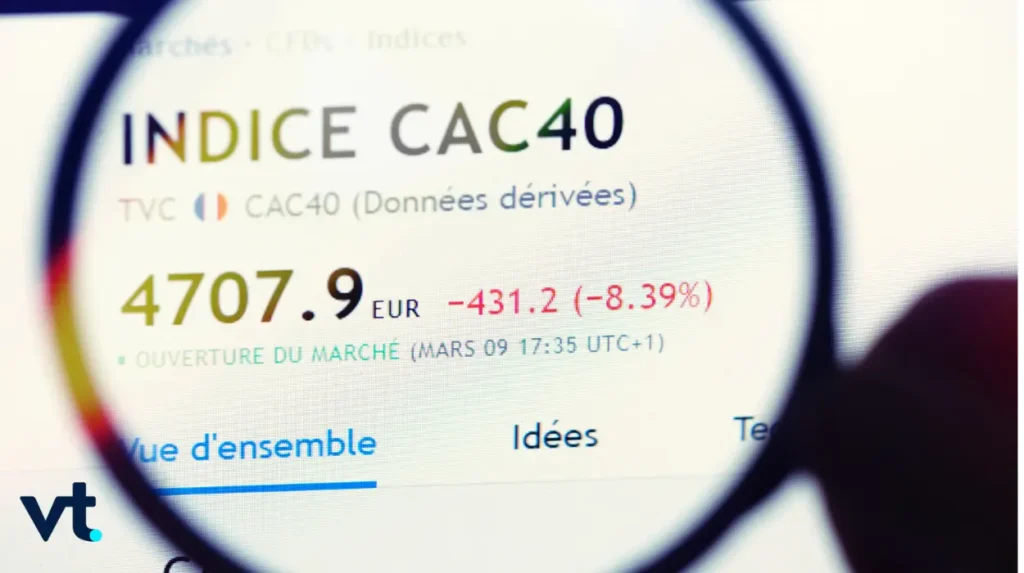
The CAC 40 index, comprised of the 40 most significant stocks listed on the Euronext Paris stock exchange, lost around one-third of its value between February 16 and March 15, 2020, due to the economic impact of the global coronavirus (COVID-19) pandemic.
This dramatic decline and subsequent recovery illustrate the index’s sensitivity to global economic events while demonstrating its resilience during recovery periods.
Using CAC 40 Data for Investment Decisions
Technical Analysis Applications
Professional traders and investors use CAC 40 data for various analytical approaches:
Chart Patterns and Indicators:
- Moving averages (50-day, 200-day)
- Relative Strength Index (RSI)
- Support and resistance levels
- Volume analysis
Seasonal Patterns:
- January effect
- Summer trading lull
- Year-end rebalancing
- Quarterly earnings impacts
Fundamental Analysis Integration
Investors should consider both technical and fundamental factors when analyzing CAC 40 performance:
| Analysis Type | Key Metrics | Timeframe |
|---|---|---|
| Technical | Price patterns, volume | Short to medium-term |
| Fundamental | Earnings, valuations | Medium to long-term |
| Macroeconomic | Interest rates, GDP | Long-term trends |
Risk Management in CAC 40 Investing
Diversification Strategies
While the CAC 40 provides exposure to France’s largest companies, investors should consider diversification across:
- Geographic regions (European, global exposure)
- Market capitalizations (mid-cap, small-cap additions)
- Sectors beyond CAC 40 concentration
- Asset classes (bonds, commodities, real estate)
Currency Considerations
International investors face EUR currency exposure when investing in the CAC 40. Currency hedging strategies may be appropriate for:
- Non-EUR based investors
- Long-term holdings
- Large portfolio allocations
- Risk-averse investment approaches
VT Markets provides currency hedging tools and multi-currency account options to help manage this exposure effectively.
Technology and Innovation in CAC 40 Companies
Digital Transformation Trends
Modern CAC 40 companies are adapting to digital transformation requirements across various sectors:
Technology Adoption Areas:
- E-commerce platforms (luxury goods, retail)
- Digital banking services
- Industrial automation
- Sustainable technology implementation
ESG Integration and Sustainable Investing
Environmental, Social, and Governance (ESG) factors increasingly influence CAC 40 companies and investor decision-making:
- Carbon neutrality commitments
- Sustainable business practices
- Social responsibility initiatives
- Corporate governance improvements
These factors affect both individual company performance and overall index attractiveness to institutional investors.
Comparing CAC 40 to Other Major Indices
European Index Comparisons
| Index | Country | Companies | Key Characteristics |
|---|---|---|---|
| CAC 40 | France | 40 | Luxury goods, banks focus |
| DAX 40 | Germany | 40 | Industrial, technology heavy |
| FTSE 100 | UK | 100 | Broader diversification |
| IBEX 35 | Spain | 35 | Banks, telecommunications |
Performance Correlations
Historical data shows the CAC 40 typically maintains high correlations with other European indices while showing more moderate correlations with Asian and American markets, except during global crisis periods when correlations tend to increase significantly.
Future Outlook for the CAC 40 Index
Economic Recovery Projections
As France continues economic recovery from recent global challenges, several factors will likely influence CAC 40 performance:
Positive Drivers:
- Tourism sector recovery
- Luxury goods demand from Asia
- Infrastructure investment programmes
- Technology sector growth
Potential Challenges:
- Geopolitical uncertainties
- Interest rate environment changes
- Global supply chain disruptions
- Energy transition costs
Structural Changes and Evolution
The CAC 40 continues evolving to reflect France’s changing economy:
- Technology company representation
- Sustainable business model adoption
- International expansion of French companies
- Merger and acquisition activity
VT Markets monitors these developments to provide clients with updated market insights and trading opportunities aligned with structural market changes.
Frequently Asked Questions (FAQ)
Q: What does CAC 40 stand for and how many companies does it track?
CAC stands for “Cotation Assistée en Continu” (Continuous Assisted Trading), and the 40 index tracks exactly 40 of the largest publicly traded companies on the Euronext Paris stock exchange. The index serves as France’s primary stock market benchmark and uses a capitalization weighted methodology to determine each company’s influence on overall performance.
Q: How often is the CAC 40 composition updated and who decides the changes?
The CAC 40 composition undergoes quarterly reviews by an independent Index Steering Committee (Conseil Scientifique). Changes are implemented a minimum of two weeks after review meetings, ensuring market stability. Companies are selected from the top 100 French companies based on free float market capitalisation and share turnover over the previous 12 months.
Q: What is the base value of the CAC 40 and when was it established?
The CAC 40 has a base value of 1,000, established on December 31, 1987. This base point represented a market capitalisation of 370,437,433,957.70 French francs at that time and serves as the reference point for all index calculations and historical performance comparisons.
Q: Which sectors have the largest representation in the CAC 40 index?
The luxury goods sector dominates the CAC 40, with companies like LVMH, Hermès, and L’Oréal representing significant weightings. Other major sectors include banks (BNP Paribas, Société Générale), industrial companies (Saint-Gobain, Michelin), and consumer goods firms. This sector concentration reflects France’s economic strengths and global competitive advantages.








