



A CFD trader speculates on price movements using contracts for difference (CFDs), without owning the asset. Success takes more than placing trades. It means understanding how CFDs work, managing leverage and margin, building analysis skills, and staying disciplined. This guide covers five stages to becoming a CFD trader: understanding CFD mechanics, choosing a broker, developing trading skills, selecting a trading style, and managing costs while avoiding beginner mistakes. It also covers leverage, position sizing, risk management, and platforms like MT4 and MT5.
Key Takeaways:
- A CFD trader speculates on price movement using a contract for difference, without owning the underlying asset.
- Risk management is the core competency. Analysis matters, but position sizing decides whether you survive long enough to use it.
- Costs compound with trade frequency, so your trading style matters as much as your strategy.
- Leverage magnifies losses exactly as much as gains, which is why margin requirements and stop out levels must be understood before funding an account.
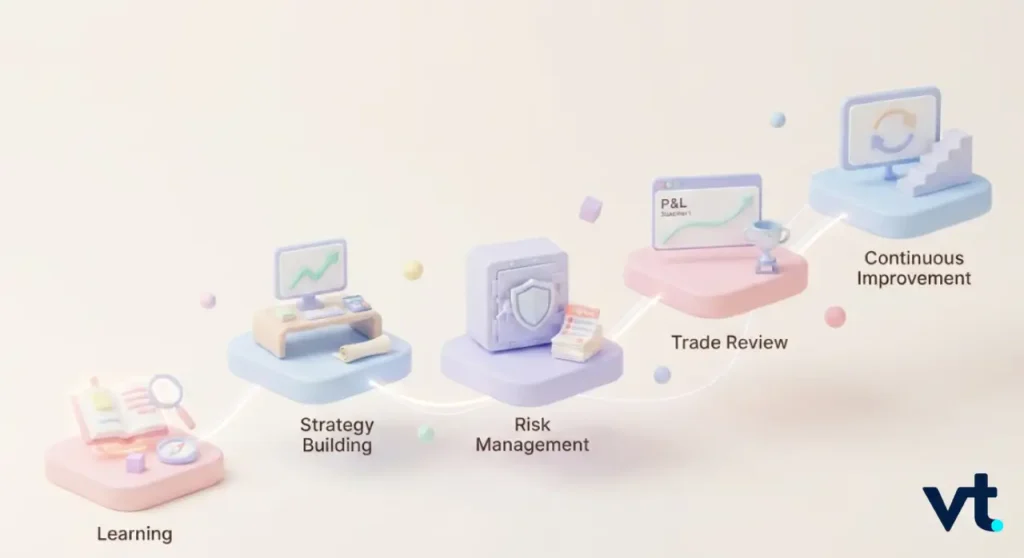
Almost nobody becomes a competent CFD trader in a straight line. The path usually runs from curiosity, to a demo account, to a small live account, to an expensive lesson, and only then to something resembling a process.
This guide breaks that path into five clear stages. It explains what a CFD trader actually does, the skills required at each stage, the costs nobody mentions upfront, and the misconceptions that stall most beginners.
Stage 1: What Is a CFD Trader?
Before anything else, get the instrument straight. Most early mistakes trace back to a vague understanding of what is actually being traded.
What a Contract for Difference Actually Is
What is a CFD in trading? A contract for difference is an agreement between you and a provider to exchange the difference in an asset’s price, which is between the point you open a position and the point you close it.
You never own the underlying asset, and the contract tracks price rather than ownership rights. Also, you can go long or short with equal ease. Your profit and loss are both settled in cash.
What a CFD Trader Does Day to Day
The trading itself takes up less time than most people expect. A trader reviews the economic calendar and overnight price action. The trader also marks key levels, then calculates position sizing and places orders.
Next in line are managing open positions and updating stop loss levels. Subsequently, the person logs into every trade and reviews the week’s results.
Which Markets a CFD Trader Can Access
This is the practical appeal of a multi-asset broker. One account, many markets. These include:
- Forex majors, minors and exotics
- Indices such as US 500, Germany 40 and Hong Kong 50
- Commodities including gold, silver and crude oil
- Share CFDs, and cryptocurrency CFDs where regionally permitted
Why Traders Use CFDs Rather Than the Underlying Asset
- Short selling is as simple as buying, with no borrowing arrangement
- Smaller lot sizes allow precise exposure control
- A single platform covers several asset classes, with no custody or settlement to manage
The trade-off is real. Leverage cuts both ways, and positions held overnight incur financing costs.
Stage 2: How to Become a CFD Trader
There is no licensing exam. That makes sequencing entirely your responsibility. Well, this is where CFD trading for beginners most often goes wrong. Following are the essentials to take note and implement:
Build Underlying Knowledge First
- Learn how pip value, lot sizes and margin are calculated
- Study order types until placing them is automatic
- Read your broker’s product schedule, not just its marketing pages
Choose a Regulated Broker
Regulation is your baseline filter, not a bonus feature. Check it before you compare spreads.
- Verify the licence number directly on the regulator’s register
- Confirm client funds are held in segregated accounts
- Check whether negative balance protection applies to your account type
- Assess platform stability, execution speed and withdrawal reliability, and confirm the platforms offered such as MetaTrader 4 and MetaTrader 5
Practise on a Demo Account
A demo account exists to make your process boring and repeatable before money is involved.
- Prove the strategy across at least 50 to 100 trades
- Practise at the times of day you will actually trade
- Pro tip: Set your demo balance to the amount you plan to deposit live, not an unrealistic figure. Trading a USD100,000 demo teaches habits a USD1,000 account cannot afford.
Define a Written Strategy and Risk Limits Before Funding
If it is not written down, it is not a strategy. It is simply a mood. Instead, here’s the rule of thumb routines:
- Which markets and sessions you trade, with entry and exit criteria stated specifically
- Maximum risk per trade, usually 1 to 2 percent
- Maximum daily and weekly loss limits, and when you stop trading entirely
How Much Capital You Realistically Need to Start
Minimum deposits vary by broker and account type, and a low minimum is not the same as a workable one. The deciding factor is whether your balance allows sensible sizing while keeping risk per trade small.
A simple illustration:
Risking 1 percent per trade, with a 30-pip stop on EUR/USD:
| Account balance | 1% risk | Max position size | Pip value |
| 500 USD | 5.00 USD | 0.01 lots | 0.10 USD |
| 2,000 USD | 20.00 USD | 0.06 lots | 0.60 USD |
| 5,000 USD | 50.00 USD | 0.16 lots | 1.60 USD |
| 10,000 USD | 100.00 USD | 0.33 lots | 3.30 USD |
Smaller accounts are not disqualified. They simply require smaller positions and more patience.
Stage 3: What Skills Does a CFD Trader Need?
Four skills matter, and they are not equally weighted. Most traders spend their time on the first and lose money because of the second.
Technical and Fundamental Analysis
- Technical analysis: market structure, support and resistance, trend, volume
- Fundamental analysis: interest rates, inflation data, employment figures, earnings
- Technicals answer where, fundamentals answer why. Pick one primary framework rather than stacking a dozen indicators
Risk Management as the Core Competency
This is the skill that separates traders who last from traders who do not. Fixed percentage risk on every position, with a stop loss placed before entry. A minimum risk-to-reward ratio you will not trade below.
Correlation awareness, so five positions are not one bet in disguise. Hard daily loss limits that end the session automatically.
Trading Psychology and Discipline
Revenge trading after a loss is the most expensive habit in the market. Moving a stop loss further away converts a small loss into a large one. Boredom, not fear, causes most unnecessary trades.
Record Keeping and Performance Review
A trading journal is how you find out whether your strategy works or your memory is generous. Log entry, exit, size, reason and outcome for every trade, with a chart screenshot.
Review weekly for repeating errors, not individual results. Track your win rate and average risk-to-reward separately.
Stage 4: Types of CFD Trader
Your style should follow your schedule, your temperament and your cost tolerance. Choosing the wrong one is a common reason capable people fail.
| Type | Hold time | Trades per week | Cost sensitivity | Screen time |
| Scalper | Seconds to minutes | 50+ | Very high | Very high |
| Day trader | Minutes to hours | 10 to 25 | High | High |
| Swing trader | Days to weeks | 2 to 8 | Moderate | Low |
| Position trader | Weeks to months | 1 to 4 | Low on spread, high on funding | Very low |
Scalpers:
- Target very small moves at high frequency, needing tight spreads and fast execution
- Costs are the single biggest threat to profitability
Day Traders:
- Open and close within the same session, avoiding overnight funding
- Depend on session volatility, especially the London and New York overlap
Swing Traders:
- Hold across several days, so spread costs matter far less relative to target size
- Must account for overnight funding and weekend gap risk
Position Traders:
- Hold for weeks or months on a macro view, so financing costs must be built into the plan
- Require wider stops and correspondingly smaller position sizes
Full-Time vs Part-Time:
- Part-time trading suits swing and position styles far better than scalping
- Full-time trading requires a proven track record and separate living expenses first
Stage 5: The Costs a CFD Trader Pays
Costs are the most predictable part of trading and the most commonly ignored. They apply whether you win or lose.
Spreads and Commissions
- Spread: the difference between bid and ask, paid on entry
- Commission: a per-lot charge on raw-spread account types
- Compare total cost per round trip, not the headline spread alone
Overnight Funding and Swap Charges
- Charged or credited on positions held past the daily rollover
- Driven by the interest rate differential between the two currencies
- Typically charged at triple weight on one weekday to cover the weekend
Currency Conversion Costs
- Instruments denominated outside your account currency incur conversion on profits, losses and sometimes commissions
- Choosing a base currency that matches your main markets reduces this
How Costs Compound With Trade Frequency
CFD trading example. Assume a total round-trip cost of 8 USD per standard lot on EUR/USD, over a 20-day trading month:
| Trades per day | Monthly trades | Monthly cost | Cost on a 5,000 USD account |
| 1 | 20 | 160 USD | 3.2% |
| 3 | 60 | 480 USD | 9.6% |
| 5 | 100 | 800 USD | 16.0% |
| 10 | 200 | 1,600 USD | 32.0% |
The strategy did not change. Only the frequency did. A scalper must overcome a far higher hurdle before making a single unit of profit.
How Leverage and Margin Work for CFD Traders
Leverage is the most misunderstood feature in leveraged trading, largely because it is marketed as opportunity and experienced as risk.
What Leverage Does to Both Sides of a Position
Consider a 100,000 USD EUR/USD position at 30:1 leverage. The margin requirement is roughly 3,333 USD.
- A 1 percent move either way is 1,000 USD, or about 30 percent of the margin posted
- Leverage changes the capital required, not the risk of the position
- Your true exposure is the position size, never the margin posted
Margin Requirements and Margin Calls
- Free margin is the balance available to absorb losses, and margin level is equity divided by used margin
- A margin call warns you that this level has fallen too far
- Adding funds mid-drawdown to hold a losing trade is rarely the right response
Stop Out Levels and Negative Balance Protection
- A stop out level is where the broker automatically closes positions, protecting the broker as much as you
- Negative balance protection, where offered, prevents your balance falling below zero
- Confirm both figures in your account terms before your first trade
Why Leverage Limits Differ by Region
Retail leverage is a regulatory matter, so the same broker may offer different maximums in different jurisdictions.
| Region | Retail approach |
| UK and EU | Capped by regulation, with major FX limited to 30:1 |
| Australia | Capped, broadly similar to the UK and EU model |
| United States | CFDs are not available to retail clients |
| Various other jurisdictions | Higher limits permitted, varying by broker and asset |
Limits change, so verify the current figures for your account.
For example, VT Markets publishes leverage of up to 500:1 on eligible account types where regionally permitted.
Read further on how to achieve the five milestones each new trader ought to target themselves for.
Frequently Asked Questions (FAQs)
Q1: What is a CFD trader?
A CFD trader is someone who speculates on the price movement of an asset using a contract for difference rather than owning the asset itself. The trader and the provider settle the difference between the opening and closing price of the position, so profits and losses both apply.
Q2: What does a CFD trader actually do?
A CFD trader analyses markets, identifies potential setups, decides position size and risk limits, then opens and manages positions on a trading platform. Much of the work sits outside placing trades: reviewing past performance, tracking economic events and refining a documented strategy.
Q3: How do you become a CFD trader?
Learn how CFDs, leverage and margin work, choose a regulated broker, then complete account verification. Practise on a demo account and write down a strategy with defined risk limits before funding a live account. Start with a position size you are fully prepared to lose.
Q4: What is the difference between a CFD trader and a share investor?
A share investor owns the underlying asset and may hold it for years, with any dividend and voting entitlements attached. A CFD trader holds a leveraged contract with no ownership, typically over shorter periods, and pays financing costs on positions held overnight.
Begin Your CFD Trader Journey With VT Markets
The five stages are sequential for a reason. Understanding the instrument makes the setup meaningful. A proper setup makes the skills worth building. Skills make a trading style sustainable. Understanding economics is what keeps the whole thing standing when a run of losses arrives.
With VT Markets, you can work through every one of those stages on MetaTrader 4 and MetaTrader 5, across forex, gold, indices, commodities and share CFDs from a single multi-asset account.
Start on a demo account, build the process while nothing is at stake, then scale into live markets when your execution has become second nature. Open your VT Markets account and start Stage 1 today.










