





Key Takeaways
- Slow trade execution happens when there is a delay between placing an order and having it filled at your intended price.
- The main factors that slow down trade execution are high latency, low liquidity, sudden volatility, a weak internet connection, and the wrong broker or order type.
- Slow execution leads to slippage, requotes, and higher trading costs, and it hurts scalpers and day traders the most.
- You can fix it with a VPS, lower latency, cleaner platform settings, and a broker built for fast, transparent order execution.
In fast markets, the gap between clicking buy and getting filled can decide whether a trade wins or loses. That gap is trade execution. When it stretches, small delays quietly turn into real money lost.
So What does trade execution mean? In simple terms, it is the process of completing your buy or sell order in the live market. In other words, it means from the moment you place it to the moment it is filled.
A question every trader eventually asks is: How long does it take for a trade to be executed? On a well-run platform, the answer is usually milliseconds. Poor habits, though, can stretch that delay when it matters most.
This guide breaks down the five mistakes that slow down trade execution. In addition, there are practical fixes that can help you trade faster.
What Does Slow Trade Execution Mean?

Every trade follows the same basic journey. You place an order, it travels to your broker, it is matched against available prices, and it is filled. Order execution is simply the completion of that journey. When any step takes longer than it should, small habits begin to slow down trade execution.
What Is Slow Trade Execution?
Slow trade execution is a noticeable delay between placing your order and having it filled. Instead of an almost instant fill, your order waits in the queue while the market keeps moving. The result is often a worse fill price than the one you saw on screen.
What Is An Execution Delay?
An execution delay is the measurable time lag between your click and your fill, (usually counted in milliseconds.) Small delays are normal. Long or unpredictable delays are the real problem. It is because prices can shift before your order lands.
What Is The Difference Between Execution Speed And Execution Delay?
The two terms describe the same event from opposite ends:
- Execution speed is how quickly your order is filled. Faster is better.
- Execution delay is how much time is lost along the way. Lower is better.
A fast platform has high execution speed and low execution delay. A slow one has the reverse.
What Does Fast Versus Slow Execution Look Like In Practice?
Here is a simple example:
Say EUR/USD is quoted at 1.0850 when you click buy:
- With fast execution, your order fills at 1.0850 or within a fraction of a pip.
- With slow execution, a 300-millisecond delay lets price drift to 1.0853, so you pay three pips more.
On one trade that gap is minor. Repeated across hundreds of trades, it adds up fast.
| Aspect | Fast Execution | Slow Execution |
| Fill time | Milliseconds | Seconds or delayed |
| Fill price | At or near your quote | Worse than quoted |
| Slippage | Minimal | Frequent |
| Best suited for | Every trading style | No one |
The 5 Mistakes That Slow Down Trade Execution
Most execution problems are not bad luck. They are the result of habits and setups that quietly slow down trade execution. A natural first question is, why is my trade execution slow? In most cases the answer is one of the five mistakes below:
Mistake 1: Ignoring Latency
Latency is the time your order takes to travel from your platform to the broker server and back. The further your data travels, the longer that round trip takes.
- Trading from a home connection far from the broker servers adds distance and delay.
- Every extra hop between you and the server raises latency and slows the fill.
High latency is the single biggest reason retail orders slow down trade execution.
Mistake 2: Trading In Low Liquidity
Liquidity is how easily an asset can be bought or sold without moving its price. When market liquidity is thin, there are fewer counter-orders to match yours.
- Quiet sessions, such as the gap between the New York close and the Tokyo open, often have thin order books.
- Exotic pairs and less-traded assets usually carry lower liquidity than the majors.
Thin liquidity means your order waits longer to find a match, which widens the spread and slows the fill.
Mistake 3: Chasing High-Impact News
Volatility around major news can slow down trade execution even on a fast platform. When the data hits, prices move fast and order flow spikes.
- Central bank decisions, inflation data, and jobs reports trigger sharp bursts of volatility.
- In those seconds, quotes update rapidly and orders can queue or be rejected.
Firing an order straight into the release, with no plan, is one of the easiest ways to get a slow and unpredictable fill.
Mistake 4: Relying On A Weak Internet Connection
Your own setup matters more than many traders think. A slow or unstable connection adds delay before your order even reaches the broker.
- Wi-Fi drops, background downloads, and old hardware all raise your ping.
- A poor connection can turn a millisecond fill into a multi-second wait.
A stable, wired connection is one of the simplest fixes for slow execution.
Mistake 5: Using The Wrong Broker Model Or Order Type
Your broker execution model decides how your order is handled:
- A dealing desk (market maker) may add a confirmation step before filling.
- A no dealing desk model, such as ECN or STP, routes orders straight to liquidity providers for faster fills.
Order type is crucial too. A market order fills fast at the best available price. Meanwhile, a limit order only fills at your chosen price or better, which can delay or block the fill. The wrong combination for the moment can slow down trade execution.
| # | The Mistake | Why It Slows Execution | Quick Fix |
| 1 | Ignoring latency | Longer data round trip | Use a VPS or a nearby server |
| 2 | Low liquidity | Fewer orders to match | Trade active sessions |
| 3 | Chasing news | Price and flow spike | Let the dust settle first |
| 4 | Weak connection | Delay before the order sends | Wired connection or VPS |
| 5 | Wrong model or order | Extra processing steps | Pick ECN or STP, right order |
What Are The Effects Of Slow Trade Execution?
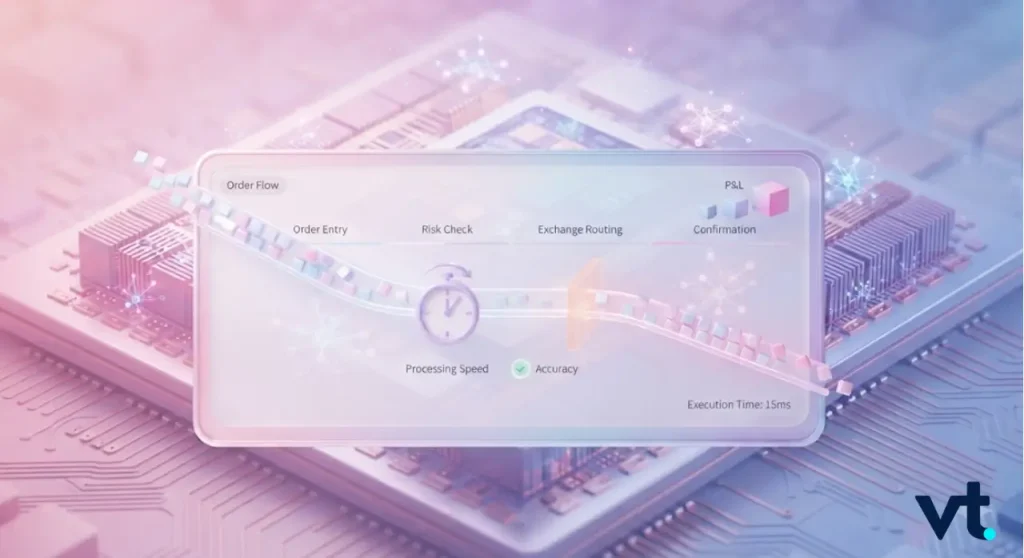
Slow execution is not just an annoyance. Left unchecked, the factors that slow down trade execution have direct, measurable effects on your results.
How Does Slow Execution Cause Slippage?
Slippage is the difference between the price you expected and the price you got. When execution is slow, the market has time to move before your order fills, so the gap grows.
For example:
- You buy gold expecting 2,400.0.
- A delay lets price climb to 2,400.5 before the fill.
- That 0.5 move is negative slippage, and on a one-lot position it can cost around $50.
Can Slow Execution Cause Requotes?
Yes. A requote happens when the price moves during the delay and the broker offers a new price instead of filling the original. You then have to accept, reject, or resend. Frequent requotes are a classic symptom of slow order execution.
How Do Mistakes That Slow Down Trade Execution Affect Scalpers And Day Traders?
Fast traders feel the pain first:
- Scalpers target only a few pips per trade, so even one pip of slippage can erase the edge.
- Day traders placing many orders see small delays compound across the session.
For these styles, execution speed is not a nice-to-have. It is the strategy.
How Much Can Slow Execution Cost You?
Let the maths speak. Suppose slow execution costs you an average of one pip per trade on EUR/USD, where one standard lot is worth roughly $10 per pip.
| Trades Per Day | Cost Per Day (1 pip, 1 lot) | Monthly Cost (20 Days) |
| 1 | $10 | $200 |
| 5 | $50 | $1,000 |
| 10 | $100 | $2,000 |
That is real money leaking out of an otherwise sound strategy.
How To Fix Slow Trade Execution
The terrific news is that most causes are fixable. Here is how to execute trades faster and stop the habits that slow down trade execution.
How Do You Speed Up Trade Execution?
Start with the highest-impact changes:
- Shorten the distance between you and the broker servers.
- Trade during high-liquidity sessions, where fills are quicker.
- Avoid firing orders into the first seconds of major news.
- Use a stable, wired internet connection.
- Choose a broker with a fast, transparent execution model.
How Can A VPS Improve Execution Speed?
A VPS (virtual private server) hosts your trading platform close to the broker servers.
- It shortens the data journey, cutting latency dramatically.
- It keeps your platform and any expert advisors running even if your home connection drops.
For active traders on MetaTrader 4 or MetaTrader 5, a VPS is one of the most effective upgrades available.
How Do You Reduce Latency In Trading?
- Pick a server location near your broker.
- Use a VPS or a wired connection instead of Wi-Fi.
- Close background apps that eat bandwidth.
- Test your ping to the broker server and aim for the lowest number you can.
Which Platform Settings Improve Execution Speed?
On MT4 and MT5, a few settings help:
- Enable one-click trading to remove confirmation steps.
- Keep only the charts and indicators you actually need open.
- Turn off unnecessary news feeds and heavy scripts.
- Set a sensible maximum deviation so valid fills are not rejected.
How Do You Test Your Own Execution Speed?
- Note the quoted price at the moment you click.
- Compare it with your actual fill price.
- Track the difference across many trades.
A consistent gap points to a latency or broker issue worth fixing.
How To Choose A Broker For Fast Execution
Your broker sets the ceiling on how fast you can trade. However, even a perfect setup cannot fix a slow platform. Look past the marketing and check what actually drives speed.
What Execution Speed Should You Expect From A Broker?
A competitive broker fills most orders in milliseconds under normal conditions. If fills routinely take seconds, treat that as a warning sign.
How Do You Check A Broker’s Execution Speed?
- Test on both a demo and a live account, since conditions can differ.
- Watch how fills behave during busy sessions and around news.
- Ask whether the broker publishes execution statistics.
What Is Best Execution, And How Does It Relate To Speed?
Best execution is a broker duty to fill your orders on the most favourable terms reasonably available. It weighs price, speed, cost, and the likelihood of the fill. A broker that takes best execution seriously invests in the infrastructure that keeps orders fast.
What Features Indicate Fast Execution?
Look for:
- A no dealing desk model such as ECN or STP.
- Deep liquidity drawn from multiple providers.
- Free or low-cost VPS hosting.
- Support for MetaTrader 4 and MetaTrader 5.
- Transparent, published execution data.
VT Markets was built around these features, with fast order execution across MT4 and MT5.
On another note, find out related information on how to review and actually improve your trades.
link back this:How to Review Your Trades And Actually Improve
Deliberate Slowdowns In Trade Execution
Not every slowdown is a fault. Some markets slow orders on purpose to protect fairness and stability. Knowing the difference helps you read your fills correctly.
What Is An Exchange Speed Bump?
A speed bump is a tiny, deliberate delay an exchange adds to incoming orders. It is measured in milliseconds and is designed to blunt the edge of the very fastest trading firms.
What Are Circuit Breakers And Trading Halts?
- A circuit breaker pauses trading when prices move too sharply.
- A trading halt stops trading in an asset around major news or extreme moves.
Both are safety mechanisms, not platform faults.
Why Do Some Exchanges Deliberately Slow Down Orders?
To level the playing field. Small, engineered delays reduce the advantage of firms that would otherwise win purely on raw speed.
What Is A Latency Floor Or Minimum Resting Time?
A latency floor, or minimum resting time, forces orders to stay live for a set period before they can be cancelled. It discourages fleeting orders and supports fairer, more stable pricing.
Frequently Asked Questions (FAQs)
What Causes Trade Execution To Slow Down?
Several factors slow down trade execution. The most common are high latency, low liquidity, sudden volatility around news, an unstable internet connection, and the broker execution model. Each one adds time between your click and your fill.
How Do You Speed Up Slow Trade Execution?
You speed up slow trade execution by removing delays in the order path. Use a VPS near your broker, keep a stable wired connection, trade during high-liquidity sessions, avoid major news spikes, and choose a broker with a fast, transparent execution model.
Does A VPS Improve Trade Execution Speed?
Yes. A VPS hosts your platform close to the broker servers, which cuts latency and shortens the time your order takes to travel. It also keeps trades and expert advisors running if your home connection drops, which matters most to scalpers and algorithmic traders.
How Does Latency Affect Trade Execution?
Latency is the round-trip time for your order to reach the broker and back. Higher latency slows execution and raises the chance that price moves before your fill, which causes slippage or requotes. Lower latency generally means faster, more accurate fills.
How Does Slow Execution Cause Slippage?
Slow execution causes slippage because the market can move in the time between placing and filling your order. If price shifts during that delay, your order fills at a different level than expected. The effect is larger during volatile or fast-moving conditions.
Trade Faster With VT Markets
Speed is not a luxury in trading. It is the difference between the price you see and the price you get. Every fix in this guide helps you avoid the traps that slow down trade execution.
The fixes are within your control. Tidy up your connection, add a VPS, trade the right sessions, and pick a platform built for speed.
VT Markets gives you fast, transparent order execution on MetaTrader 4 and MetaTrader 5, designed to keep the gap between click and fill as small as possible.
Create a live VT Markets account today to access our platform features, including market insights and educational content.








