







Key Points
- USDJPY traded around 155.5, after two consecutive losing sessions for the yen
- Hawkish Fed leadership expectations and Japan’s fiscal outlook continue to favour the dollar
The Japanese yen hovered near 155.5 per dollar on Tuesday, struggling to recover after falling for two straight sessions.
The move reflected renewed dollar strength, driven by robust US economic data and expectations that the next Federal Reserve chair may take a more hawkish stance.
Support for the dollar has firmed as markets reassess US growth momentum, while speculation around Fed leadership has reduced expectations of aggressive easing in the near term.
That shift has weighed on the yen, which remains sensitive to interest rate differentials given Japan’s still-accommodative monetary stance.
A cautious forecast suggests USDJPY may remain elevated as long as US data continue to outperform and rate expectations stay anchored in favour of the dollar.
Political Signals Add Pressure to the Yen
Domestic political rhetoric has also played a role in weakening the currency. Over the weekend, Prime Minister Sanae Takaichi described a weak yen as a potential opportunity for Japan’s export sector, remarks that were widely interpreted as tacit tolerance for further depreciation.
Although Takaichi later clarified that her comments were meant to emphasise the need for an economy resilient to currency swings, the initial message added to market perceptions that policymakers are in no rush to defend the yen.
Finance Minister Satsuki Katayama reinforced that view, stating that the prime minister was merely outlining standard economic principles regarding the impact of a weaker currency.
These signals have reduced expectations of near-term verbal or direct intervention, keeping the yen on the defensive.
Election Outlook and Fiscal Risks Weigh on Sentiment
The yen’s softness also comes ahead of the February 8 snap lower house election, where Takaichi’s ruling party is expected to gain seats.
Markets anticipate that a stronger mandate could lead to more expansionary fiscal policies, including potential tax cuts and increased spending.
Japanese government bonds and the yen both weakened last month amid expectations of fiscal stimulus, and ongoing discussions around tax relief have continued to raise concerns about public finances.
These dynamics complicate the outlook for monetary normalisation and reinforce downward pressure on the currency.
If fiscal expansion accelerates after the election, the yen may face renewed selling as investors reassess Japan’s debt trajectory.
Technical Analysis
USDJPY edged lower to 155.433, down 0.12%, following a modest intraday decline of 18.2 pips. Price briefly peaked at 155.617 before momentum faded, leading to a series of shallow lower highs and lower lows.
Support was found at 155.380, with price attempting to stabilise above this level into the current candle.
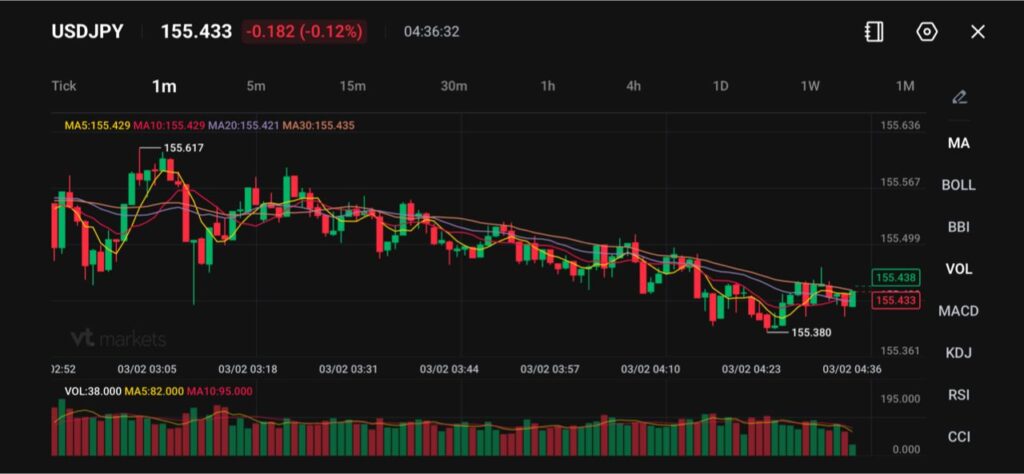
The pair is now trading in tight proximity to its moving averages, all converging around the 155.42–155.43 zone (MA5–MA30), signalling indecision.
Volume remains muted at 38.00, and no clear breakout signal has emerged yet. A clean push above 155.50 could revive bullish bias, while failure to hold above 155.38 may invite further downside pressure.
What to Watch Next
Traders will focus on upcoming US data releases for confirmation of growth resilience, as well as any further guidance on the Federal Reserve’s leadership and policy outlook. In Japan, election developments and fiscal signals will remain central to yen sentiment.
Unless Japanese officials deliver clearer resistance to currency weakness, the yen may struggle to regain ground against a dollar supported by yield differentials and policy divergence.
Learn more about trading Forex Pairs on VT Markets here.










