







Key Points
- USDJPY rose toward 158.7, extending losses for the yen after the BoJ kept rates unchanged
- The yen remains vulnerable as markets watch the 160 level for intervention risk
The Japanese yen weakened to around 158.7 per US dollar on Friday, extending this week’s decline after the Bank of Japan kept its policy rate unchanged.
The decision met expectations, following the BoJ’s rate hike last month to 0.75%, the highest level in 30 years.
While the hold itself did not surprise markets, it failed to offer fresh support to the yen. Traders had looked for stronger forward guidance after the central bank revised four of its six inflation forecasts upward, a move that reinforced the view that underlying price pressures remain firm.
The BoJ reiterated that it stands ready to raise rates again if economic and inflation projections materialise. However, the absence of a clearer signal on timing has left traders cautious, particularly given how stretched yen positioning has already become.
A cautious outlook suggests that without stronger guidance from policymakers, the yen may continue to trade defensively rather than recover meaningfully.
Forward Guidance in Focus as Credibility Tested
Market attention has shifted toward Governor Kazuo Ueda’s communication strategy. Traders remain concerned that the yen could face renewed pressure if he stops short of signalling further rate hikes in upcoming remarks.
These concerns have grown alongside signs of stress in domestic markets. Japan has already seen selloffs in both government bonds and the currency, reflecting anxiety over policy coordination and fiscal sustainability.
Without a clear policy path, the yen risks remaining exposed to external rate differentials, particularly as US yields stay elevated.
If the BoJ maintains a cautious tone despite rising inflation forecasts, traders may continue to test the central bank’s tolerance for currency weakness.
Fiscal Uncertainty Adds Another Layer of Risk
Political developments have added to the yen’s challenges. Prime Minister Sanae Takaichi is preparing to dissolve parliament and call a snap election, aiming to consolidate power and pursue increased fiscal spending.
Markets view this prospect warily. Higher spending could widen fiscal deficits at a time when Japan is already grappling with heavy debt loads.
These concerns have fed into broader risk aversion toward Japanese assets, reinforcing downward pressure on the yen.
Unless fiscal plans are paired with a credible monetary response, political uncertainty may continue to undermine confidence in the currency.
Technical Analysis
The USDJPY pair is trading modestly higher at 158.608, up 0.13%, as short-term momentum attempts to stabilise after a brief dip to 158.502.
Price action shows a sharp rally earlier in the session, peaking at 158.739, followed by a mild correction before consolidating in a narrow band.
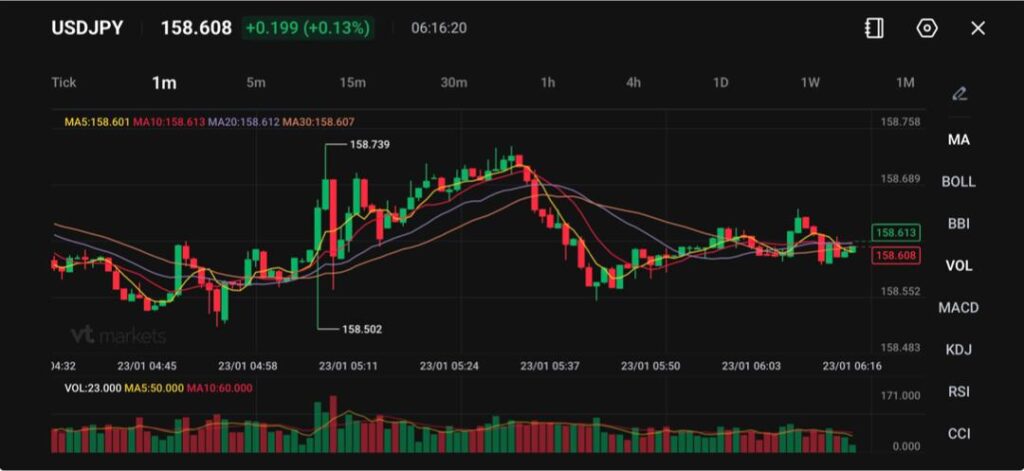
The 1-minute chart suggests near-term indecision, with candles weaving around the 5- and 10-period moving averages. However, the pair remains above key short-term support and may see renewed bullish pressure if it can sustain above 158.60.
A clear break above 158.74 would open the door for another leg higher, while a fall back below 158.50 could invite more sellers. Volume remains steady, but conviction is still building.
Intervention Risk Looms Near 160
As USDJPY edges closer to 160, markets are increasingly alert to the risk of currency intervention. Japanese authorities have previously acted near this level, and verbal warnings alone could trigger sharp, short-lived pullbacks.
That said, intervention without supportive policy shifts may only slow the move rather than reverse it. Traders are likely to remain cautious but opportunistic, especially if US dollar strength persists and BoJ guidance remains restrained.
For now, the yen sits in a vulnerable position, caught between rising inflation signals, political uncertainty, and a central bank unwilling to rush its next move.
Learn more about trading Forex Pairs on VT Markets here.










