




Key Points
- Wall Street indices declined sharply during Monday’s trading session, with the S&P 500 falling 1.9% and the Nasdaq Composite losing 2.5%, extending their losing streaks to three consecutive sessions.
- Nvidia dropped another 4% ahead of its earnings announcement, while semiconductor stocks fell between 5% and 9% amid renewed concerns over AI spending.
- Federal Reserve Chair Kevin Warsh warned that disappointment in the AI market could trigger a sharp equity correction and potentially weaken economic growth.
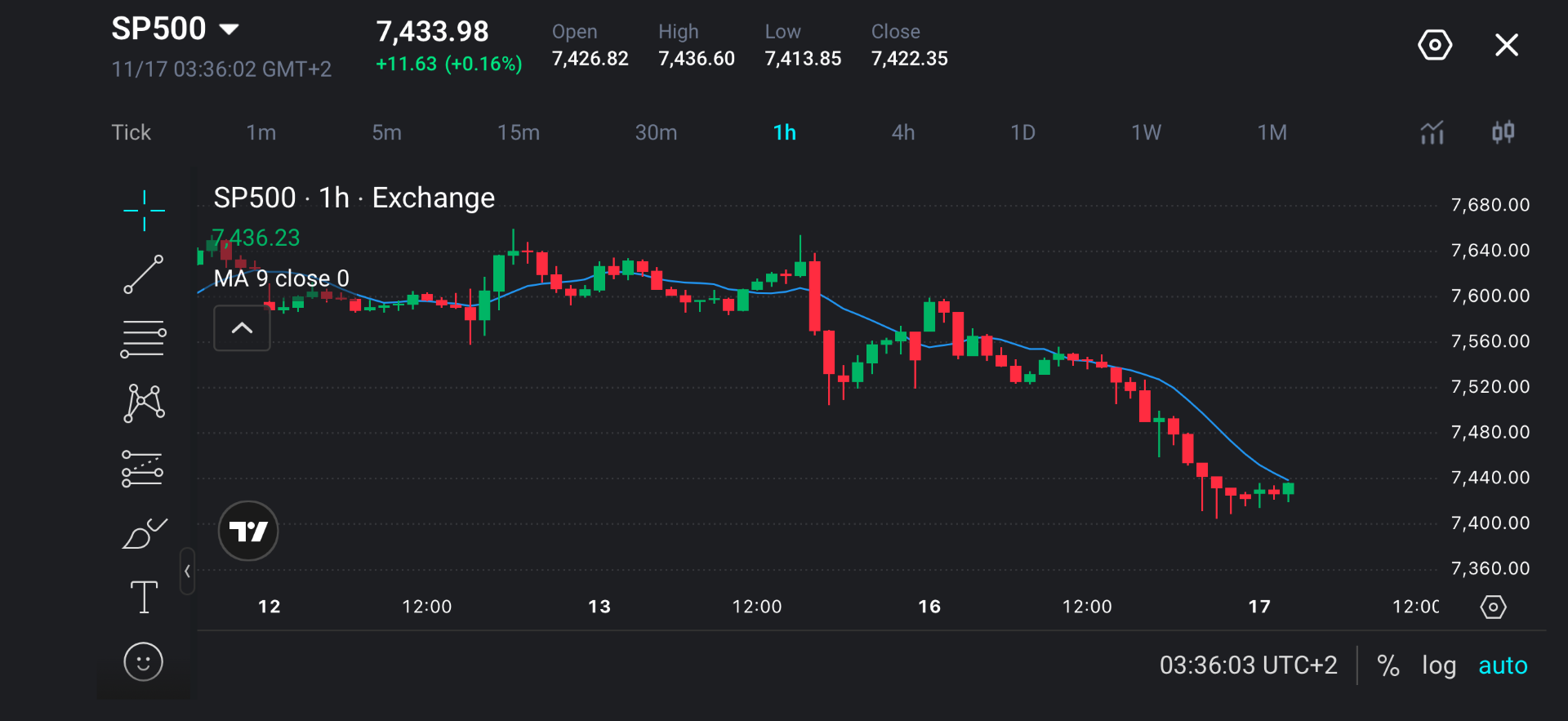
- The SP500 remains under technical pressure after breaking below several short-term support levels, with traders monitoring 7,400 as immediate support and 7,440–7,480 as the first recovery area.
Market Move
Wall Street extended its sell-off on Monday as weakness in AI and semiconductor stocks weighed on major US equity benchmarks. The S&P 500 declined 1.9%, while the Nasdaq Composite lost 2.5%, marking a third consecutive string of losses for both indices. The Dow Jones Industrial Average and Nasdaq 100 also faced selling pressure, reflecting the market’s retreat from technology stocks.
Nvidia plays a key role in the decline, falling another 4% ahead of its quarterly earnings announcement scheduled for after Tuesday’s market close. The stock has now lost almost 35% from its peak, with its market capitalisation falling below $4 trillion.
The decline spread across the semiconductor industry, with AMD, Intel, Broadcom, Micron and Sandisk recording losses ranging from 4% to 8%. The widespread weakness suggests growing concern over AI spending and its sustainability.
Why Traders Are Watching
Nvidia’s upcoming earnings will likely influence confidence in AI-related stocks. Investors will focus on revenue growth and whether AI infrastructure continues to deliver returns. Nvidia’s leadership uncertainty has also weighed on sentiment, following reports that Nvidia’s board has no plans to reinstate Jensen Huang as CEO amid investigations.
Meanwhile, Federal Reserve Chair Kevin Warsh warned that disappointing AI investment returns could trigger a sharp decline in stock prices and slow economic growth. Although he did not address monetary policy directly, he outlined contrasting scenarios in which AI could either accelerate productivity and support employment or disrupt labour markets and increase unemployment.
Despite Brent crude falling 3.55% towards $92.44 per barrel, lower energy costs have provided limited relief. Investors are also monitoring the anticipated Anthropic IPO for signs of sustained demand for AI-related investments. Traders are now watching whether stronger corporate guidance can restore confidence or whether further disappointment could extend losses across Wall Street.
Key Trading Levels
| Level | Significance |
| 7,560–7,600 | Major resistance zone associated with previous consolidation and failed recovery attempts. |
| 7,520 | Secondary resistance and former support area before the latest decline. |
| 7,480 | Near-term resistance that could limit a stronger technical rebound. |
| 7,440–7,450 | Immediate recovery threshold near the declining nine-period moving average. |
| 7,400–7,420 | Immediate support zone around the latest hourly lows. |
| 7,360 | Next downside reference if selling pressure breaks the current support area. |
The SP500 is trading around 7,434 after retreating from the 7,600–7,640 region, maintaining a bearish short-term structure. Recent price action suggests selling pressure is easing near 7,400–7,440, although the declining nine-period moving average continues to limit recovery attempts. A sustained move above the moving average could signal improving momentum, while further rejection may expose the index to additional downside.
Bullish and Bearish Setups
| Scenario | Confirmation | Potential Outlook |
| Bullish | SP500 breaks above 7,440–7,450 and establishes a sequence of higher lows. | A recovery towards 7,480 becomes possible, with 7,520 representing a broader upside target. |
| Bearish | SP500 breaks below 7,400 as selling pressure accelerates. | Prices could extend towards 7,360, particularly if weakness across technology stocks persists. |
A bullish recovery could develop if the SP500 breaks above 7,440–7,450 and establishes a sequence of higher lows, signalling improving buying momentum. A sustained move above this resistance zone could support a rebound towards 7,480, with 7,520 emerging as the next upside target if buying pressure strengthens.
The bearish outlook could strengthen if the SP500 falls below 7,400, confirming a continuation of the recent downward trend. A breakdown accompanied by stronger selling momentum could push prices towards 7,360, particularly if weakness in Nvidia and other technology stocks continues to weigh on broader market sentiment.
Disclaimer
The price levels and market scenarios above reflect the author’s assessment at the time of writing. They do not represent financial advice or an official recommendation from VT Markets. Traders should conduct their own analysis and manage risk carefully.
SP500 Prediction: What Could Drive Stocks Up or Down?
The SP500‘s near-term direction will likely depend on Nvidia’s earnings results, broader technology-sector performance and investors’ assessment of AI-related spending. Stronger-than-expected Nvidia earnings and reassuring guidance could help restore confidence in semiconductor stocks, potentially supporting a recovery across the S&P 500 and Wall Street. Conversely, disappointing results or weaker spending expectations could reinforce concerns about elevated AI valuations and prolong selling pressure across major US equity indices.
Demand for the anticipated Anthropic IPO could also provide another signal for investor appetite for AI. Lower crude oil prices could provide some support by easing inflation concerns. However, market reaction suggests that earnings expectations and technology valuations remain the dominant drivers.
Trade SP500 with VT Markets
Explore index CFD trading with VT Markets and monitor SP500 alongside other global equity benchmarks.
The S&P 500 remains closely watched during periods of technology-sector volatility and major economic releases.
With VT Markets, traders can access SP500 and other index CFDs alongside forex, gold, oil, share CFDs, ETFs and other global markets through one platform. This allows traders to monitor broad market movements while comparing developments across technology stocks, commodities, currencies and other major asset classes.
Start a live trading account today and discover 24/7 trading.

Frequently Asked Questions (FAQs)
Why did the S&P 500 fall?
The S&P 500 declined as selling pressure intensified across Nvidia and other semiconductor stocks. Concerns about AI valuations, future investment returns and broader economic risks weighed on investor sentiment.
Is Nvidia affecting the broader US stock market?
Yes. Nvidia’s substantial market capitalisation and influence within the technology sector mean significant movements in its shares can affect major indices, particularly the S&P 500 and Nasdaq.
Could Nvidia’s earnings help Wall Street recover?
Yes. Strong earnings and positive forward guidance could improve confidence in AI-related investments and support a recovery in technology stocks. However, the market reaction will also depend on investor expectations and valuations.
Could falling oil prices support US stocks?
Yes. Lower oil prices can reduce inflationary pressure and operating costs for some businesses. However, their positive impact may be limited when investors are primarily concerned about corporate earnings and technology-sector valuations.
Could the SP500 decline further?
Yes. Further declines remain possible if the index breaks below recent support and selling pressure across technology stocks continues. Nvidia’s earnings and broader market sentiment will be important factors in determining the next move.



