




Key Points
- USDJPY traded near 162.30 as the yen remained close to its weakest levels in four decades.
- The yen stayed under pressure after expectations for a near-term shift in Japan’s state pension fund allocation faded.
- US inflation data remains in focus because stronger inflation could support the dollar and keep pressure on the yen.
- Higher oil prices from renewed US-Iran tensions added another headwind for the Japanese currency.
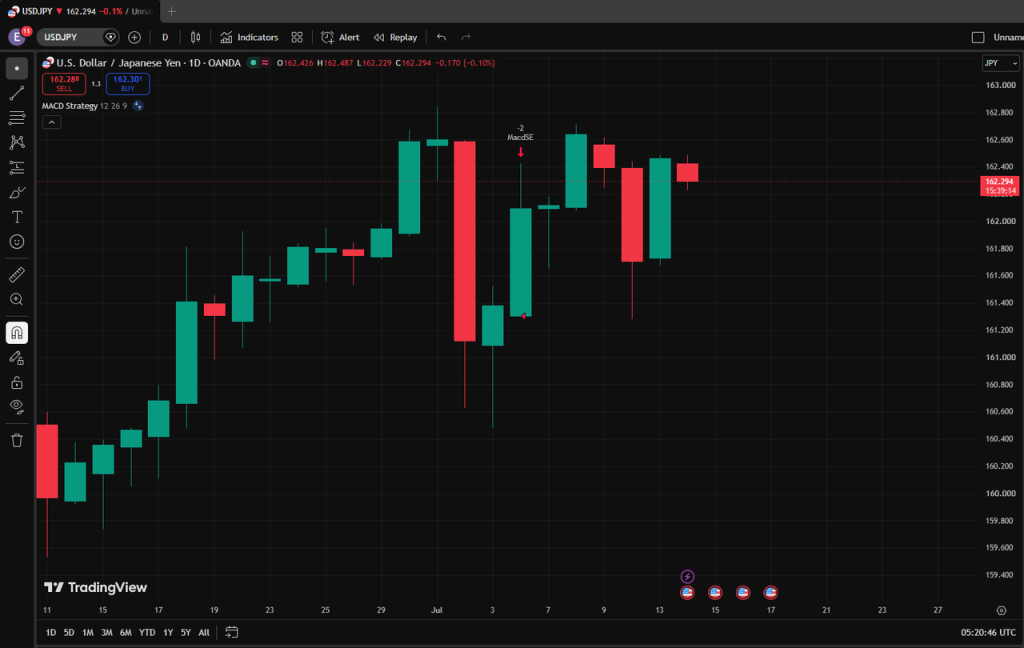
- The USDJPY daily chart places immediate resistance near 162.50, while 162.20 is the first support level to monitor.
USDJPY traded near 162.30 on Tuesday as the yen remained under pressure against the US dollar.
The pair stayed close to recent highs after the yen gave back most of its earlier gains. Traders remained alert to possible intervention from Japanese authorities, while the currency continued to hover near its weakest levels in four decades.
The dollar was broadly steady ahead of US inflation data, while Middle East tensions lifted oil prices and added to inflation concerns. This kept markets focused on whether upcoming data could reinforce expectations of tighter Federal Reserve policy.
Why Traders Are Watching
USDJPY remains sensitive to three main drivers: US inflation expectations, Japanese policy signals and energy-price pressure.
Higher US inflation can support the dollar by raising expectations that the Federal Reserve may keep policy restrictive or consider further tightening. That would usually widen the policy gap between the US and Japan, keeping upward pressure on USDJPY.
At the same time, intervention risk remains in focus. With USDJPY near historically elevated levels, any stronger warning or direct action from Japanese authorities could trigger a sharp reaction.
This makes the current setup event-driven. Stronger US inflation data could keep USDJPY supported, while Japanese policy signals or intervention risks could slow the move.
Japan Pension Fund Signals Remain in Focus
The yen weakened after expectations faded for a near-term overhaul of Japan’s state pension fund asset allocation.
Japan had no immediate plan to change the asset allocation targets of its state pension funds. That reduced expectations that large domestic institutions would quickly shift more money into Japanese assets, removing one potential source of yen support.
The issue remains important because the Government Pension Investment Fund is one of the world’s largest pension funds. Any meaningful shift towards domestic assets could influence Japanese bonds, equities and the yen.
Finance Minister Satsuki Katayama later said Japan’s Government Pension Investment Fund would make adjustments to its portfolio allocations if needed.
The comment helped limit some of the yen’s weakness, but traders may need clearer action before treating the pension theme as a lasting support factor.
Oil and Middle East Risks Add Dollar Support
Oil prices also remain relevant for USDJPY.
Renewed US-Iran tensions lifted oil prices and added to global inflation concerns. For Japan, higher energy prices can be negative because the country relies heavily on imported fuel. That can weigh on the yen when oil markets move sharply higher.
US President Donald Trump said Washington was reinstating a naval blockade on Iranian shipping and seeking reimbursement from countries benefiting from US efforts to secure the Strait of Hormuz.
This matters for USDJPY because higher oil prices can strengthen inflation expectations, support US yields and increase demand for the dollar. If oil remains elevated, the yen may struggle to recover unless Japanese policy signals become stronger.
Key Trading Levels
| Price Level | What Traders Are Watching |
| 163 | Wider resistance and psychological upside level |
| 162.8 | Recent high area if bullish momentum extends |
| 162.5 | Immediate resistance near the latest upper range |
| 162.3 | Current chart area |
| 162.2 | Immediate support near the latest session low |
| 162 | Short-term support and key intraday reference |
| 161.7 | Secondary support from recent consolidation |
| 161.3 | Deeper support if selling pressure increases |
The USDJPY daily chart shows the pair trading near 162.30 after opening around 162.43. The latest session high stood near 162.49, while the low was approximately 162.23.
The pair remains close to the upper end of its recent range, but momentum has slowed after failing to extend clearly above 162.50.
Immediate resistance is located near 162.50. A sustained move above this level could bring the recent high area near 162.80 into focus.
A stronger breakout would shift attention towards the psychological 163.00 level.
On the downside, 162.20 is the first support level to monitor. A break below this area could expose 162.00.
Bullish and Bearish Setups
| Setup | Trigger | Potential Market Reaction |
| Bullish Breakout | Move above 162.50 | USDJPY may retest 162.80 |
| Bullish Extension | Break above 162.80 | Attention may shift towards 163.00 |
| Range Consolidation | Remain between 162.20 and 162.50 | Traders may wait for US inflation data or Japan policy signals |
| Bearish Pullback | Fall below 162.20 | USDJPY may retest 162.00 |
| Deeper Correction | Break below 162.00 | The pair may decline towards 161.70 |
| Intervention-Risk Move | Sharp reversal below 161.70 | Downside may extend towards 161.30 |
The bullish scenario depends on USDJPY breaking above 162.50 and holding that level. This would suggest that dollar strength and yen weakness remain in control.
A confirmed move above 162.80 would strengthen the upside setup and bring 163.00 into focus.
The neutral scenario is consolidation between 162.20 and 162.50. Range-bound movement may indicate that traders are waiting for US inflation data, Fed signals or clearer comments from Japanese officials.
The bearish scenario strengthens if USDJPY falls below 162.20. A confirmed break could bring 162.00 into focus.
Disclaimer
The price levels and market scenarios above reflect the author’s view at the time of writing and do not represent financial advice or an official recommendation from VT Markets. Traders should conduct their own analysis and manage risk carefully.
Trade USDJPY CFDs With VT Markets
USDJPY remains active when US inflation expectations, Japanese policy signals, energy prices and intervention risks move at the same time.
With VT Markets, traders can access USDJPY CFDs alongside other major forex pairs, gold, oil, indices, shares, ETFs and global CFD markets from one platform. This allows traders to follow yen movement while monitoring related moves in the US dollar, Treasury yields and broader risk sentiment.
Use VT Markets’ charting tools to monitor support, resistance, moving averages and breakout behaviour as the next USDJPY setup develops.
Learn more about trading Forex Pairs on VT Markets here.
Why Trade USDJPY as a CFD?
USDJPY CFDs allow traders to take a view on rising or falling price movements without directly exchanging the underlying currencies.
That flexibility can be useful when the pair reacts quickly to US inflation data, Federal Reserve expectations, Japanese policy signals, intervention risks or changes in energy prices.
If USDJPY breaks above resistance, traders can watch for bullish continuation. If the yen strengthens or intervention risk rises, traders can monitor downside setups as momentum weakens.
With VT Markets, traders can follow USDJPY price action in real time and compare it with other major CFD markets through one account.
What to Watch Next
US inflation data will be the main near-term focus. A stronger CPI reading could reinforce expectations of tighter Federal Reserve policy and support the dollar, while softer data may reduce some pressure on the yen.
Japanese official comments also remain important. Traders will continue watching whether Tokyo increases verbal warnings or signals stronger action as the yen trades near historically weak levels.
State pension fund allocation signals should also stay in focus. Any clearer move towards higher domestic asset allocations could support Japanese markets and potentially offer some relief to the yen.
Oil prices remain another key factor. Further increases linked to Middle East tensions could support the dollar through inflation expectations while weighing on Japan’s terms of trade.
For now, the 162.20 to 162.50 range is the main short-term area to watch. A confirmed move above 162.50 could bring 162.80 into focus, while a break below 162.20 may expose 162.00.
Frequently Asked Questions
Why is the yen under pressure?
The yen is under pressure because the US dollar remains supported by inflation and rate expectations, while expectations for near-term Japanese pension fund allocation changes have faded.
Why does Japan’s pension fund matter for the yen?
Japan’s Government Pension Investment Fund is one of the world’s largest pension funds. A shift towards domestic assets could support Japanese bonds, equities and potentially the yen, so traders watch allocation signals closely.
Why do oil prices affect USDJPY?
Higher oil prices can hurt Japan because the country imports much of its energy. Rising energy prices can also increase global inflation concerns, support the US dollar and place additional pressure on the yen.
What are the main USDJPY levels to watch?
Immediate resistance is near 162.50, followed by 162.80 and 163.00. Immediate support is near 162.20, followed by 162.00 and 161.70.
What could push USDJPY higher?
Stronger US inflation data, higher Treasury yields, rising oil prices or limited Japanese policy response could push USDJPY higher.
What could push USDJPY lower?
Softer US inflation data, stronger Japanese policy signals, intervention concerns or a pullback in the US dollar could pressure USDJPY lower.










