






Key Points
- USDCNH remained near multi-year lows as the offshore yuan continued to trade strongly against the US dollar.
- Firmer yuan sentiment was supported by policy guidance in China and reduced expectations for further Federal Reserve tightening.
- Softer US inflation signals weighed on the dollar, supporting demand for emerging-market currencies.
- Traders are monitoring China’s growth outlook and whether recent yuan strength can be sustained.
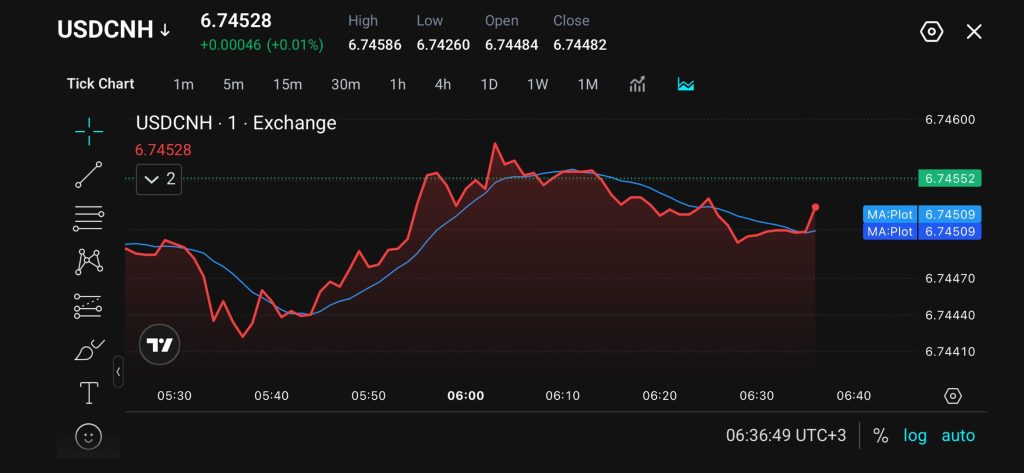
USDCNH traded around the 6.7450 area after moving close to multi-year lows, with the pair showing signs of short-term consolidation following recent yuan strength.
The offshore yuan has strengthened in recent sessions, although the pair recovered from an intraday low near 6.7425 as short-term buying interest emerged.
Why Traders Are Watching USDCNH
USDCNH is being closely monitored as traders evaluate the interaction between China’s currency policy, economic conditions and global dollar trends.
The PBOC has continued setting a firmer midpoint for the onshore yuan, supporting broader yuan sentiment across domestic and offshore markets. The midpoint was set at 6.7878 per dollar, its strongest level since February 2023, reinforcing expectations for continued yuan stability.
Meanwhile, softer US inflation data has reduced expectations for additional Federal Reserve rate increases. A less aggressive Fed outlook has weighed on the dollar and narrowed the interest-rate gap between the US and China, providing support for the offshore yuan.
However, traders remain cautious as slower Chinese growth momentum could limit further yuan appreciation.
Key Trading Levels
| Price Level | What Traders Are Watching |
|---|---|
| 6.7500 | Psychological resistance area if recovery extends |
| 6.7460 | Immediate resistance near recent intraday highs |
| 6.7450 | Current trading area and near-term reference level |
| 6.7425 | Recent low and initial support zone |
| 6.7400 | Next support area if yuan strength resumes |
USDCNH is trading around the 6.7450 area after recovering from the intraday low near 6.7425, showing a modest rebound after recent weakness.
A break above 6.7460 could signal improving short-term dollar momentum and bring the 6.7500 resistance area into focus.
A move below 6.7425 could indicate renewed yuan strength, with 6.7400 becoming the next support level to watch.
Bullish and Bearish Setups
| Setup | Trigger | Potential Market Reaction |
| Dollar Recovery | Hold above 6.7450 | USDCNH may retest the 6.7460–6.7500 resistance zone |
| Bullish Breakout | Break above 6.7500 | Short-term USD momentum could strengthen |
| Range Consolidation | Hold between 6.7425 and 6.7500 | Pair may remain rangebound as traders assess market direction |
| Bearish Breakdown | Fall below 6.7425 | Yuan strength could extend towards 6.7400 |
The bullish scenario depends on USDCNH gaining momentum above the 6.7460 resistance area, which could open the way towards 6.7500.
The bearish scenario becomes more relevant if USDCNH breaks below 6.7425, which could indicate renewed yuan strength and expose the 6.7400 support area.
Disclaimer
The price levels and market scenarios above reflect the author’s view at the time of writing and do not represent financial advice or an official recommendation from VT Markets. Traders should conduct their own analysis and manage risk carefully.
Trade USDCNH CFDs With VT Markets
USDCNH remains closely watched as traders assess yuan movements, Federal Reserve expectations and broader currency market conditions.
With VT Markets, traders can access USDCNH CFDs alongside forex, indices, commodities, shares and other global CFD markets through MT4, MT5, WebTrader, TradingView and the VT Markets App.
Use VT Markets’ charting tools to monitor USDCNH price movements, analyse technical levels and follow major economic developments affecting currency markets.
Learn more about trading Forex Pairs on VT Markets here.
Why Trade USDCNH as a CFD?
USDCNH CFDs allow traders to gain exposure to movements between the US dollar and offshore Chinese yuan without holding the underlying currencies.
This flexibility allows traders to respond to changes in central bank policy, economic data releases and shifts in global currency sentiment.
With VT Markets, traders can follow USDCNH price action alongside other major forex and CFD markets from one account.
CFD trading involves risk, and leverage can magnify both potential gains and losses.
What to Watch Next
USDCNH’s next move will depend on developments in China’s policy outlook, US monetary expectations and broader dollar trends.
Key factors include:
- PBOC Policy Signals: Changes in yuan guidance and daily fixing trends.
- Federal Reserve Outlook: Shifts in expectations for future US rate decisions.
- US Economic Data: Inflation and labour-market indicators that may affect dollar demand.
- China Growth Conditions: Economic developments influencing yuan sentiment.
- Dollar Performance: Broader USD movements affecting USDCNH.
From a technical perspective, traders are watching whether USDCNH can break above 6.7460, while 6.7425 remains the key short-term support level.
Frequently Asked Questions
Why is USDCNH near multi-year lows?
USDCNH remains near multi-year lows as the offshore yuan has strengthened against the US dollar, supported by firmer yuan sentiment and reduced expectations for further US rate increases.
Why is the offshore yuan strengthening?
The offshore yuan has gained support from stronger yuan guidance, softer US dollar conditions and changing expectations around global interest rates.
How does Fed policy affect USDCNH?
Changes in US interest-rate expectations can influence the dollar. Lower expectations for rate increases may weaken the dollar and support the offshore yuan.
What is the difference between USDCNY and USDCNH?
USDCNY represents the onshore yuan market, where the PBOC midpoint fixing plays a direct role. USDCNH represents the offshore yuan market and is more influenced by international market demand and sentiment.
What are the key USDCNH levels to watch?
Traders are monitoring 6.7500 as resistance and 6.7425 as short-term support.
What could weaken the yuan?
A stronger US dollar, renewed expectations for higher US interest rates or concerns over China’s economic outlook could put pressure on the yuan.
Start trading now — click here to create your real VT Markets account.








