






Key Points
- Brent trades near $67.55 and WTI around $62.85, both set for weekly losses
- IEA forecasts supply exceeding demand; Venezuelan output may recover
Crude oil prices changed little on Friday, with Brent crude at $67.55 (+0.04%) and WTI at $62.85 (+0.02%), following sharp losses in the previous session.
Despite a brief rally earlier in the week on fears of a potential U.S. military action against Iran, prices are now on track for a second consecutive weekly decline. Brent is set to fall about 0.8% this week, while WTI is set for a roughly 1.1% drop.
The shift comes after U.S. President Donald Trump indicated that a diplomatic settlement with Iran might be achievable within the next month, reducing the near-term geopolitical risk premium that had supported oil prices.
Markets responded by easing elevated risk premia tied to conflict scenarios, leading to lower crude valuations.
IEA Forecasts Easier Supply-Demand Balance
Adding to downward pressure, the International Energy Agency (IEA) released its monthly report showing that global oil supply growth is likely to exceed demand growth in 2026.
This weaker demand outlook contrasts with earlier projections, signalling that markets may be overestimating consumption strength this year.
The report also comes as U.S. inventory figures have been surprisingly bearish. A recent massive build in U.S. crude stockpiles, as reported earlier this week, has weighed on prices.
Additionally, expectations that Venezuelan oil supply could rise from roughly 880,000 barrels per day to about 1.2 million bpd further tilt the supply outlook toward surplus.
The U.S. Treasury is set to issue further sanctions waivers to ease Venezuelan energy exports, potentially lifting prohibitions and encouraging higher output.
U.S. Secretary of Energy Chris Wright said oil sales from U.S.-controlled Venezuelan assets have already topped $1 billion since January, with another $5 billion expected in the coming months—highlighting potential incremental supply additions.
Technical Analysis
Crude oil prices (CL-OIL) are currently hovering around $62.695, down slightly by 0.04%, as prices edge lower for the second consecutive session.
This follows a rejection from the recent peak at $66.465, with technical indicators now suggesting a potential short-term correction.
The price action has slipped below the 5-day MA (63.772) and 10-day MA (63.608), with current support being tested at the 20-day MA (62.729).
A confirmed close below this level could open the way for a further pullback toward the 30-day MA (61.441) and the psychological level of $60.
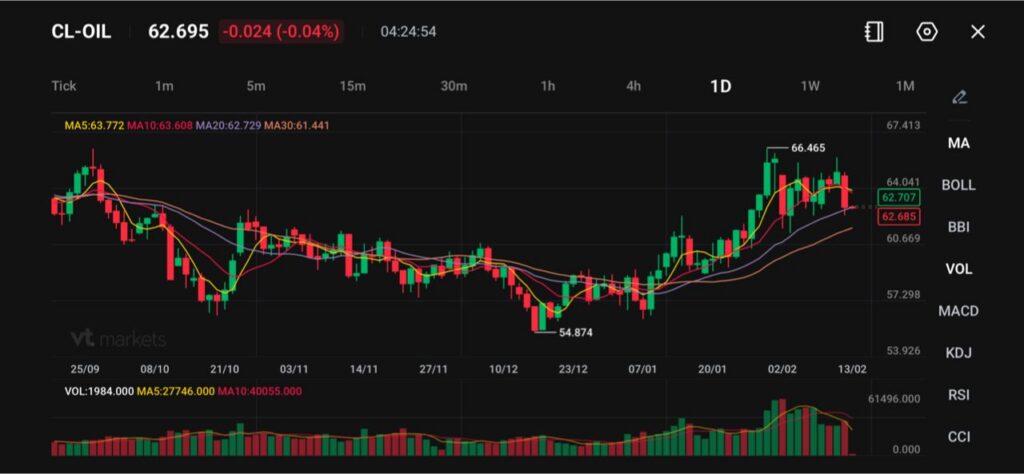
Notably, the strong upward momentum observed since the December low of $54.874 appears to be stalling, as evidenced by the falling volume and waning bullish momentum.
Still, the overall structure remains technically constructive unless the price breaks below $60.50–$60.00. If bulls regain control and price reclaims the $64.00–$65.00 range, a retest of $66.465 and potential extension to $67.40 (the upper Bollinger Band) may be possible.
Volume has declined over the past few days, hinting at reduced conviction in either direction. Traders may be eyeing upcoming inventory data or geopolitical headlines for clearer direction in the coming sessions.
Market Implications
In the short term, oil prices may continue to trade within a range as markets digest the supply-demand dynamic and geopolitical developments.
With geopolitical risk premiums retreating and the IEA forecasting supply outpacing demand, the immediate bias points toward consolidation rather than extension of recent gains.
Traders will also monitor upcoming inventory data from official sources, which could provide further clues about U.S. stock levels and near-term demand.









