






Key Points
- WTI trades at $64.19, down 0.6%, while Brent slips to $67.57.
- Ukraine strikes on Russian energy sites sustain risk premium, though demand worries cap gains.
Oil prices dipped on Friday but remained poised to close the week higher, with traders balancing global risks against concerns of a potential supply glut later this year. WTI crude slipped to $64.19 a barrel and Brent eased to $67.57, with both benchmarks retreating after Thursday’s gains.
Support for prices came from ongoing cross-border tensions. Ukraine’s latest attacks on Russian energy infrastructure underscored risks of supply disruption, while German Chancellor Friedrich Merz said direct peace talks between Russia’s President Vladimir Putin and Ukraine’s Volodymyr Zelensky were unlikely.
ING analysts noted that “the lack of progress towards a peace deal means risks of sanctions and secondary tariffs continue to hang over the oil market.”
At the same time, seasonal demand weakness heading into autumn and concerns about oversupply later this year have capped upside momentum.
Analysts warn that rising U.S. production and sluggish refinery throughput could tilt balances back toward surplus, limiting the market’s ability to sustain gains despite higher cross-border premiums.
Technical Analysis
Crude oil (CL-OIL) has had a volatile year, with price dropping to a low of $55.11 in April before rallying to $77.90 in July. Since then, it has retreated and is now consolidating around $64.30.
The short-term moving averages (5, 10) are starting to flatten and converge with the 30-day MA, suggesting reduced downward momentum after weeks of pressure. The MACD is still below the zero line but is beginning to curl upwards, pointing to early signs of stabilisation.
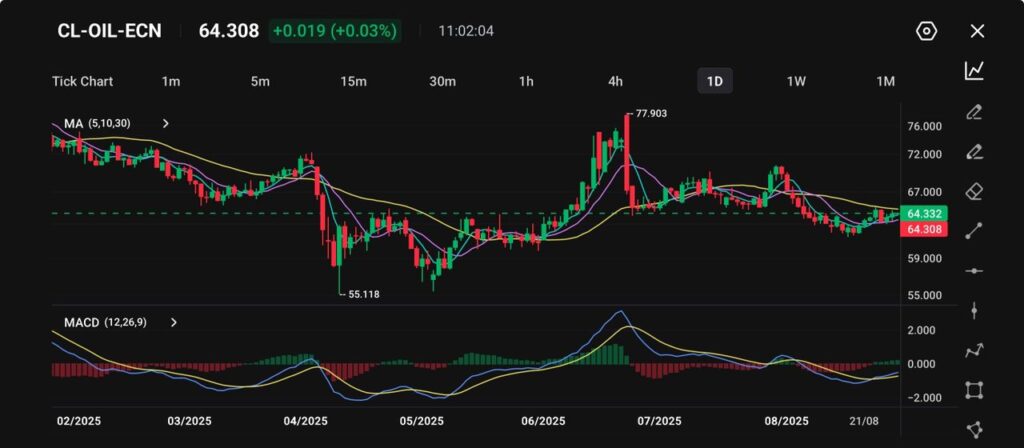
In the near term, resistance sits at $66–67, with stronger resistance near $70. On the downside, immediate support is at $60, while $55 remains the critical long-term floor.
A break above $67 would confirm bullish momentum and could lead to another attempt at the $72–75 region, while failure to hold $60 risks a retest of April’s low.
For now, oil appears to be forming a base, but traders should watch for catalysts such as OPEC+ announcements, US inventory data, and global demand signals to determine the next move.
Cautious Forecast
If global risks intensify, crude could retest the $67.00–$70.00 zone. However, should demand data soften further or supply indicators point to a surplus, prices risk slipping back toward $61.00 in the coming weeks.










