






Key Points
- Nvidia fell 2.26% to $177.29, after intraday losses of over 7%.
- Meta may adopt Google TPUs as early as 2027, breaking Nvidia’s dominance.
- Google stock rose again (+1.5%) amid trader optimism for its custom AI chip ambitions.
Nvidia’s reign over the AI chip market was rattled this week after Meta was reported to be considering a switch to Google’s tensor processing units (TPUs), a move that could reshape the high-stakes race for AI infrastructure.
While Nvidia’s GPUs remain the gold standard for AI training and inference, Google’s TPUs are tailored for specific AI workloads, promising greater energy efficiency and lower costs.
For mega-spenders like Meta (with projected $72 billion in AI infrastructure spending this year), even marginal gains in efficiency can equate to billions saved.
This shift toward diversification isn’t a direct dethroning, but it signals a maturing AI hardware landscape where hyperscalers like Meta want multiple suppliers, especially after supply chain constraints highlighted the risks of Nvidia dependence.
Nvidia Stock Tumbles on Chip Shock
Nvidia’s stock fell 2.26% on Tuesday to $177.29, reacting to the news with a swift sell-off after dropping more than 7% intraday. This came despite no change in earnings or guidance, underscoring how sensitive traders are to margin pressure and competition risks.
The broader message is clear: even the AI chip king is vulnerable. A potential erosion of Nvidia’s pricing power or market share, even if small, can significantly impact its bottom line, given its extraordinary earnings multiple and high expectations baked into the price.
Google’s Strategic Advantage
Unlike Nvidia, which supplies chips but relies on partners for cloud infrastructure, Google’s vertically integrated model offers clients a full-stack solution.
This synergy may prove especially attractive to companies seeking plug-and-play AI computers, where simplicity and cost-efficiency matter more than raw horsepower.
Google’s momentum has lifted its stock once again (+1.5%), reflecting rising trader confidence that its TPUs and Cloud business could gain real traction in the coming AI boom.
Technical Analysis
NVIDIA’s price action has weakened after failing to hold above the 212.1 high in early November. The stock is now trading around 177, breaking below both its 10- and 30-day moving averages.
This puts it in a vulnerable technical position, with recent candles showing increasing bearish momentum and growing downside pressure.
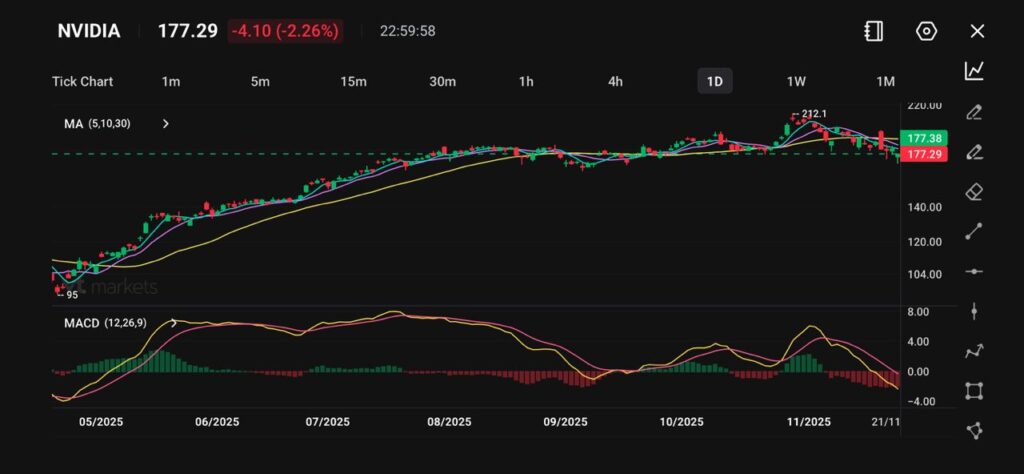
Price is approaching a horizontal support zone around 175, which has held through multiple retests since August.
The MACD has crossed decisively below the signal line, with the histogram expanding in the red. This confirms a shift in sentiment and suggests the correction may extend if no strong bounce materialises soon.
If the 175 level breaks, NVIDIA could see a further slide toward 160, while recovery above 190 is needed to re-establish bullish footing. The broader uptrend from mid-year remains intact for now, but cracks are forming in the short-term structure.
Outlook
While Nvidia remains a dominant force in AI hardware, the landscape is evolving. Meta’s potential pivot toward Google’s TPUs underscores a key trend: clients are demanding alternatives, and competitors are rising to meet the moment.
This isn’t a dethroning, but it’s a warning shot—reminding markets that AI’s semiconductor throne won’t stay uncontested forever. Expect more volatility, rivalry, and headlines as the AI arms race heats up through 2026 and beyond.
Stay on top of market moves on VT Markets.










