






Key Points
- The Japanese yen traded near 161 per US dollar on Friday after strengthening by almost 1% during the previous session.
- Finance Minister Satsuki Katayama said Japan remained prepared to respond to excessive currency moves and continued to communicate with US authorities.
- Weaker US employment data reduced expectations for another near-term Federal Reserve rate increase, placing pressure on the dollar.
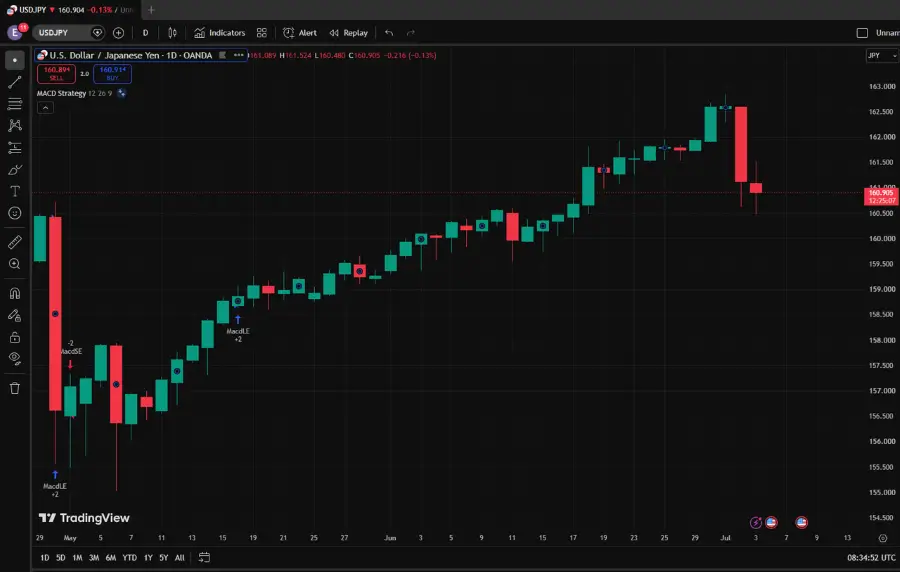
- USDJPY retreated from a recent high near 162.84, its highest level in approximately four decades.
- The chart places immediate support near 160.50, while 161.50 is the first resistance level for a potential recovery.
- Intervention uncertainty and thinner holiday trading conditions may keep short-term volatility elevated.
The Japanese yen held most of its recent gains on Friday, with USDJPY trading around 161 after a sharp reversal during the previous session.
The pair had climbed to approximately 162.84 earlier in the week, reaching its highest level in roughly four decades. The yen then staged a sudden recovery on Thursday, briefly pushing USDJPY down by almost 1%.
There was no official confirmation of fresh currency intervention. Japan’s Ministry of Finance declined to comment on the movement, while some market participants said the rebound was smaller than the moves usually associated with direct intervention.
The yen received additional support after weaker US employment data reduced expectations that the Federal Reserve would raise interest rates again in the near term.
Why Traders Are Watching
Intervention risk has become one of the main short-term drivers of USDJPY. Options traders have increased protection against sharp yen moves as thin US holiday liquidity and uncertainty over Japan’s intervention strategy raise volatility concerns.
The increase in hedging demand suggests that traders are preparing for sudden price swings, even without confirmation that Japanese authorities have entered the market.
Finance Minister Satsuki Katayama reiterated that Japanese officials remained prepared to take appropriate action in the foreign exchange market when required.
She also said Japan and the US remained in regular communication over foreign exchange issues. Her remarks reinforced the view that officials are closely monitoring rapid or disorderly movements in the yen.
Reports also suggest that Japanese authorities may be changing how they communicate intervention risk. Rather than giving markets clear warnings before acting, officials may be adopting a more targeted and less predictable approach.
A less predictable strategy could make it harder for traders to identify a specific USDJPY level that might trigger official action. It may also increase the cost of maintaining large speculative positions against the yen.
For traders, this means USDJPY may react not only to economic data and interest-rate expectations, but also to official comments, options-market positioning and sudden changes in intervention expectations.
Softer US Jobs Data Pressures the Dollar
The yen’s recovery was supported by a broader decline in the US dollar following the June employment report.
US nonfarm payroll employment increased by 57,000 in June, while the unemployment rate remained at 4.2%. Employment growth for April and May was revised down by a combined 74,000.
Following the report, markets reduced the estimated probability of a September Federal Reserve rate increase to around 52%, from 64% before the data. The dollar index was also heading towards its largest weekly decline since early April.
USDJPY is sensitive to changes in US and Japanese interest-rate expectations. Lower US yields or reduced expectations for Federal Reserve tightening can narrow the expected yield advantage of the dollar, potentially providing support for the yen.
However, the interest-rate difference between the two economies remains an important influence. The Bank of Japan raised its policy interest rate to around 1.0% in June and indicated that further gradual increases would depend on economic activity, inflation, and financial conditions.
| Level | What Traders Are Watching |
| 162.60 to 162.85 | Recent multi-decade high and major resistance zone |
| 162 | Secondary resistance and previous breakout area |
| 161.5 | Immediate resistance near the latest session high |
| 161 | Current pivot area |
| 160.5 | Immediate support near the latest session low |
| 160 | Major psychological support |
| 159.5 | Wider support from the earlier breakout structure |
USDJPY is trading near 160.90, placing the pair close to the 161.00 pivot area.
The latest session low near 160.48 makes 160.50 the first downside level to monitor. A sustained break below this area could bring the psychological 160.00 level into focus.
If 160.00 fails, the next wider support area is near 159.50, where the pair previously consolidated during its June advance.
On the upside, USDJPY would need to recover above 161.50 to ease immediate selling pressure. A confirmed move beyond this level could shift attention towards 162.00.
The main resistance remains between 162.60 and 162.85. A return to this area would indicate that the yen’s latest recovery is losing momentum, although intervention risk could increase as the pair approaches its recent peak.
Bullish and Bearish USDJPY Scenarios
| Setup | Trigger | Potential Market Reaction |
| Recovery Attempt | Move above 161.50 | USDJPY may retest 162.00 |
| Bullish Extension | Break above 162.00 | Attention may return to 162.60 to 162.85 |
| Range Consolidation | Remain between 160.50 and 161.50 | The pair may consolidate after the sharp reversal |
| Bearish Continuation | Break below 160.50 | USDJPY may move towards 160.00 |
| Deeper Correction | Fall below 160.00 | The decline may extend towards 159.50 |
USDJPY Upside Scenario
The upside scenario for USDJPY may strengthen if the pair recovers above 161.50 and US interest-rate expectations begin to rise again.
Stronger US economic data, higher Treasury yields or reduced concern about Japanese intervention could place renewed pressure on the yen. Under this scenario, 162.00 would become the next level to monitor.
A sustained move above 162.00 could bring the recent 162.60 to 162.85 resistance zone back into focus. However, intervention risk may increase as USDJPY approaches or exceeds its recent peak.
USDJPY Downside Scenario
The downside scenario may strengthen if USDJPY breaks below 160.50 and the dollar continues to weaken.
Further deterioration in US economic data, lower Treasury yields or stronger warnings from Japanese officials could encourage additional yen buying.
A sustained move below 160.50 could expose the psychological 160.00 level. If that support also fails, attention may shift towards 159.50.
The possibility of direct intervention could also cause traders holding short-yen positions to reduce exposure quickly, potentially accelerating any decline in USDJPY.
Volatility Scenario
USDJPY may also remain within a wide and unstable range between 160.50 and 161.50.
The absence of confirmed intervention means the yen’s latest recovery may still be tested. At the same time, uncertainty surrounding Japan’s intervention strategy could make traders reluctant to rebuild large positions against the currency.
Thin liquidity around the US holiday period may increase the effect of individual orders, official comments and market rumours.
Disclaimer
The price levels and trade scenarios above reflect the author’s view at the time of writing and do not represent financial advice or an official recommendation from VT Markets. Traders should conduct their own analysis and manage risk carefully.
Trade USDJPY CFDs With VT Markets
Forex CFDs remain closely watched during periods of shifting interest-rate expectations, currency intervention risk and changing bond yields.
With VT Markets, traders can access USDJPY alongside other forex pairs, indices, gold, oil, silver, share CFDs, ETF CFDs and other global markets through one platform.
VT Markets provides the tools to monitor price action, identify key levels and respond as market conditions evolve. Whether USDJPY recovers above 161.50 or extends its decline below 160.50, traders can follow the setup using advanced charting tools, flexible account options and access to multiple asset classes.
Learn more about trading Forex Pairs on VT Markets here.
Why Trade USDJPY as a CFD?
CFDs allow traders to take a view on both rising and falling currency pairs without owning the underlying currencies.
This can make USDJPY CFDs useful during fast-moving macroeconomic events, particularly when Federal Reserve policy, Bank of Japan decisions, Treasury yields and intervention risk create short-term volatility.
With VT Markets, traders can access USDJPY and other major global markets through one account, making it easier to monitor cross-market opportunities as they develop.
What to Watch Next
Traders should monitor several factors when assessing the next USDJPY move.
US economic releases remain important because they may influence expectations for the Federal Reserve’s next policy decision. Softer data could continue to weigh on Treasury yields and the dollar, while stronger figures may restore expectations for further tightening.
Comments from Japan’s Ministry of Finance will also remain in focus. Any change in the language used by Katayama or other senior currency officials may affect market expectations for intervention.
Japan’s government bond market is another factor to watch. The benchmark 10-year government bond yield reached a 30-year high on Friday amid concerns about fiscal policy. Higher domestic yields may provide some support for the yen, although broader fiscal concerns could create a more mixed reaction.
For now, 160.50 to 161.50 is the main short-term range. A confirmed move above 161.50 could shift attention towards 162.00, while a break below 160.50 may expose 160.00.
The wider range remains between the psychological 160.00 support level and the recent high near 162.84.
Frequently Asked Questions (FAQs)
Why did the Japanese yen strengthen?
The yen strengthened as traders became more cautious about possible intervention by Japanese authorities. It also benefited from a weaker US dollar after softer employment data reduced expectations for another near-term Federal Reserve rate increase.
Did Japan intervene in the currency market?
There was no official confirmation that Japan intervened during the yen’s latest rally. The Ministry of Finance declined to comment, and some market participants said the move appeared smaller than previous confirmed intervention episodes.
Why does US employment data affect USDJPY?
US employment data can change expectations for Federal Reserve interest rates. Weaker data may reduce expectations for higher US rates, placing downward pressure on Treasury yields and the dollar. This can support the yen and push USDJPY lower.
What are the main USDJPY levels to watch?
Immediate support is near 160.50, followed by 160.00 and 159.50. Immediate resistance is near 161.50, followed by 162.00 and the recent high between 162.60 and 162.85.
Is 161.00 a support or resistance level?
At the current price, 161.00 is better treated as a short-term pivot rather than a confirmed support or resistance level. Price is moving around this area, so the reaction at 160.50 and 161.50 may provide clearer directional signals.
Could the yen weaken again?
The yen could come under renewed pressure if US yields rise, Federal Reserve tightening expectations recover or intervention concerns fade. However, official Japanese warnings and the possibility of unexpected intervention may limit confidence in sustained USDJPY gains.
Start trading now — click here to create your real VT Markets account.








