




Key Points
- GBPUSD held near 1.3373 after UK inflation slowed more than expected.
- Headline inflation eased to 2.6%, but services inflation remained elevated at 3.6%.
- Markets continued to price at least one Bank of England rate increase before the end of 2026.
- Sterling weakened against the euro as traders assessed the mixed inflation signal.
- Oil prices and geopolitical uncertainty remain important risks for the pound.
The British pound held broadly steady against the US dollar on Wednesday after softer UK inflation data failed to significantly change Bank of England interest rate expectations.
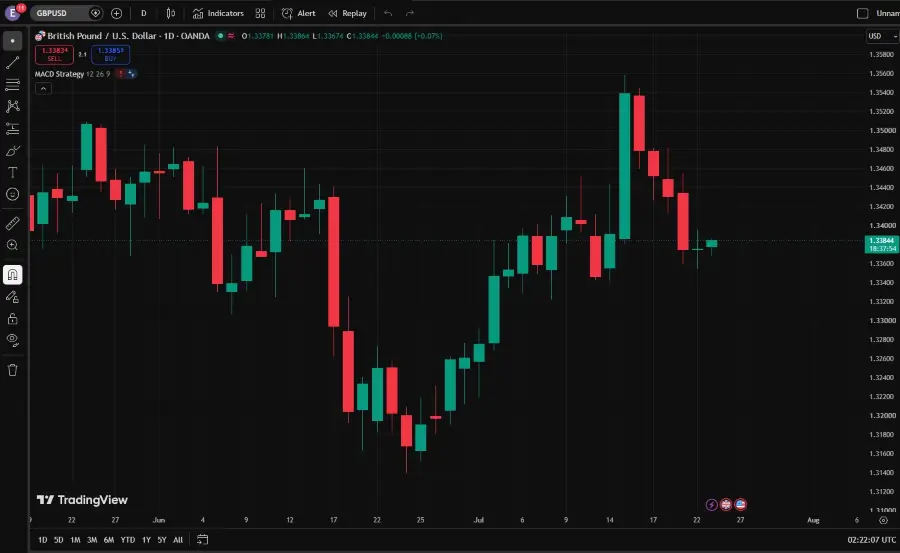
GBPUSD traded around 1.3373 after declining for four consecutive sessions. The pair remained below the 1.34 level, while sterling weakened by approximately 0.2% against the euro. Despite the recent pullback, the pound remained on track for a monthly gain of around 1%.
The limited reaction suggested that much of the inflation slowdown had already been anticipated. Traders remained focused on whether the decline represented a lasting improvement or temporary relief from lower fuel prices.
Why Traders Are Watching the Pound
Sterling is being influenced by two competing forces: softer inflation pressures and continued expectations for restrictive monetary policy.
Lower inflation could reduce the need for tighter monetary policy, potentially limiting the pound’s interest-rate support. However, services inflation remains elevated, while renewed energy-price pressures could create further inflation risks.
UK inflation data also comes as the government faces continued pressure over household costs.
Geopolitical developments remain another factor for sterling. Higher oil prices caused by Middle East tensions could increase inflation concerns, particularly as the UK remains a net energy importer.
Money markets continued to expect the Bank of England to leave its benchmark rate unchanged at 3.75% at its next meeting. Traders were also fully pricing in a quarter-point increase by December, with an estimated 56% probability of a second increase.
This explains why GBPUSD did not fall sharply after the inflation release. The headline figure was softer, but the data did not substantially alter the expected path of UK interest rates.
UK Inflation Sends a Mixed Signal
UK annual consumer price inflation slowed to 2.6% in June from 2.8% in May. The reading was below the 2.7% consensus forecast and marked the lowest inflation rate since March 2025. Monthly consumer prices increased by 0.1%.
Transport costs made the largest downward contribution, particularly motor fuels. Food and non-alcoholic beverage inflation also slowed to 1.7% from 2.2%, while prices in that category fell by 0.2% during June.
Underlying inflation was less supportive.
Core CPI, which excludes energy, food, alcohol and tobacco, remained at 2.6%. Services inflation eased only slightly to 3.6% from 3.7% and remained above expectations.
For the Bank of England, services inflation remains an important measure because it reflects domestic wage pressures and pricing trends. The combination of lower headline inflation and relatively firm services inflation supports a cautious policy approach rather than an immediate shift.
Key Trading Levels
| Price Level | What Traders Are Watching |
| 1.36 | Wider resistance zone if GBPUSD resumes broader upside momentum |
| 1.3556 | Recent swing high and key resistance level |
| 1.35 | Psychological resistance and previous breakout area |
| 1.3465 | Near-term resistance after recent pullback |
| 1.3440–1.3450 | Previous consolidation area and potential recovery resistance |
| 1.34 | Key psychological level |
| 1.3370–1.3380 | Current consolidation zone |
| 1.335 | Immediate downside support |
GBPUSD has pulled back from the recent high around 1.3556, with price consolidating near the 1.3370–1.3380 area.
The pair remains below the 1.3400 level, which is an important short-term reference point.
A move back above 1.3500 could bring the recent resistance zone into focus, while a break above 1.3556 may strengthen upside momentum towards 1.3600.
On the downside, traders are watching the 1.3440–1.3450 area as a potential recovery resistance zone, followed by 1.3400 and 1.3350 if selling pressure continues.
Bullish and Bearish Sterling Setups
| Setup | Trigger | Potential Market Reaction |
| Bullish Recovery | Move above 1.3500 | GBPUSD may retest the 1.3556 resistance area |
| Bullish Breakout | Break above 1.3556 | Upside momentum may extend towards 1.3600 |
| Range Consolidation | Hold between 1.3440 and 1.3500 | Pair may continue trading within a short-term range |
| Bearish Pullback | Fall below 1.3440 | GBPUSD may revisit the 1.3400 support level |
| Deeper Correction | Break below 1.3400 | Downside pressure may increase towards 1.3350 |
The bullish scenario depends on GBPUSD recovering above 1.3500 and maintaining buying momentum. A confirmed break above 1.3556 could strengthen the upside move towards 1.3600.
The neutral scenario is continued consolidation between 1.3440 and 1.3500. This may indicate that traders are waiting for clearer signals from inflation trends, Bank of England expectations and broader US dollar movements.
The bearish scenario strengthens if GBPUSD remains below resistance and breaks below the 1.3440 area. A confirmed move lower could increase selling pressure towards 1.3400, with further weakness potentially exposing 1.3350.
Disclaimer
The price levels and market scenarios above reflect the author’s view at the time of writing and do not represent financial advice or an official recommendation from VT Markets. Traders should conduct their own analysis and manage risk carefully.
Trade GBPUSD CFDs With VT Markets
GBPUSD remains active when UK economic conditions, Bank of England expectations, US dollar movements and global risk sentiment influence currency markets.
With VT Markets, traders can access GBPUSD CFDs alongside other major forex pairs, gold, oil, indices, shares, ETFs and global CFD markets from one platform.
This allows traders to follow GBPUSD movements while monitoring related factors such as US Treasury yields, energy markets and broader market sentiment.
Use VT Markets’ charting tools to monitor support, resistance, moving averages and breakout behaviour as the next GBPUSD setup develops.
Learn more about trading Forex Pairs on VT Markets here.
Why Trade GBPUSD as a CFD?
GBPUSD CFDs allow traders to take a view on rising or falling price movements without directly exchanging the underlying currencies.
This flexibility can be useful when the pair reacts quickly to US inflation data, Federal Reserve expectations, UK policy signals or changes in energy prices.
If GBPUSD breaks above resistance, traders can monitor potential bullish continuation. If sterling weakens or dollar demand increases, traders can assess possible downside setups.
With VT Markets, traders can follow GBPUSD price action in real time and compare it with other major CFD markets through one account.
What to Watch Next
The Bank of England’s next policy decision will be the main domestic event for sterling.
Markets largely expect the central bank to keep Bank Rate unchanged at 3.75%, meaning the accompanying statement and voting split may be more important than the decision itself. Any change in policymakers’ views on inflation risks could affect GBPUSD and GBP crosses.
Traders will also monitor:
- UK services inflation and wage growth
- Oil and natural gas prices
- Developments affecting Middle Eastern energy routes
- US dollar and Treasury yield movements
- UK fiscal policy developments
- Whether GBPUSD can recover above 1.34
For now, the pound remains caught between cooling headline inflation and continued expectations that UK interest rates may remain restrictive.
Frequently Asked Questions
Why did the pound remain stable after UK inflation fell?
The inflation slowdown had already been partly expected by markets and did not significantly change Bank of England rate expectations. Services inflation also remained relatively firm, limiting the impact of the softer headline figure.
Does inflation at 2.6% mean the Bank of England will cut rates?
Not necessarily. Inflation remains above the Bank of England’s 2% target, while services inflation remains elevated. Markets continued to expect a cautious policy approach.
Why is the 1.34 level important for GBPUSD?
The 1.34 level is a widely watched psychological reference point. GBPUSD remaining below this level suggests short-term momentum has weakened following its recent decline.
How can higher oil prices affect sterling?
Higher oil prices can increase inflation risks because the UK is a net energy importer. This may affect household costs and influence expectations for Bank of England policy.
Which events could move the pound next?
Future inflation data, wage growth, Bank of England communication, energy-price movements, UK fiscal developments and US dollar trends are likely to remain important drivers for GBPUSD.










