





Key Points
- USDX fell to 98.20, down nearly 10% year-to-date, worst performance among major currencies
- Fed futures fully price in two 2025 cuts, with a third possible in early 2026
- Political pressure on Fed escalates as Trump pushes to oust officials and overhaul governance
The U.S. dollar index slipped to 98.20 this week, edging closer to July’s seven-month low of 95.97 as bearish sentiment dominated currency markets.
Down nearly 10% in 2025, the greenback has become the weakest major currency, weighed by aggressive Fed cut expectations and deepening political interference in monetary policy.
Traders are now fully pricing in two rate cuts this year, with some expecting a third early next year. At the same time, markets have grown wary of U.S. central bank independence as former President Trump continues to criticise Chair Jerome Powell, calls for sharply lower rates, and pushes for the dismissal of Fed Governor Lisa Cook.
Trader concerns about U.S. fiscal discipline and the politicisation of monetary policy have fuelled an aggressive short-dollar trade.
A Reuters FX survey found 80% of respondents expect short bets to rise or stay elevated through September. Meanwhile, the euro is forecast to reach 1.20 over the next 12 months as the dollar weakens further.
Still, some strategists warn that consensus trades carry risk. A surprise inflation rebound or hawkish shift from the Fed could squeeze dollar bears and send the greenback higher in the short term.
Technical Analysis
The US Dollar Index (USDX) has been in a prolonged downtrend since its February peak near 109.73, sliding to a low of 95.97 in July before stabilising.
Currently trading around 98.20, the index is holding just above that July floor but remains capped below the 99.50 resistance area.
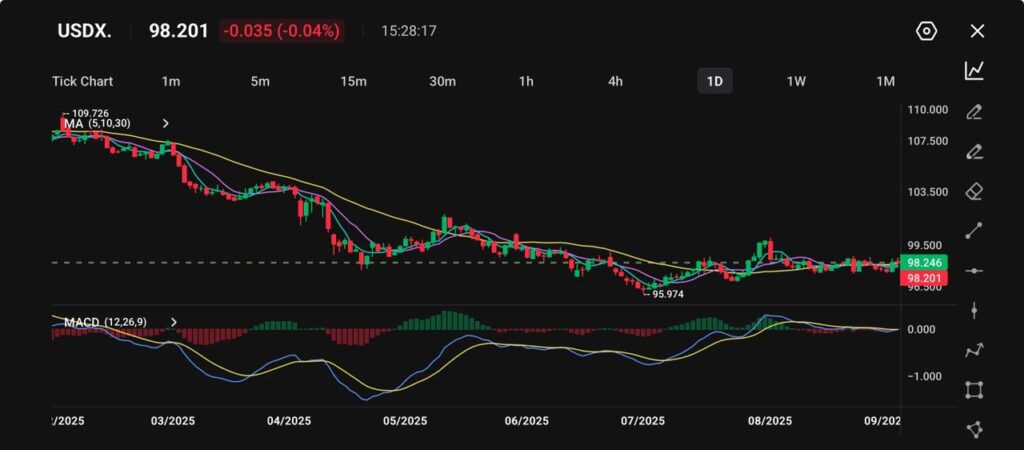
The moving averages (5, 10, 30) are flat and converging, showing indecision after months of weakness. The MACD is hovering near the zero line, reflecting muted momentum and the absence of a strong directional push.
For the near term, resistance lies at 99.00–99.50, and only a decisive breakout above this would suggest a shift back toward bullish momentum.
On the downside, support remains firm at 96.00, with a break below exposing fresh downside risks.
Until either boundary is cleared, the dollar is likely to remain range-bound, with traders watching closely for upcoming US jobs and inflation data, as well as Federal Reserve policy signals, to set the next move.
Cautious Forecast
With markets leaning heavily short and Fed cuts priced in, the dollar remains vulnerable to policy surprises or inflation shocks. Traders will be watching Friday’s nonfarm payrolls report for signs of labour market strength.
A hot print could delay cuts and lift the USD temporarily — but barring a major reversal, the greenback’s broader downtrend looks set to continue.










