




Key Points
- Brent crude retreated below $90 after a sharp rally driven by renewed US-Iran tensions and concerns over potential disruptions to global oil supply.
- Prices gained more than 7% during the rally as markets reacted to rising risks around Middle East production and shipping routes.
- The rally lost momentum as traders assessed whether supply disruptions would become prolonged, with continued tanker activity easing immediate concerns.
- The Strait of Hormuz remains a key risk area, while US crude inventory declines and OPEC+ supply decisions continue to influence the oil outlook.
Brent crude retreated below $90 after a sharp rally driven by renewed US-Iran tensions and concerns over possible supply disruptions. Prices had surged more than 7% as markets reacted to rising risks around Middle East production and shipping routes.
However, the rally lost momentum as traders reassessed the risk of a prolonged supply shock. Continued tanker movements through parts of the region suggested that some oil flows remained active, easing immediate supply concerns. Brent later slipped towards $89.45.
The market is now balancing two factors: ongoing geopolitical uncertainty supporting prices, and continued supply flows limiting further upside pressure.
Why Traders Are Watching This
The main focus remains on whether Middle East tensions could develop into a sustained disruption to global oil supply. The Strait of Hormuz remains a key risk area, as any impact on shipping activity could quickly increase supply concerns.
However, Brent’s move below $90 suggests traders are reassessing how much geopolitical risk has already been priced into the market. Despite ongoing tensions, continued tanker activity has reduced immediate concerns over a major supply interruption.
Beyond geopolitical risks, supply fundamentals are also influencing oil sentiment. US crude inventories have drawn attention after stocks fell by 7.2 million barrels, reaching their lowest level since 2018.
The inventory decline points to tighter near-term supply conditions, although traders continue to monitor whether OPEC+ production decisions could add additional supply to the market.
Key Trading Levels
| Price Level | What Traders Are Watching |
| $92.00 | Wider resistance area if Brent extends its recovery |
| $91.00 | Near-term resistance after the recent rebound |
| $90.00 | Key psychological level and immediate resistance |
| $89.10 | Current trading area after recent consolidation |
| $88.00 | Short-term support zone from recent price action |
| $86.00 | Important support area if selling pressure increases |
| $84.00 | Deeper support zone near recent lows |
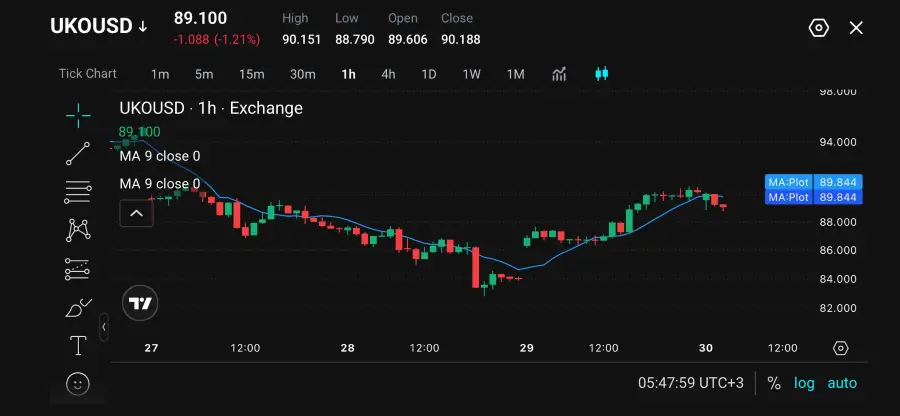
UKOUSD is consolidating around the $89 area after recovering from recent lows near the $84 region. The price remains below the $90 psychological resistance level, where traders are watching whether buyers can regain momentum.
A sustained move above $90.00 could strengthen the recovery and bring $91.00 and $92.00 resistance levels into focus.
On the downside, a failure to hold the $88.00 support area could signal renewed selling pressure, with the next support levels around $86.00 and $84.00.
Bullish and Bearish Setups
| Setup | Trigger | Potential Market Reaction |
| Bullish Recovery | Break above $90.00 | UKOUSD may retest the $91.00 resistance area |
| Bullish Extension | Hold above $91.00 | Momentum may strengthen towards $92.00 |
| Range Consolidation | Remain between $88.00 and $90.00 | Price may continue moving sideways as traders wait for clearer direction |
| Bearish Pullback | Fall below $88.00 | Selling pressure may increase towards $86.00 |
| Deeper Correction | Break below $86.00 | UKOUSD may revisit the $84.00 support zone |
UKOUSD remains at a key technical area as traders assess the balance between supply concerns, geopolitical risks and broader oil market sentiment.
The bullish scenario would require buyers to reclaim the $90.00 resistance level and maintain momentum above it. A sustained move higher could bring $91.00–$92.00 into focus.
The bearish scenario strengthens if UKOUSD breaks below the $88.00 support area. Further weakness could expose $86.00 and potentially the $84.00 region.
Disclaimer
The price levels and market scenarios above reflect the author’s assessment at the time of writing. They do not represent financial advice or an official recommendation from VT Markets. Energy markets can experience rapid movements due to geopolitical developments, supply changes and macroeconomic factors.
Trade UKOUSD CFDs With VT Markets
UKOUSD remains sensitive to geopolitical developments, global supply conditions, inventory changes and OPEC+ production decisions.
With VT Markets, traders can access Brent crude CFDs alongside other energy markets, commodities, forex, indices, shares and global CFD products through MT4, MT5 and the VT Markets App.
Market participants can use charting tools to monitor price movements, key support and resistance levels, and changing market conditions as the next Brent crude setup develops.
Start trading energy CFDs with VT Markets.
Why Trade UKOUSD With VT Markets?
UKOUSD allow traders to gain exposure to oil price movements without owning physical crude oil.
This provides flexibility when markets respond to geopolitical events, supply disruptions, inventory reports and changes in global energy demand.
With access to multiple CFD markets from one platform, traders can monitor oil alongside currencies, indices, metals and other major financial instruments.
CFDs are leveraged products, meaning relatively small market movements can result in larger gains or losses compared with the amount deposited.
What to Watch Next
The next direction for Brent crude will likely depend on whether geopolitical risks continue to outweigh improving signs around oil transportation.
Key factors to watch include:
- Strait of Hormuz developments: Any disruption to one of the world’s most important oil transit routes could quickly increase supply concerns.
- US crude inventories: Further inventory declines could reinforce tighter supply expectations.
- OPEC+ decisions: Future production adjustments may influence the balance between supply and demand.
- Global demand outlook: Economic growth expectations will remain important for assessing future oil consumption.
- Geopolitical developments: Further escalation or easing of tensions could drive short-term price volatility.
From a technical perspective, Brent’s next move may depend on whether prices can reclaim the $90 level or break below the $88 support zone.
Frequently Asked Questions
Why did Brent crude fall below $90?
Brent crude declined after the initial geopolitical-driven rally weakened. Although Middle East tensions remain elevated, continued tanker movements reduced immediate concerns about a major supply disruption.
Why did Brent crude rise initially?
Brent surged after renewed US-Iran tensions increased concerns over possible disruptions to oil production and shipping routes.
Is the Middle East conflict still affecting oil prices?
Yes. Geopolitical developments remain a major influence on Brent crude because the region plays an important role in global energy supply and shipping routes.
What are the key UKOUSD levels to watch?
The main levels from the chart are $90 and $91 on the upside, with support around $88, $86 and $84.
What could move Brent crude next?
Future price movements may depend on Middle East developments, shipping activity, inventory data, OPEC+ decisions and changes in global oil demand.









