






Key Points
- Bitcoin (BTCUSD) has fallen towards $65,000 after trading above $70,000, reflecting selling pressure and weakening short-term momentum.
- Expectations of tighter Federal Reserve policy, elevated Treasury yields and a stronger US dollar continue to pressure cryptocurrencies.
- Bitcoin ETF outflows and leveraged liquidations could increase volatility if institutional buying fails to absorb selling pressure.
- The $64,000 area provides an immediate technical reference, while $60,000 remains a major psychological support level.
- Upcoming US economic data, Federal Reserve commentary and Nasdaq performance could influence Bitcoin’s market direction.
Market Move
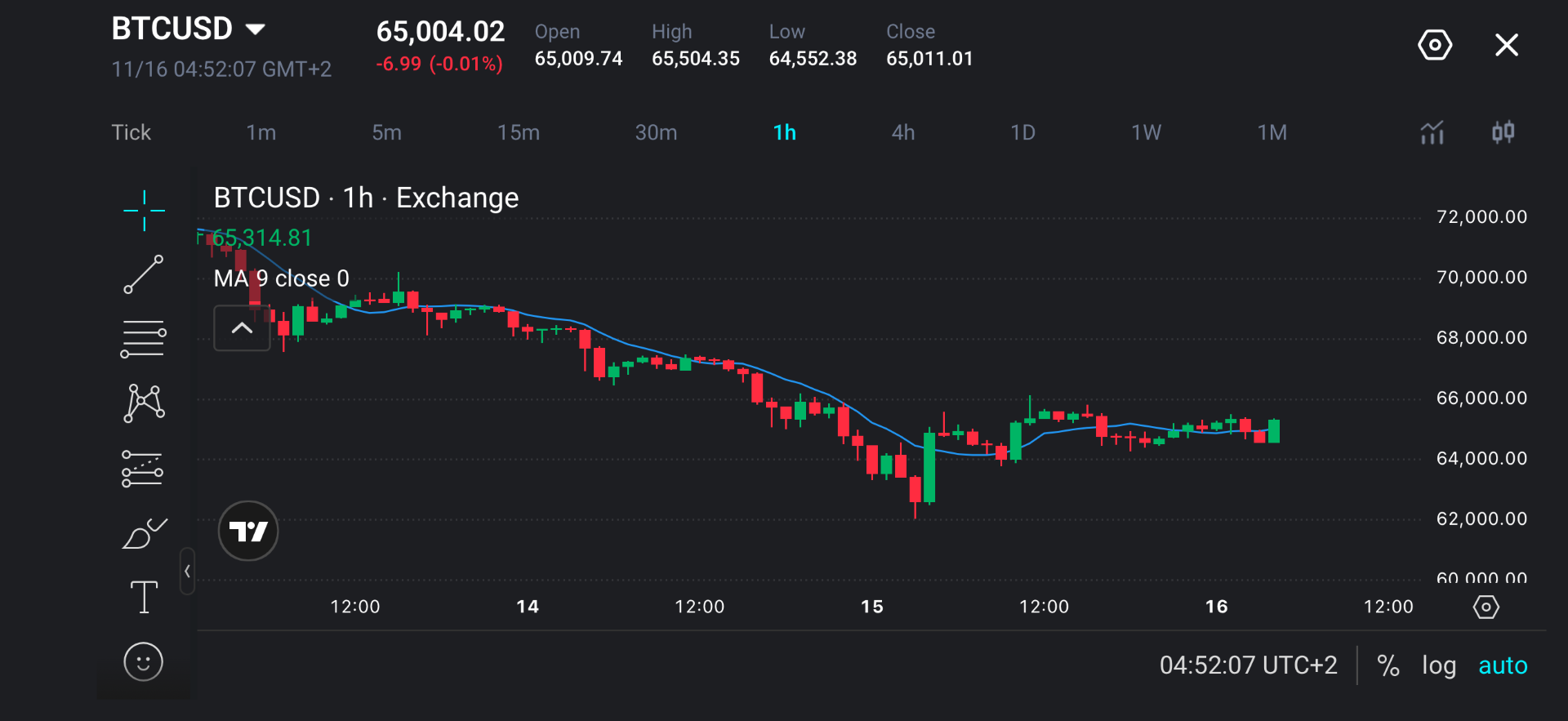
Bitcoin remained under pressure after a sustained decline from above $70,000, extending a broader correction that has weakened short-term market sentiment. Bitcoin briefly approached $62,000 before attracting renewed buying interest. However, the rebound has struggled to establish a convincing recovery, with prices consolidating near $65,000.
The latest session shows a sequence of lower highs and lower lows during the sell-off, followed by a sharp rebound and a narrower trading range. This suggests that immediate selling pressure has eased, although buyers have yet to reverse the broader bearish structure.
Bitcoin’s inability to sustain a stronger rebound leaves the market vulnerable to renewed selling, particularly if macroeconomic conditions continue to favour the US dollar and Treasury yields.
Why Traders Are Watching
Bitcoin’s decline comes amid concerns that persistent US inflation could keep Federal Reserve policy restrictive for longer than previously anticipated. Higher Treasury yields can reduce the relative appeal of high-risk assets, while a stronger US dollar may tighten global financial conditions.
Institutional demand is another concern, as continued spot Bitcoin ETF outflows could weaken buying support. Meanwhile, leveraged liquidations risk accelerating losses if prices decline further.
Traders are also monitoring the Nasdaq for signs of broader market sentiment. Further weakness in technology stocks could add pressure to Bitcoin, while a recovery alongside easing Treasury yields may help stabilise prices.
Key Trading Levels
| Price Level | Significance |
| $70,000 | Major psychological resistance and broader recovery target. |
| $68,000 | Previous trading area that could attract selling on a stronger rebound. |
| $65,500–$66,000 | Immediate resistance zone near recent consolidation highs. |
| $65,000 | Short-term pivot level, with Bitcoin currently trading around this area. |
| $64,000 | Immediate support and an important level for maintaining the rebound. |
| $62,000–$62,500 | Recent swing-low zone where buyers previously emerged. |
| $60,000 | Major psychological support and potential downside target if selling resumes. |
Bitcoin is consolidating around $65,000, a key short-term pivot following its recent sell-off. Immediate resistance sits between $65,500 and $66,000, where selling pressure could limit further gains. A sustained move above this zone may open the way towards $68,000, with $70,000 representing a broader psychological resistance level.
Bullish and Bearish Setups
| Scenario | Confirmation | Potential Outlook |
| Bullish | Bitcoin breaks above $65,500–$66,000 and maintains buying momentum. | A recovery towards $68,000 becomes possible, with $70,000 a broader upside target. |
| Bearish | Bitcoin loses $64,000 and selling pressure accelerates. | Prices could revisit $62,000–$62,500, with $60,000 becoming the next major downside reference. |
The bullish scenario would gain momentum if Bitcoin breaks above $65,500–$66,000, signalling stronger buying interest. A sustained move above the nine-period moving average, followed by higher highs and higher lows, could indicate improving short-term momentum and support a recovery.
The bearish scenario would strengthen if Bitcoin falls below $64,000, confirming renewed selling pressure. A continuation of lower highs and lower lows, alongside a downward-sloping nine-period moving average, could reinforce the bearish structure and expose $62,000–$62,500, with $60,000 becoming the next downside target.
Disclaimer
The price levels and market scenarios above reflect the author’s assessment at the time of writing. They do not represent financial advice or an official recommendation from VT Markets. Traders should conduct their own analysis and manage risk carefully.
BTCUSD Prediction: What’s Next?
Softer US inflation data or dovish Federal Reserve commentary could ease Treasury yields and weaken the US dollar, improving demand for risk-sensitive assets. A return to net inflows into spot Bitcoin ETFs could also support buying interest and help Bitcoin establish a more sustained recovery.
On the downside, stronger-than-expected economic data could reinforce expectations of restrictive monetary policy, keeping pressure on cryptocurrencies. Continued ETF outflows, further Nasdaq weakness and leveraged liquidations could accelerate selling and increase the risk of another decline.
Traders will be watching upcoming US economic releases, Federal Reserve commentary and institutional fund flows for signs of whether Bitcoin’s recent consolidation can develop into a recovery or give way to further losses.
Trade BTCUSD with VT Markets
Bitcoin’s recent volatility highlights how quickly cryptocurrency prices can respond to macroeconomic developments, institutional flows and changes in investor sentiment.
With VT Markets, traders can access Bitcoin CFDs and speculate on both rising and falling prices without owning the underlying cryptocurrency. The VT Markets trading platforms provide access to real-time charts, technical indicators and order management tools to help traders monitor market movements and manage their exposure.
Explore Bitcoin CFD trading with VT Markets.

Frequently Asked Questions (FAQs)
Why is Bitcoin falling?
Bitcoin has come under pressure from tighter Federal Reserve policy expectations, elevated Treasury yields and weaker demand for risk-sensitive assets. ETF outflows and leveraged liquidations can also intensify selling.
Do Bitcoin ETF outflows affect BTCUSD prices?
Yes. Sustained ETF outflows can indicate weakening institutional demand and contribute to negative sentiment, although ETF flows are not the only factor influencing Bitcoin prices.
What should Bitcoin traders watch next?
Traders should monitor Federal Reserve commentary, US economic releases, Treasury yields, the US dollar, Nasdaq performance and Bitcoin ETF flows for signs that selling pressure may ease or intensify.
Start trading now — click here to create your real VT Markets account.



