




Key Points
- Bitcoin dropped roughly 5.7% towards $75,970, while Ethereum lost around 7.7% towards $2,235 during its latest trading session.
- The Nasdaq Composite fell 5.5% on 5 November, as selling in AI-related shares weakened broader risk appetite.
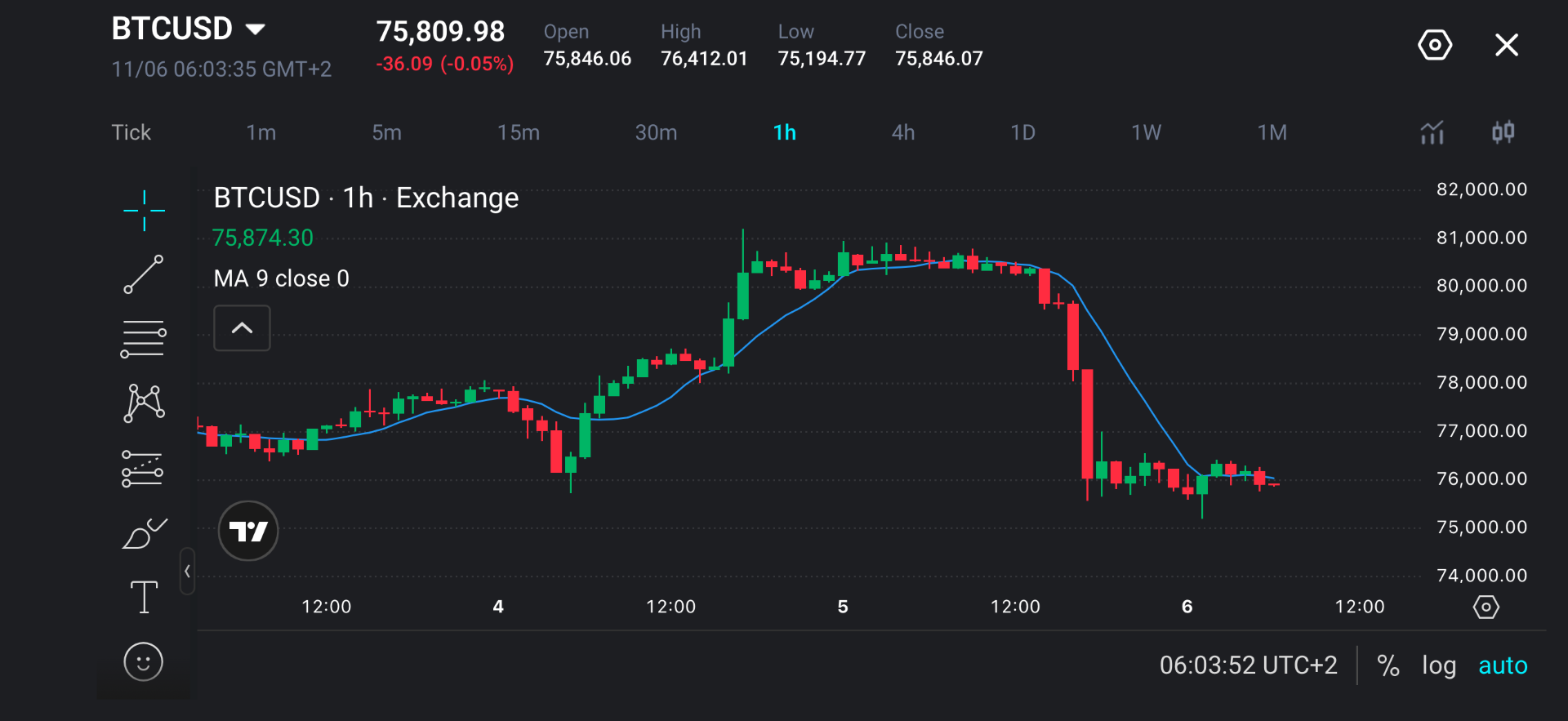
- Bitcoin remains bearish, with price below a declining nine-period moving average after reversing from above $80,000.
- US Non-Farm Payrolls on 6 November could shape the next move, with $75,000 support and $76,400–$76,500 resistance the immediate technical areas to watch.
Market Move
Bitcoin reversed sharply on 5 November, surrendering its recovery above $80,000 and falling below $76,000. Ethereum suffered a heavier percentage decline, bringing the $2,200 psychological level into focus.
BTCUSD’s latest session on 6 November opened at $75,846.06 and closed at $75,846.07, reaching a high of $76,412.01 and a low of $75,194.77.
Technically, the decline from the $80,000–$81,000 region produced several large bearish candles before price began consolidating near $76,000. Bitcoin remains below its declining nine-period moving average, suggesting that stabilisation has yet to develop into a rebound.
Why Traders Are Watching
Bitcoin’s near-term direction is closely linked to the major sell-off in US technology shares. The Nasdaq Composite’s 5.5% decline reflected concerns surrounding AI-related businesses, including possible restrictions on data-centre development following the US election. Continued weakness in this sector could keep cryptocurrencies under pressure.
Leverage has also excelerated the decline. When falling prices trigger the forced closure of leveraged long positions, those liquidations can generate additional selling. Potential changes to crypto regulation remain a risk. However, the next assessment should focus on proposals and legislative developments.
Friday’s employment report also weighs on market outlook as interest-rate expectations and the US dollar can influence Bitcoin’s short-term performance.
Key Trading Levels
| Level | Role | Technical significance |
| $80,000–$81,000 | Major resistance | Former consolidation area before the sharp sell-off. |
| $78,000 | Recovery resistance | Breakdown area that could attract renewed selling during a rebound. |
| $77,000 | Intermediate resistance | Nearby reference level above the current consolidation. |
| $76,400–$76,500 | Immediate resistance | Includes the displayed high of $76,412.01 and the upper edge of recent trading. |
| $76,000 | Near-term pivot | Current consolidation area and an early measure of recovery strength. |
| $75,195–$75,000 | Key support | Combines the displayed low of $75,194.77 with psychological support. |
| $74,000 | Downside reference | Next round-number area below $75,000. |
The $76,000 area is the first level buyers need to reclaim and hold. However, a move above this threshold alone would leave Bitcoin inside its recent consolidation. A sustained recovery through $76,400–$76,500 would provide stronger evidence that immediate selling pressure is easing.
On the downside, $75,195–$75,000 is the main defensive area. Repeated tests without a meaningful rebound could leave support vulnerable. A confirmed break would shift attention towards $74,000.
Bullish and Bearish Setups
| Scenario | Trigger | Potential levels |
| Bullish setup | Sustained hourly break above $76,400–$76,500, followed by support holding on a retest. | $77,000, then $78,000 |
| Bearish setup | Sustained hourly break below $75,000, followed by a failed attempt to reclaim it. | $74,500, then $74,000 |
The bullish setup depends on Bitcoin going beyond the recent consolidation and holding above it. Higher lows following a retest of $76,400–$76,500 would strengthen the recovery case. A quick return below $76,000 would weaken that signal.
The bearish setup requires acceptance below $75,000. A brief move beneath support followed by an immediate recovery could represent a false break. Failure to reclaim the level would increase the risk of another downward leg, with $74,500 serving as an intermediate reference.
Disclaimer
The price levels and market scenarios above reflect the author’s assessment at the time of writing. They do not represent financial advice or an official recommendation from VT Markets. Traders should conduct their own analysis and manage risk carefully.
Bitcoin Prediction: What’s Next?
The main scheduled catalyst remaining this week is the US employment report for October, due on Friday, 6 November at 8:30 am EST. Markets should assess payroll growth, unemployment, average hourly earnings and revisions to previous months together.
The next move will likely be influenced by:
- Payrolls and wage growth: Stronger employment and persistent wage pressure could encourage expectations of tighter Fed policy. Softer figures could support expectations of easier policy, although a severe deterioration could also increase growth concerns.
- The US dollar and Treasury yields: A rise in both following NFP could complicate Bitcoin’s recovery. Falling yields and a weaker dollar could create more favourable conditions if risk appetite also stabilises.
- US technology shares: A recovery in the Nasdaq and semiconductor stocks would strengthen the case for improving sentiment. Another wave of equity selling could leave Bitcoin vulnerable to further support tests.
A softer jobs report could possibly lead to an uptrend if Bitcoin holds support and equities stabilise. A stronger dollar, renewed technology-sector selling would favour further downside.
Trade Bitcoin with VT Markets
Access Bitcoin CFD trading with VT Markets and monitor market movements with flexible trading tools, competitive conditions and more.
With VT Markets, traders can access BTCUSD alongside other global markets through a single trading platform.
Create a live VT Markets account today to access our platform features, including market insights and educational content.

Frequently Asked Questions (FAQs)
Why did Bitcoin fall below $76,000?
Bitcoin declined alongside a sharp sell-off in US technology shares. Weaker risk appetite and leveraged liquidations contributed to the selling pressure.
Why is Ethereum’s $2,200 level important?
Ethereum’s decline towards $2,235 brought $2,200 into focus as a nearby psychological threshold. Holding above it could indicate stabilisation, while a sustained break would suggest continued weakness.
When is the US Non-Farm Payrolls release?
The October employment report is scheduled for 6 November 2026 at 8:30 am EST.
How could NFP affect Bitcoin?
NFP could change expectations for Fed policy and influence the dollar, Treasury yields and risk appetite. Bitcoin’s response will depend on how the full report compares with expectations and how other markets react.
Could Bitcoin fall below $75,000?
A sustained break below $75,000 would increase the risk of further losses. An immediate recovery above the level would weaken the breakdown signal, making the retest particularly relevant.



