




Key Points
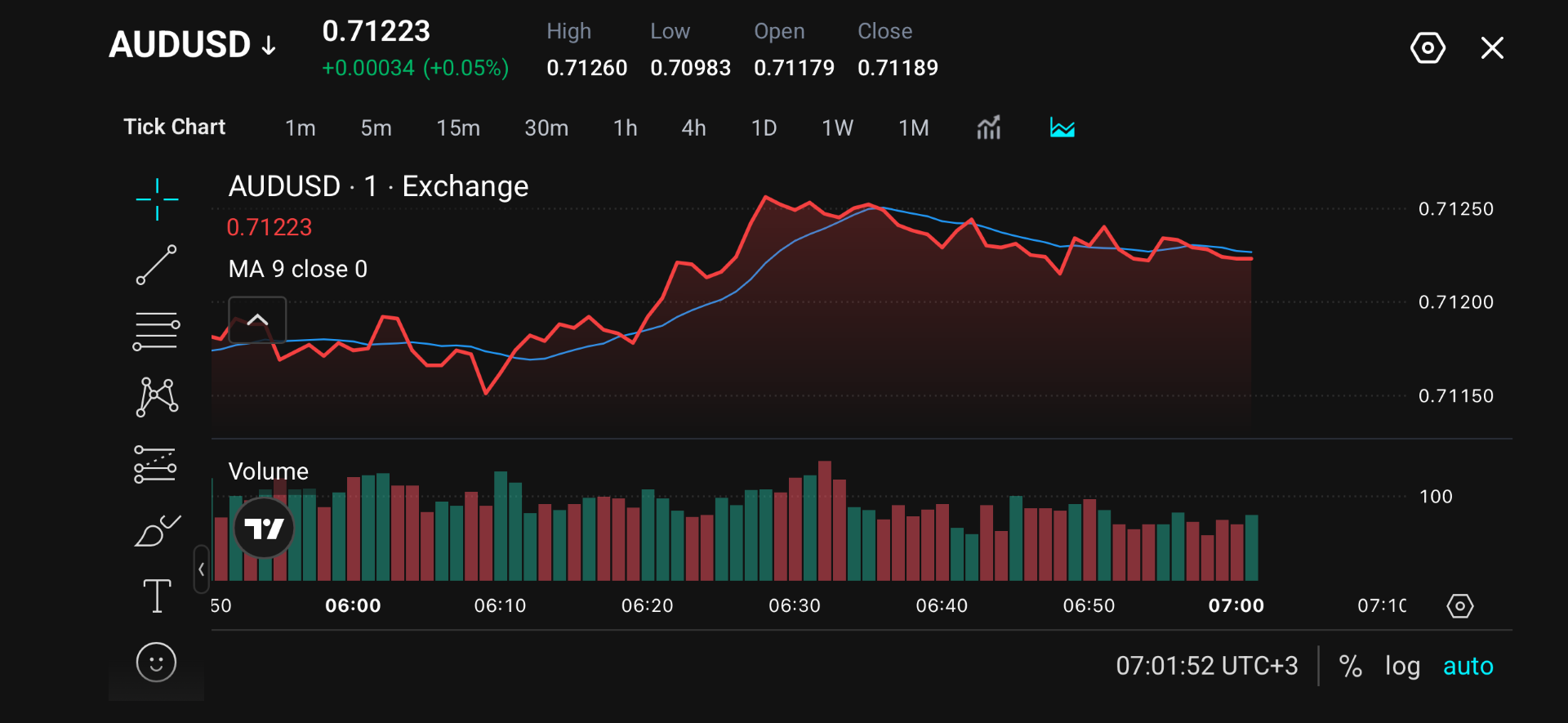
- AUD/USD is trading around 0.7122, holding above the important 0.7100 support zone as buyers defend recent gains.
- The Australian dollar remains supported by expectations that the Reserve Bank of Australia (RBA) may maintain a tighter policy stance amid persistent inflation concerns.
- RBA Governor Michele Bullock has highlighted ongoing upside inflation risks, keeping interest-rate expectations as a key driver for AUD/USD.
- The upcoming RBA monetary policy decision on 29 September remains the next major catalyst for the Australian dollar.
Market Move
AUD/USD is consolidating around 0.7120 after a short-term rebound from lower levels. AUD/USD climbed from around 0.7115 before pushing towards 0.7125, where upward momentum started to ease.
The Australian dollar remains supported as markets expect further policy tightening from the RBA.
However, upward momentum is limited as the US dollar performs strongly following the Federal Reserve’s recent rate hike.
Why Traders Are Watching
AUD/USD remains sensitive to changes in interest rate-expectations in Australia and the US.
The RBA’s focus on inflation risks has supported expectations that Australian rates may remain elevated for longer. Stronger rate expectations could continue to strengthen the Australian dollar by attracting demand for higher-yielding assets.
The US dollar remains an important factor. The recent rate hike by the Federal Reserve has lifted federal funds rate to 3.75%–4.00%, putting weight on the US Dollar.
Key Trading Levels
| Level | Price Area | Significance |
| Resistance 2 | 0.715 | Major psychological resistance and recent upside barrier |
| Resistance 1 | 0.7125–0.7126 | Current intraday high and immediate selling zone |
| Current Price | 0.7122 | Short-term consolidation area |
| Support 1 | 0.71 | Key psychological support level |
| Support 2 | 0.7098 | Recent intraday low |
AUD/USD is approaching an important technical zone, with 0.7125–0.7126 acting as the immediate resistance level after the latest intraday high. A break above this area could strengthen buying momentum and bring the 0.7150 resistance level into focus.
On the downside, 0.7100 remains a key psychological support level, where buyers may attempt to defend the current bullish structure. If price falls below this level, the recent low near 0.7098 could become the next area to watch for further downside risks.
Bullish and Bearish Setups
| Scenario | Conditions | Potential Direction |
| Bullish Setup | Price holds above 0.7100 and breaks above 0.7125 | AUD/USD may retest 0.7150 |
| Bearish Setup | Price falls below 0.7100 support | AUD/USD may face further downside pressure towards 0.7080–0.7090 |
For a bullish setup, AUD/USD could extend higher if buyers maintain control above 0.7100 and break through the 0.7125–0.7150 resistance zone, potentially opening the path towards further upside.
In a bearish scenario, AUD/USD may face renewed selling pressure if price falls below 0.7100 support, with a break lower signalling weakening momentum and possible downside continuation.
Disclaimer
The price levels and market scenarios above reflect the author’s assessment at the time of writing. They do not represent financial advice or an official recommendation from VT Markets. Traders should conduct their own analysis and manage risk carefully.
AUD/USD Prediction: What’s Next
The next major domestic catalyst is the RBA meeting on 29 September.
If the RBA raises rates again later this month, the policy gap between Australia and the United States (US) would widen, giving the Australian Dollar a relative yield advantage.
On the other hand, if the Feds raise interest rates again, the US dollar would likely receive support as higher US yields may attract demand for dollar-denominated assets. This could create downside pressure on AUD/USD, especially if the Fed adopts a more hawkish stance than the RBA.
If both central banks do not continue increasing rates, AUD/USD could become more dependent on the relative strength of each economy. A stable policy outlook may reduce the impact of interest-rate differences, moving attention towards inflation trends, labour market conditions and economic growth data.
Trade AUD/USD with VT Markets
Trade AUD/USD with competitive spreads and access to global markets through VT Markets. Monitor market movements and manage positions with flexible trading platforms such as MT4, MT5 and the VT Markets app.
Use advanced charting tools to analyse price movements and manage positions with flexible trading conditions.
Start trading forex CFDs with VT Markets.
FAQ
Why is the Australian dollar supported against the US dollar?
The Australian dollar may receive support when traders expect the RBA to maintain a tighter monetary policy stance or when Australian economic data shows resilience. Higher interest-rate expectations can increase demand for the currency.
How would a Fed rate hike affect AUD/USD?
A Federal Reserve rate hike could strengthen the US dollar by increasing US bond yields and supporting demand for dollar-denominated assets. This may create pressure on AUD/USD, depending on the RBA’s policy outlook.
What happens to AUD/USD if both the RBA and Fed pause rate hikes?
If both central banks pause further rate increases, AUD/USD may become more influenced by economic data, market sentiment and expectations for future policy changes rather than immediate rate moves.
What is the key factor to watch for AUD/USD next?
Traders will monitor the RBA’s upcoming policy decision, US monetary policy signals, inflation data and labour market conditions for clues about the next direction of AUD/USD.
Is AUD/USD affected by risk sentiment?
Yes. As a commodity-linked currency, the Australian dollar can be sensitive to global risk appetite. Changes in market sentiment can influence AUD/USD movements.










