



There has always been a simple reason to own a mining stock instead of bitcoin itself. Miners offer leveraged exposure to the coin. Their costs are largely fixed, while revenue rises and falls with bitcoin prices, creating larger moves in the shares.
That was the trade: bitcoin, with extra upside and extra risk.
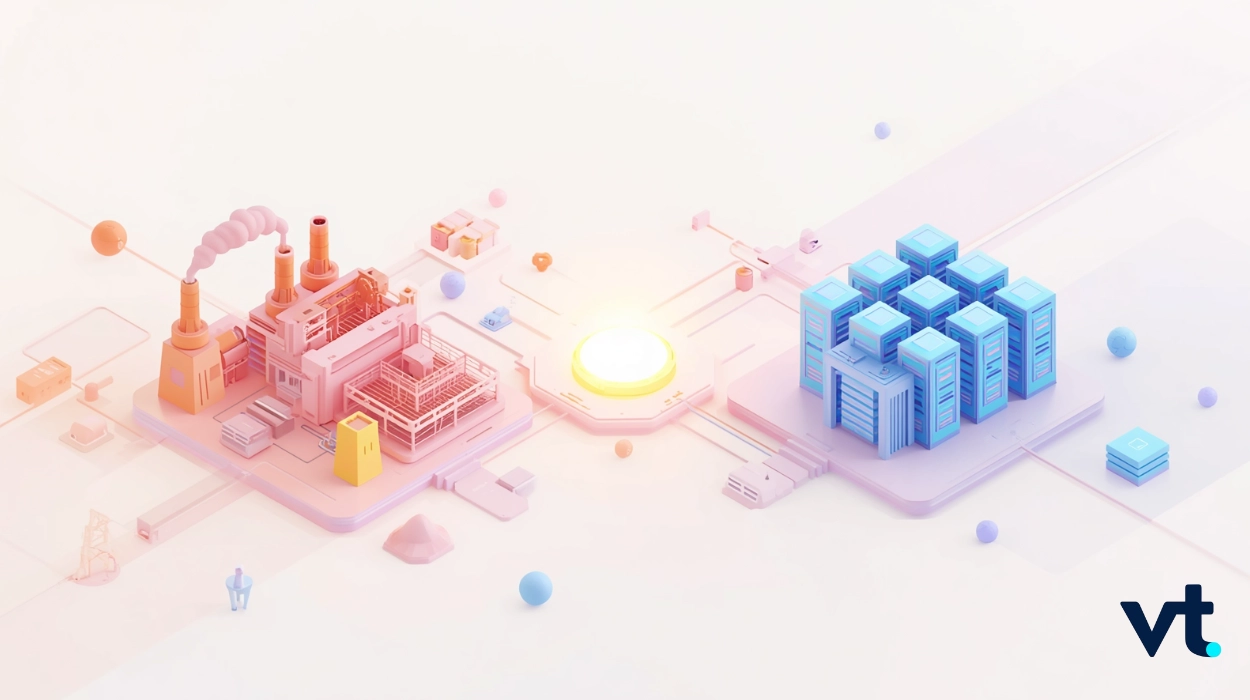
The dynamic is starting to change. Bitcoin is still central to these companies, but some miners are now exploring whether their most valuable asset is not the coins they produce but the power infrastructure behind them.
Mining still pays. Something else pays more
Hashprice, what a miner earns per unit of computing power, has been squeezed since the halving. Network hashrate keeps climbing, so each machine earns a smaller slice, and the reward per block is half what it used to be. A miner can run a well-managed fleet on cheap power and still find the margin thinner than it was two years ago.
Meanwhile, AI companies turned up looking for electricity, and they pay differently. Mining earns you a few hundred thousand dollars per megawatt a year at best, priced by the market, changing daily, falling over time. Renting that same megawatt to an AI tenant can earn a million or more a year, fixed by contract, for ten years or longer.
That is not a narrative pivot. It is arithmetic. If you own power and someone offers you triple for it on a decade-long contract, you take the meeting.
Why power became the scarce asset
Here is where it gets less simple, and where a lot of announcements oversell what is happening.
A mining site is a shed. The machines inside tolerate patchy power, no backup, dust, and 45 degrees of heat, and they can be switched off in seconds when the grid needs the power back. That is exactly why miners got cheap electricity in the first place. They took the power nobody else wanted.
AI computing cannot live like that. It needs steady power with proper backup, because a training run that loses electricity loses days of work. It needs liquid cooling. Customers want uptime promises with money behind them.
So the shed is nearly worthless for this. What is valuable is the connection to the grid: the substation, the cables, and the spot in the queue to get hooked up in the first place. In most places that queue runs for years. Owning a site that is already connected and already drawing serious power is the genuinely scarce thing, and it cannot be conjured up quickly.
Which means converting a mining site is closer to knocking it down and building something new. Roughly ten times the cost per megawatt of the original shed. That is why the pivot is real, and also why it takes years rather than quarters.
Strip off the “bitcoin miner” labels, and there are three different businesses here.
- The landlord. You build the shell, supply the power, and the tenant brings their own computers. You collect rent for ten to fifteen years. Less money per megawatt than the alternative, but contracted and dull in a good way. This is a property business, and it should be valued like one.
- The operator. You buy the computers yourself and sell computing time by the hour. Much more revenue per megawatt, and much more risk. You own expensive chips that lose value fast, and you have to keep them busy.
- Still a miner. You make your money from bitcoin. The AI business is a plan, a site study, or a first small contract. What you are really selling shareholders is the chance of becoming one of the first two.
Bitcoin miners are no longer one trade.
The term “Bitcoin miner” now covers very different business models. Some companies are still primarily leveraged bitcoin plays, while others are using their power assets to pursue AI infrastructure opportunities. Each model carries a different growth profile, capital requirement and valuation framework.
| Company | What investors are buying | Evidence | What needs to happen next |
| IREN | AI infrastructure transition | Expanding GPU capacity and AI cloud ambitions | AI revenue needs to become meaningful |
| Riot | Power assets and future data-centre potential | Large-scale sites and grid connections | Convert infrastructure advantage into contracted revenue |
| MARA | Bitcoin exposure with AI optionality | Large BTC holdings and mining scale | Prove AI partnerships can generate returns |
| CleanSpark | Efficient bitcoin mining | Strong operational execution and low-cost power strategy | Show how existing assets fit into AI demand |
CleanSpark
CLSK has been one of the more disciplined bitcoin miners, but its AI strategy is becoming more than just an idea. The company has been expanding its power and land portfolio, positioning its existing infrastructure for AI and high-performance computing applications. It has highlighted progress across site development, leasing and power expansion, including additional ERCOT-approved capacity and AI/HPC-ready assets.
The company’s advantage is similar to other miners entering infrastructure: access to power and sites that would take new data-centre developers years to secure. CleanSpark has also moved toward commercialising these assets, including a long-term data-centre lease announcement at its Sandersville site.
The challenge is timing. Unlike a pure mining operation, AI infrastructure requires large upfront investment before revenue scales. CleanSpark still needs to prove that its power portfolio can generate contracted AI/HPC revenue at a level that changes how the market values the company.
Iris Energy Limited
IREN has moved farthest towards the AI transition, with the company expanding beyond bitcoin mining into AI cloud infrastructure. It has invested in GPU capacity and signed multi-year AI infrastructure agreements, including a reported partnership with Microsoft-linked cloud demand through its data-centre expansion plans. The company has also increased its AI infrastructure targets, with plans to scale its GPU fleet significantly over the coming years.
The transition has a trade-off: shifting capacity away from bitcoin mining can pressure near-term mining revenue before AI-related income fully replaces it.
Riot Platforms
RIOT has the strongest infrastructure case. The company operates large-scale sites in Texas, including Rockdale and Corsicana, with significant power capacity that can potentially be repurposed for AI and high-performance computing. Riot now owns and manages 1.7 GW of approved power capacity across its Texas facilities, including a 700 MW grid connection at Rockdale.
The company also secured its first major data centre customer through a lease with AMD. The agreement covers an initial 25 MW deployment, with a 10-year term and expected contract revenue of around $311 million. AMD also holds options that could expand the arrangement to 200 MW of critical IT load capacity.
That deal strengthens Riot’s infrastructure argument, but the larger opportunity depends on whether it can convert more of its power portfolio into long-term AI and HPC contracts. One lease proves demand exists. Scaling the model across its available capacity is what would change how the market values the company.
MARA holdings
MARA remains the most complicated case because it combines three businesses: a bitcoin miner, a large bitcoin holder and a company exploring infrastructure opportunities beyond mining.
The company has built one of the largest bitcoin treasuries among public miners, with its BTC holdings becoming a meaningful part of the investment case alongside mining operations. However, a large bitcoin position does not automatically create shareholder value. The balance sheet can move significantly with bitcoin prices, while capital raised for expansion and infrastructure investment also affects financial flexibility.
MARA has also explored AI and high-performance computing opportunities, but the transition remains less developed than companies already building dedicated AI infrastructure. The market will need evidence that these investments can generate contracted revenue rather than simply adding another potential growth avenue.
Bitcoin is competing with AI for power
The AI transition also matters if you look at Bitcoin movements rather than the stock value.
Every megawatt moved away from mining reduces the computing power supporting the network. If enough miners redirect capacity, hashrate growth could slow, and remaining miners may benefit from a lower competitive environment.
However, this is not an immediate change.
Bitcoin’s security has always rested on the assumption that mining is the most profitable use of cheap electricity. AI is now bidding against it, with deeper pockets and longer contracts. Nothing breaks tomorrow. But if the most competent operators of cheap power decide their best customer is not Bitcoin, that is worth noticing.
The Bitcoin Correlation Test
One way to judge the transition is to look at how closely mining stocks continue to follow bitcoin.
A strong relationship suggests investors are still treating the company mainly as a crypto proxy. A weaker relationship may suggest another factor is driving valuation, such as AI expectations, infrastructure assets or company-specific developments.
Correlation alone cannot prove a business transition. Share issuance, broader risk sentiment and bitcoin volatility can all affect the relationship. The stronger evidence remains simple:
- signed contracts
- named customers
- disclosed investment plans
- revenue appearing in financial results
These four companies may still carry the same label, but they are no longer identical businesses. Some are becoming power infrastructure plays. Some are building AI computing businesses. Others remain primarily bitcoin miners with future ambitions.
- Announced capacity versus contracted capacity – Megawatts under contract is a real number. Megawatts under discussion is not. When a company as large as Google has to stand behind an AI tenant’s lease, as it did at TeraWulf and Cipher, that tells you the tenant’s own credit was not enough on its own.
- How the transition is funded – Heavy dilution or expensive debt tells you what lenders think of the risk long before results do.
- Whether bitcoin correlation changes – A miner moving into AI may eventually trade differently from the coin, but crypto sentiment will likely remain part of the share price for some time. Read alongside the other two rather than on its own.
For investors, the decision is no longer only about whether bitcoin rises. It is about identifying which business model sits underneath the ticker.
Track how bitcoin mining stocks respond as the industry shifts towards AI infrastructure. Download the VT Markets app to monitor real-time CFD price movements on RIOT, MARA, CLSK, IREN and other global companies.
Tap for Trader FAQ
Why are bitcoin mining stocks becoming linked to AI infrastructure?
Bitcoin miners already control large-scale power assets and grid connections. As AI data centres compete for electricity, some miners are exploring higher-value uses for their infrastructure.
Are bitcoin miners still mainly a bet on bitcoin prices?
Not all of them. Some companies remain closely tied to bitcoin mining economics, while others are shifting towards AI computing or data-centre infrastructure.
Why is electricity becoming the focus for bitcoin miners?
Power access and grid connections are becoming scarce assets for AI development. Existing mining sites can offer a starting point, although converting them into AI facilities requires significant investment.
What should investors watch in bitcoin mining stocks?
The focus is shifting from mining output alone to evidence of AI monetisation, including signed contracts, customer commitments, infrastructure development and revenue growth.









