





Key Takeaways
- Cryptocurrency has developed from a niche technology into a recognised digital asset class, supported by exchanges, payment platforms, and growing institutional participation.
- Bitcoin and Ethereum remain the two largest and most established cryptocurrencies by market capitalisation, liquidity, and adoption.
- Solana, XRP, and BNB have each built a significant position by focusing on specific strengths, from blockchain scalability to cross-border payments to exchange ecosystem growth.
- Cryptocurrency remains a highly volatile asset class, with prices often influenced by market sentiment, regulation, technological developments, and broader economic conditions.
- A diversified, research-driven approach is generally more resilient than concentrating exposure in a single coin.
With thousands of cryptocurrencies available today, identifying established assets with strong adoption, utility, and market presence can be challenging.
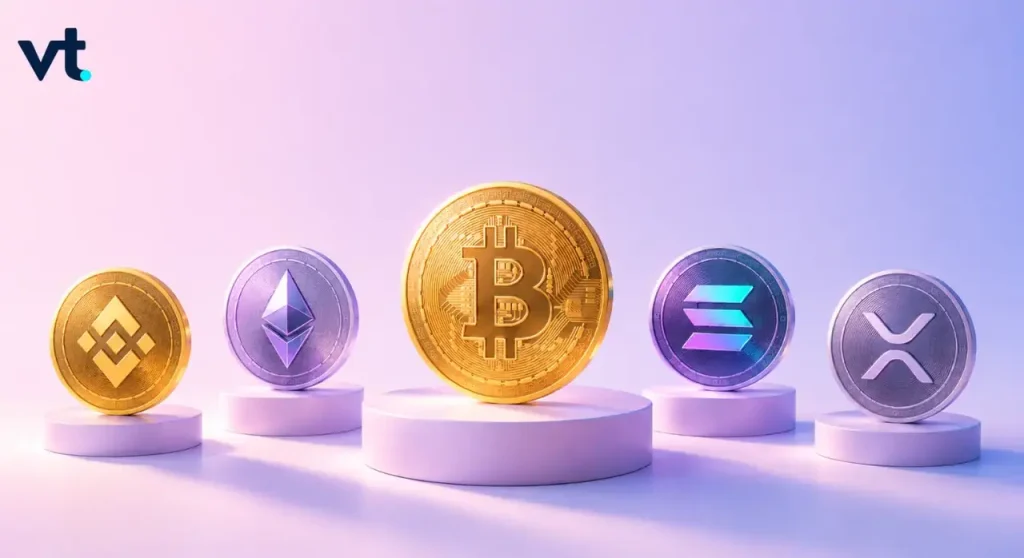
Bitcoin remains the dominant reference point for the sector, while other assets, including Ethereum, Solana, XRP, and BNB, have each developed their own role within the broader cryptocurrency ecosystem.
This guide examines five of the most recognised cryptocurrencies in 2026, their core strengths, and the risks investors should consider before gaining exposure.
What Is Cryptocurrency?
Cryptocurrency is a form of digital asset secured by cryptography and recorded using blockchain technology. Unlike traditional currencies issued by central banks, cryptocurrencies operate through decentralised networks of computers that verify and record transactions independently of any single institution.
A blockchain functions as a shared digital ledger, allowing transactions to be stored transparently and permanently without requiring a central authority. This structure enables users to transfer value directly across a network while maintaining a clear, tamper-resistant record of ownership and transaction history.
Decentralisation, however, introduces its own challenges. Users are responsible for safeguarding their own assets, and transactions are generally irreversible once confirmed on the blockchain.
5 Best Cryptocurrencies to Buy Now in 2026
The five cryptocurrencies below represent some of the most established and widely held assets in the market today, each occupying a distinct role within the broader ecosystem.
1. Bitcoin (BTC)
Bitcoin is the original cryptocurrency, introduced in 2009 as a peer-to-peer alternative to traditional money. It runs on a proof-of-work network with a fixed supply of 21 million coins, which has shaped its reputation as digital gold rather than an everyday payments tool. That scarcity continues to attract interest from individuals, companies, and institutions looking for a long-term store of value.
Key Strengths
- Largest market capitalisation and deepest liquidity of any cryptocurrency
- Fixed supply cap of 21 million coins limits long-term dilution
- Growing institutional adoption through custody services and exchange-traded products
Market Snapshot
| Metric | Value |
| Market Cap | $1.283T |
| Fully Diluted Valuation | $1.34T |
| 24h Volume | $21.35B |
| Vol/Market Cap (24h) | 1.66% |
| All-Time High | $126,198.07 |
| All-Time Low | $171.51 |
| Start Date | 13 July 2010 |
2. Ethereum (ETH)
Ethereum introduced smart contracts, self-executing code that lets developers build applications directly on the network, turning it into a platform rather than just a currency.
That shift gave rise to decentralised finance, NFT marketplaces, and thousands of tokens built on its infrastructure. Since moving to proof-of-stake in 2022, it has focused on scaling solutions that lower fees while making it one of the most widely used platforms for blockchain development.
Key Strengths
- Largest developer ecosystem and share of decentralised application activity
- Proof-of-stake model that reduces energy costs relative to earlier mining-based networks
- Ongoing protocol upgrades aimed at improving scalability and lowering transaction fees
Market Snapshot
| Metric | Value |
| Market Cap | $224.187B |
| Fully Diluted Valuation | $224.58B |
| 24h Volume | $9.07B |
| Vol/Market Cap (24h) | 4.04% |
| All-Time High | $4,953.73 |
| All-Time Low | $82.83 |
| Start Date | 7 August 2015 |
3. Solana (SOL)
Solana was built to solve the throughput problems that have made Ethereum slow and expensive during busy periods, processing a high volume of transactions per second at a fraction of the cost. That speed has made it a natural fit for gaming, NFTs, and high-frequency decentralised exchanges, though its history of network outages is worth weighing against those advantages.
Key Strengths
- Significantly faster transaction speeds and lower fees than many competing networks
- Growing adoption in gaming, NFTs, and high-frequency decentralised exchanges
- Continued network reliability improvements following earlier outages
Market Snapshot
| Metric | Value |
| Market Cap | $44.228B |
| Fully Diluted Valuation | $48.01B |
| 24h Volume | $1.57B |
| Vol/Market Cap (24h) | 3.54% |
| Total Supply | 630.61M |
| All-Time High | $294.33 |
| All-Time Low | $0.51 |
| Start Date | 10 April 2020 |
4. XRP
XRP was built to solve a specific problem in traditional finance: the slow, expensive process of settling payments across borders.
Its network confirms transactions within seconds at a fraction of the cost of correspondent banking, and Ripple, the company behind it, has spent years building relationships with financial institutions exploring this use case. A long-running legal battle with the SEC once created uncertainty around the asset, while the outcome has provided greater regulatory clarity and influenced investor sentiment around XRP.
Key Strengths
- Purpose-built for fast, low-cost cross-border settlement
- Long-standing relationships with financial institutions exploring blockchain-based payments
- Greater regulatory clarity following the resolution of its multi-year legal proceeding with the SEC
Market Snapshot
| Metric | Value |
| Market Cap | $67.92B |
| Fully Diluted Valuation | $108.78B |
| 24h Volume | $816.93M |
| Vol/Market Cap (24h) | 1.20% |
| Total Supply | 99.99B |
| All-Time High | $3.84 |
| All-Time Low | $0.12 |
| Start Date | 4 August 2013 |
5. BNB
BNB launched as a utility token offering discounted trading fees on Binance, one of the world’s largest exchanges, and has since become the native asset of its own blockchain, BNB Chain. Binance periodically burns a portion of BNB’s supply to support its value over time, though the asset’s performance remains closely tied to the wider Binance ecosystem.
Key Strengths
- Strong ecosystem connection through BNB Chain and Binance’s wider platform
- Native asset of an active blockchain ecosystem supporting a wide range of applications
- Ongoing token burns designed to reduce circulating supply over time
Market Snapshot
| Metric | Value |
| Market Cap | $75.2B |
| Fully Diluted Valuation | $75.22B |
| 24h Volume | $907.62M |
| Vol/Market Cap (24h) | 1.21% |
| All-Time High | $1,370.55 |
| All-Time Low | $1.46 |
| Start Date | 25 July 2017 |
Cryptocurrency vs Traditional Assets
Cryptocurrency differs from traditional financial assets in several important ways, from how it trades to how it is regulated and held. The comparison below outlines the main distinctions worth understanding before allocating to the asset class.
| Feature | Cryptocurrency | Stocks / ETFs |
| Trading hours | Continuous, 24 hours a day, 7 days a week | Limited to exchange trading hours |
| Regulatory framework | Still developing in most jurisdictions | Well established |
| Custody | Can be self-held or held on an exchange | Held through a regulated broker or custodian |
| Volatility | Substantially higher on average | Generally lower, particularly for diversified funds |
| Investor protection | Limited or absent in most jurisdictions | Often covered by formal investor protection schemes |
Factors to Consider Before Investing in Cryptocurrency
Interest in cryptocurrency has grown for a range of reasons, from blockchain innovation to round-the-clock market access, but popularity or recent price performance alone does not determine an asset’s long-term potential. The factors below are worth reviewing before allocating to any digital asset.
| What to Watch | What It Means | Why It Matters |
| Liquidity and trading volume | How easily the asset can be bought or sold without materially moving its price | Determines execution risk, particularly during volatile periods |
| Supply structure | How much of the total supply is already in circulation versus scheduled for future release | Future token releases can increase available supply and create selling pressure |
| Security track record | History of network exploits, exchange breaches, or extended downtime | Signals how resilient the asset has proven under stress |
| Regulatory exposure | Whether the asset has faced, or could face, direct regulatory action | Legal rulings can materially reshape both price and market perception |
| Underlying use case and adoption | Whether real usage and transaction activity support the current valuation | Distinguishes durable projects from those driven mainly by speculation |
| Development activity | Whether the protocol is actively maintained and upgraded | Ongoing development is a reasonable proxy for long-term viability |
A Portfolio Approach to Crypto Investing
Given the volatility involved, most of the coins above are better approached as part of a broader allocation rather than a single concentrated bet. A structured approach helps manage downside risk while preserving exposure to the sector’s upside.
Sample Portfolio Structure
| Portfolio Bucket | Allocation | Description |
| Core Holdings | 50% | Bitcoin and Ethereum, the most liquid and established assets in the space |
| Growth and Utility Assets | 25% | Coins tied to active ecosystems, such as Solana or BNB |
| Niche or Payments Exposure | 15% | Assets built around a specific use case, such as XRP |
| Stablecoin or Cash Reserve | 10% | Held aside to respond to volatility or take advantage of new opportunities |
More conservative investors may weight this further toward core holdings, while those comfortable with higher risk might shift allocation toward growth and speculative names.
Either way, the reserve allocation is what allows a portfolio to respond to opportunities rather than being fully committed at any given time.
How to Trade Cryptocurrency CFDs with VT Markets
Cryptocurrency exposure can be gained in different ways. While some investors choose to buy and hold digital assets directly, others use derivatives such as Contracts for Difference (CFDs) to speculate on cryptocurrency price movements without owning the underlying asset.
VT Markets provides access to selected cryptocurrency markets through CFDs, supported by trading tools and educational resources designed to help traders analyse market conditions and manage risk. The steps below outline how to approach cryptocurrency CFD trading.
1. Register and verify your account
Open an account with VT Markets and complete the verification process.
2. Select a cryptocurrency asset
Choose from available cryptocurrency CFDs, including assets such as Bitcoin and Ethereum, based on your own analysis of market conditions, price trends, and risk factors.
3. Plan your position size and risk management
Determine the amount of capital to allocate to each trade and consider factors such as volatility, leverage, and potential losses before opening a position.
4. Monitor market drivers
Cryptocurrency prices can be influenced by factors such as regulatory developments, network upgrades, market sentiment, and broader economic conditions. Monitoring these drivers can provide greater context behind price movements.
5. Review your trading activity regularly
Evaluate open positions and past trades periodically to understand performance and adjust your approach rather than reacting solely to short-term price movements.
New to crypto trading? Read our guide on How to Trade Crypto for Beginners to understand better about cryptocurrencies, common trading approaches, and key risks to consider before opening a position.
Common Mistakes to Avoid
Even experienced investors can fall into avoidable patterns when trading a market this volatile. The mistakes below are among the most common, and the most costly.
Buying based on recent momentum
Assets that have posted the largest short-term gains are not reliably the best performers going forward, and purchasing purely on momentum is one of the most common sources of losses in this market.
Neglecting basic security practices
Weak or reused passwords and disabled two-factor authentication have resulted in the complete loss of holdings for many investors.
Overconcentration in a single asset
Allocating an entire position to one coin, regardless of conviction, meaningfully increases portfolio risk relative to a diversified approach.
Overlooking tax obligations
Selling, exchanging, or spending cryptocurrency can trigger tax liabilities in many jurisdictions, and failing to plan for this in advance creates avoidable complications.
Explore Crypto Trading Opportunities
Open a live account with VT Markets today and gain access to cryptocurrency CFDs, including major digital assets, alongside global markets such as forex, indices, and commodities from one platform.
Frequently Asked Questions
How do I start trading crypto with VT Markets?
Register for an account, complete verification, and deposit funds. From there, you can choose a cryptocurrency based on your own research and decide how much of your portfolio to allocate before opening a position.
Is it too late to invest in Bitcoin or Ethereum?
There’s no reliable way to know that in advance. What’s clear is that both remain the most liquid, established assets in the space, which is a separate question from whether either still has room to grow.
How much of a portfolio should go into cryptocurrency?
There’s no fixed answer, since it depends on individual risk tolerance and financial goals. Many investors treat it as a smaller slice within a diversified portfolio rather than a core holding, but this is a personal decision rather than a rule.
Should I hold my own crypto, or leave it on an exchange?
Keeping smaller amounts on a reputable exchange is common and convenient. For larger holdings, many investors move funds to a personal wallet for added control over custody, though this comes with the added responsibility of securing it yourself.
Why are crypto prices more volatile than stocks?
Even the largest cryptocurrencies trade with less market depth than major equities, so news, regulatory developments, or shifts in sentiment tend to move prices faster and further.
Which of these five carries the least risk?
Bitcoin and Ethereum have the longest track records and the deepest liquidity, which generally puts them at the lower end of the risk spectrum here. That said, none of the five are low-risk in an absolute sense, and volatility remains a feature of the asset class as a whole.








