







Key Points
- The US Labour Department has proposed a rule that would give 401(k) fiduciaries a process-based path to consider alternative assets, including crypto, rather than steering them away from specific asset classes.
- BTCUSD trades near 67,504.63, up +865.24 (+1.30%), after failing to hold moves above $68,000 earlier in the week.
- The proposal focuses on prudence, fees, liquidity, valuation methods, benchmarks, and complexity, which could support long-term institutional access without guaranteeing immediate inflows.
Although the Bitcoin market remains cautious in the near term, the policy environment has just changed in a significant way in the long run.
The US Department of Labour, through the Employee Benefits Security Administration, has proposed a regulation that would set out the steps 401(k) plan managers should take when considering alternative assets in plan menus.
The proposal also creates process-based safe harbours for fiduciaries selecting designated investment alternatives.
In simple terms, it does not tell fiduciaries to buy crypto, but it does give them a clearer route to consider it without the same level of regulatory ambiguity that weighed on the market before.
That is a meaningful shift from the department’s 2022 guidance, which urged “extreme care” around adding crypto to 401(k) plans. The department formally rescinded that 2022 guidance in May 2025, saying it had departed from ERISA’s historically neutral, principles-based approach.
This does not create an instant demand shock for Bitcoin, but it does improve the long-term policy narrative. If the rule moves forward in something close to its current form, it could gradually lower one of the institutional barriers that have limited retirement-plan adoption.
What the Rule Actually Does
The proposal is process-driven, not promotional. The Labour Department says fiduciaries would need to evaluate potential alternatives using factors such as expected performance, fees, liquidity, valuation methods, appropriate performance benchmarks, and complexity. The department also stresses that the rule is asset-class neutral.
That distinction matters for Bitcoin. It means crypto would be assessed alongside other alternatives under a prudent framework rather than singled out for unusual treatment. It also means fiduciaries still carry real responsibility. They would need to justify how any crypto-related option fits participant needs, risk controls, cost structure, and operational oversight.
For the Bitcoin market, that is more constructive than a blanket warning, but it is still far from a green light for reckless inclusion.
Larger plans and better-resourced fiduciaries may be more willing to study crypto exposure first, while smaller plans may still wait due to governance, operational, and reputational concerns.
Why This Matters for Bitcoin Even Without Immediate Buying
Bitcoin often reacts hardest to ETF flows, macro liquidity, and Fed expectations in the short term. Retirement-plan policy works differently. It changes the addressable market slowly.
A formal framework for 401(k) fiduciaries could matter because retirement assets sit in one of the deepest pools of long-duration capital in the United States. Even a small future allocation rate would change how investors think about Bitcoin’s structural demand profile.
At the same time, the market is unlikely to price all of that in at once. Fiduciaries move slowly. Committees move slowly. Consultants move slowly. Recordkeepers and plan providers move slowly. That is why this news can be strategically important without being immediately explosive for the price.
The proposal can support the “institutional maturation” story for Bitcoin over time, but traders will still need a cleaner macro backdrop before they price in a stronger, sustained move.
Technical Analysis
Bitcoin (BTCUSD) is trading near 67,500, attempting to stabilise after a sharp decline from the 97,900 high and a subsequent low around 60,000. Price action shows the market trying to base within a broad range, but upside momentum remains limited, with the pair struggling to reclaim higher ground.
From a technical standpoint, the trend is currently neutral to slightly bearish. Price is trading around the short-term moving averages, with the 5-day (67,151) and 10-day (68,635) clustered near current levels, offering little directional clarity. The 20-day (70,072) and 30-day (69,701) remain above price and are starting to flatten or slope lower, indicating that the broader trend has weakened following the earlier breakdown.
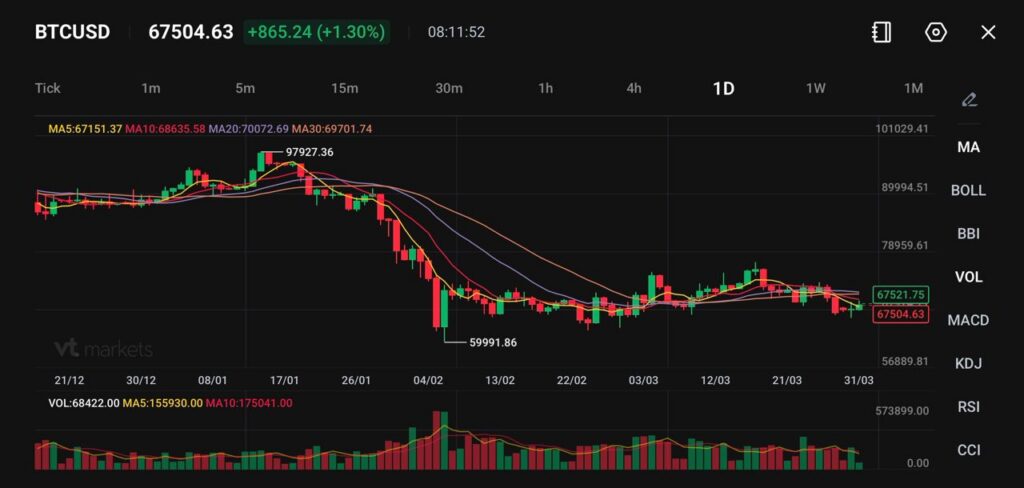
Key levels to watch:
- Support: 65,000 → 60,000 → 58,000
- Resistance: 68,600 → 70,000 → 72,000
Price is currently consolidating within the 65,000–70,000 range, with repeated rejections near the 68,600–70,000 zone capping upside attempts. A sustained break above 70,000 would be needed to shift momentum back toward the upside, potentially opening a move toward 72,000 and beyond.
On the downside, 65,000 is acting as immediate support. A break below this level could expose the 60,000 region, with further downside risk toward 58,000 if selling pressure accelerates.
Cautious Outlook
Overall, Bitcoin remains in a consolidation phase following its earlier correction, with price lacking strong directional conviction.
While the broader structure is not decisively bearish, the inability to reclaim higher resistance levels suggests that momentum remains fragile, and traders should watch for a breakout from the current range to guide the next move.
Create a live VT Markets account today to access our platform features, including market insights and educational content.
Trader Questions
What is the New 401(K) Crypto Proposal?
The proposal introduces a framework allowing retirement plans to consider alternative assets like Bitcoin (BTCUSD) under strict evaluation rules.
Does the Rule Allow Direct Investment in Bitcoin?
Yes, but indirectly. Plan fiduciaries can include crypto as an option if they follow a prudent, process-driven assessment.
What Are Safe-Harbour Rules in This Context?
Safe-harbour rules provide legal protection to plan managers who follow defined steps when evaluating and offering crypto investments.
What Must Fiduciaries Assess Before Adding Crypto?
They must review performance expectations, fees, liquidity, valuation methods, benchmarks, and the complexity of the asset.
Why Was Crypto Previously Limited in 401(K) Plans?
Earlier guidance discouraged crypto exposure due to regulatory uncertainty and fiduciary risk concerns.
How Does This Proposal Change the Landscape?
It shifts the focus from restricting asset classes to ensuring a disciplined evaluation process, giving fiduciaries more flexibility.
How Might This Impact Bitcoin Prices?
Greater institutional access through retirement funds could support long-term demand, though short-term moves still depend on macro factors.
Start trading now – Click here to create your real VT Markets account








