






For the past few years, the AI boom has grown through every layer of the stack. Chipmakers shipped more silicon than ever, cloud providers raced to add capacity, and data centres went up as fast as power grids allowed. Each new generation of models needed more compute than the last, and each round of spending went bigger than the one before.
Somewhere along the way, the spending outpaced the cash behind it. This week, the industry turned to the debt markets to close the gap.
Tap for Trader’s Takeaway
- AI chip spending is shifting from being paid for by Big Tech’s cash flow to being financed through private credit, special-purpose vehicles and leases.
- Broadcom’s role is changing from supplier to partial guarantor, and credit markets are already pricing that in.
- The upside for chip demand is real. However, the debt usually runs longer than the chips stay competitive, and that gap is where the risk sits.
Reported in Wall Street Journal, Broadcom wants more than $50 billion to fund the custom chips it is building with OpenAI. Oracle (ORCL) is talking to Apollo and Goldman Sachs about paying for chips in a new data centre, and SpaceX (SPCX), now home to xAI, has discussed borrowing about $40 billion for Nvidia GPUs.
A growing share of AI chips is now being bought with credit rather than cash, and that credit comes from lenders the market has rarely had to watch in a tech story.
| Deal | Reported size | Hardware | Lenders in talks | Status |
| Broadcom / OpenAI | $50bn+ | Broadcom custom accelerators | Apollo, Blackstone | Early stage, targeted to close by year-end |
| SpaceX | ~$40bn ($30bn bonds, $10bn loans) | Nvidia GPUs | Apollo (lead), PIMCO | In talks |
| Oracle | Not disclosed | Chips for a 1GW data centre | Apollo, Goldman Sachs | In talks, likely through a lease vehicle |
When AI spending outgrew big tech’s cash
Microsoft, Alphabet and Meta spent the early years of the AI boom paying for servers out of operating cash flow. They had little need to rely heavily on bond markets. As infrastructure spending accelerated, however, the numbers became harder to cover immediately
The five largest hyperscalers issued around $121 billion of US corporate bonds in 2025. That was more than four times their average over the previous five years, and issuance has continued to rise in 2026. Technology now accounts for about 10% of the Bloomberg US Corporate Index.
Oracle shows what happens when a company without that cash base tries to keep up. It borrowed heavily and now carries $169.1 billion of debt against $67.2 billion of equity. Next to its larger rivals, the gap is wide.
| Company | Debt-to-capital | Bonds yielding above 7.5% |
| Oracle | 71.60% | Yes |
| Microsoft | 22.60% | No |
| Alphabet | 15.50% | No |
SpaceX is the only other large AI spender with bonds in that high-yield group.
So Oracle is trying a different route. Instead of buying the chips itself, it would lease them from a special-purpose vehicle, a separate company set up only to own the chips. Lenders fund the vehicle, Oracle’s lease payments repay them, and the borrowing stays off Oracle’s balance sheet. UBS has described this model in its work on AI credit markets, and it is quickly becoming the industry’s default workaround.
Broadcom is no longer just selling chips
The new structures raise the ceiling on how many chips the industry can buy. They also move risk to the companies that make the chips and the lenders that fund them. That trade-off sits at the centre of the AI financing story.
Broadcom is where this is easiest to see. Each deal it has helped arrange for its customers has been bigger than the last, and each one moves it further onto the lending side of the table.
- June: $35 billion for Anthropic, with Broadcom as a platform partner alongside Apollo and Blackstone.
- August: more than $60 billion, swelling to as much as $100 billion, with Broadcom central to the funding agreement
- October: more than $50 billion for OpenAI, with Broadcom arranging the financing itself. Guarantee terms have not been reported yet.
A supplier that arranges its customers’ loans eventually stops being just a supplier. Broadcom is now underwriting demand for its own chips. That locks in orders. It also leaves Broadcom exposed if AI labs fail to earn enough to repay their loans. Credit markets have noticed. It’s bond yields and credit default swaps have climbed as the guarantees grow.
Wall Street still sees more runway
Equity analysts have stayed largely positive on chipmakers, even as credit markets grow more cautious. Goldman Sachs kept its Buy rating on Broadcom in September, expecting AI labs and hyperscalers to keep raising infrastructure spending.
Their case starts with who is buying. The fastest-growing AI customers are labs, and labs spend far more than they earn. Financing lets them sign multi-year commitments they could never pay for upfront, which gives suppliers years of visibility instead of quarter-to-quarter orders. OpenAI’s 10-gigawatt custom chip plan with Broadcom runs from the second half of 2026 through 2029. Commitments on that scale make Broadcom’s forecast of more than $100 billion in AI chip sales next year, set out by its chief executive in March, easier to trust.
The other half of the case is room to borrow. Oracle is the exception, not the rule, and most of the largest spenders still carry modest debt. J.P. Morgan Asset Management estimates the hyperscalers could add about $1.5 trillion of debt before their lease-adjusted leverage reaches the average for US investment-grade industrial companies.
These deals feed straight into the order books of two chipmakers. Traders tracking that demand can follow both through Broadcom (AVGO) and NVIDIA (NVIDIA) on VT Markets.
Who is actually funding the AI Boom?
Behind the borrowers, the same lender emerges. Apollo is in talks with Broadcom alongside Blackstone, with Oracle alongside Goldman Sachs, and is expected to lead the SpaceX package, with PIMCO also involved. (BigGo Finance) Private credit firms have become part of the machinery behind the AI build-out, as much as the chipmakers themselves.
Trace the money and the chain looks like this:
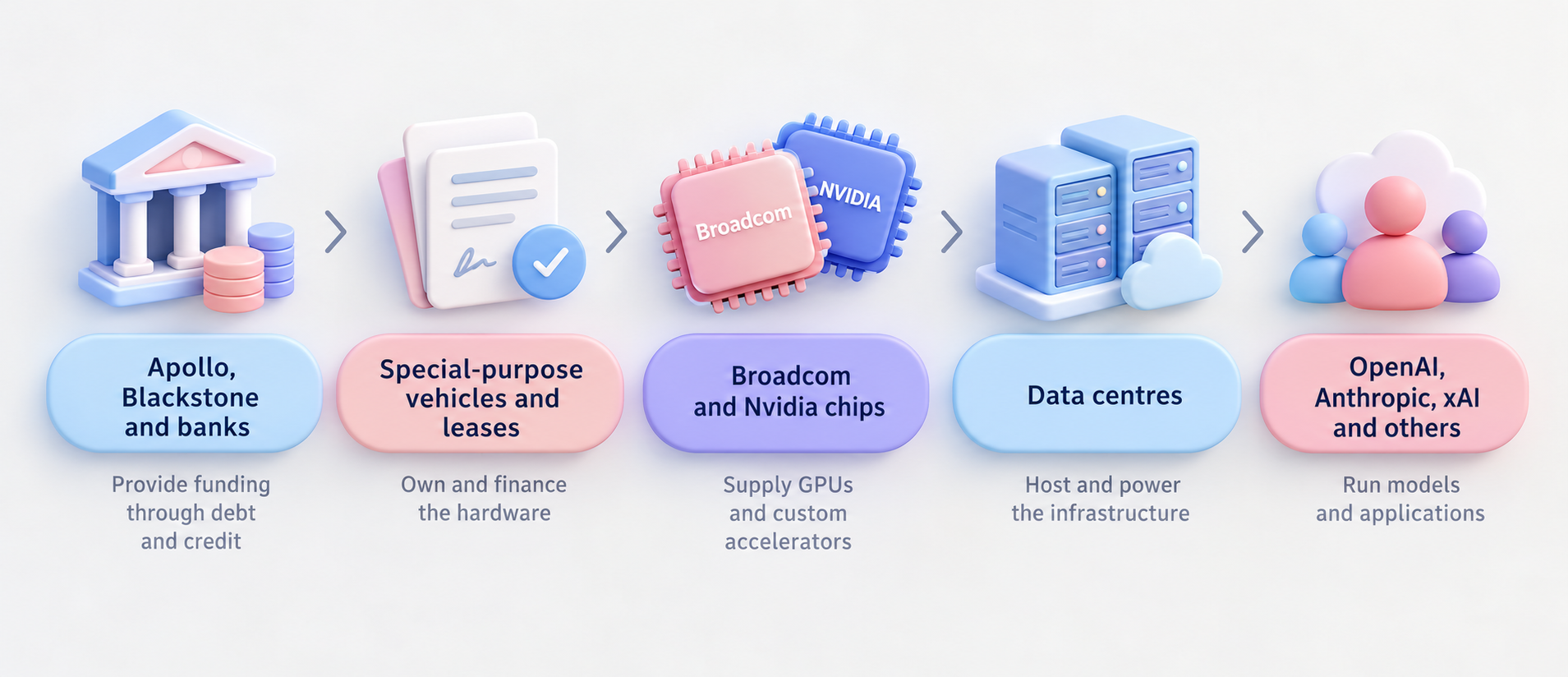
Capital moves down the chain, while repayment obligations move back up it.
The lenders at the top often manage money on behalf of institutional investors, including pension funds and insurers. If projects fail to generate enough cash to meet their obligations, losses could therefore reach investors well beyond the technology sector.
The scale is starting to show in bond markets. AI-related borrowing in US leveraged finance rose from about $20 billion in early 2025 to $88 billion in 2026. More supply means buyers want higher yields, and higher yields raise borrowing costs for companies that have nothing to do with AI. That is why this week’s reports hit more than chip stocks.
On October 8, Reuters said strains in sovereign bond markets were made worse by tech companies competing for the same limited pool of funding, and credit default insurance on SpaceX jumped to record highs.
The chips have to pay for themselves
A chip bought with borrowed money needs to generate enough income to cover more than the loan. There is interest to pay, electricity to buy and data centre space to maintain. The hardware itself is also losing value.
That last part matters because Nvidia now introduces a new chip generation roughly every year. Hardware bought in 2026 could be two generations behind by the time its financing matures. Older GPUs may then command lower rental prices.
Lenders call this residual-value risk.
The hardware securing a loan may lose value faster than expected while payments are still outstanding. This can happen even if overall AI demand remains strong. What matters to the lender is not simply how much AI the world uses, but how much income a particular piece of hardware can still generate.
If that happens, Broadcom is one of the companies left paying. By guaranteeing part of its customers’ loans, it has promised to cover some of the debt if they cannot pay. That costs nothing while customers keep paying. If an AI lab struggles, though, Broadcom gets hit twice: it loses the lab’s chip orders and has to cover part of its loan. Analysts have flagged that these guarantees could become expensive if AI spending slows.
And the cost may not stop with Broadcom. Nvidia owns a large stake in SpaceX, and SpaceX is borrowing to buy Nvidia chips. With the same few lenders behind every deal as well, a problem at one company is more likely to spread to the others.
Where the first cracks could appear
For a while, the biggest companies could absorb much of that spending themselves. Strong cash flows helped fund new servers and infrastructure for the AI story.
But the scale of the build-out is changing that.
As projects grow larger and more expensive, companies are increasingly looking beyond their own balance sheets to fund them. Debt, private credit and leasing structures are becoming part of the machinery behind AI expansion.
The credit line keeps the AI boom funded, and in the near term that supports chip demand.
None of the deals has closed yet, though, and the Broadcom talks are early enough that the size could still change. What still needs proving is whether the compute earns its keep before it ages out, and how much of that risk the suppliers end up holding. Five signals will start to answer both.
- The Broadcom and OpenAI deal – Whether it closes before year-end, at what size and with how much of the debt guaranteed will show how much risk Broadcom is willing to carry.
- Credit default swaps on Broadcom, Oracle and SpaceX – These move faster than earnings, so they are the quickest read on whether lenders think the risk is growing.
- Broadcom’s next quarterly results – Usually due in December, they give management its first chance to explain the guarantees and what they could cost.
- Investment-grade spreads and US Treasury yields. If AI borrowing keeps crowding the bond market, it will show up here as higher borrowing costs for everyone.
- Rental prices for older GPUs. Falling rents would be the earliest sign that chips are losing value faster than their loans are being repaid.
Financing news often arrives outside regular US market hours. Traders following these developments can access CFD Shares on VT Markets through regular, 24/5 and 24/7 instruments, depending on availability. This can provide access when news breaks rather than only at the next regular market open.
The AI boom is no longer only a story about chips, models and data centres. Increasingly, it is also a credit story. As borrowing grows, the key question shifts from how much computing capacity companies can build to whether that capacity can generate enough cash to pay for itself.
Make an account today | Try a Demo | Download VT Markets APP
Frequently Asked Questions
Why is the AI boom turning to debt financing?
AI infrastructure costs are rising faster than many companies can comfortably fund with cash flow alone, increasing the use of bonds, private credit and leases.
What does a rising credit default swap tell stock traders?
A CDS is insurance against a company defaulting on its debt. When its price rises, lenders see more risk. For Broadcom, it signals that the market is starting to treat its customers’ debt as partly its own.
How is Broadcom’s role different from Nvidia’s in these deals?
Broadcom is arranging financing and guaranteeing part of it. In the SpaceX deal, SpaceX borrows on its own to buy Nvidia chips. Nvidia’s exposure comes mainly through its SpaceX shareholding, not a direct guarantee.
When could these AI financing deals close?
The Broadcom and OpenAI deal is targeted to close before the end of 2026. The SpaceX package is expected to close in 2027. No timeline has been reported for Oracle.
Is heavy AI borrowing a sign of a bubble?
Not on its own. Most large spenders still have low leverage. The concern is concentrated in weaker borrowers like Oracle and in chips that may lose value before their loans are repaid.
Could AI borrowing affect markets beyond technology stocks?
Yes. Heavy borrowing can increase competition for capital, influence corporate bond yields and spread credit risk across lenders and institutional investors.
Start trading now — click here to create your real VT Markets account.








