Few assets capture market emotion as vividly as gold. It represents both refuge and risk: a hedge when confidence falters and a burden when optimism returns. This year, gold has again proven its dual identity.
After surging above USD $4,000 per ounce in early October, the highest level on record, the metal stock reflects global uncertainty. Investors are still debating whether inflation is truly subdued or merely dormant, weighing the value of its confidence or oversubscription.
The Fed’s Shadow Over Bullion
Much of gold’s performance this year has been dictated by the Federal Reserve’s path.
Expectations of policy easing earlier in 2025 ignited a record-breaking rally as traders hedged against a weaker dollar and falling real yields. But the tone shifted when stronger US data tempered those expectations.
The Federal Reserve has shown other US regulators the outlines of a revised plan that would dramatically relax a Biden-era bank capital proposal for Wall Street’s largest lenders https://t.co/z0dmZjFYEG
Each fresh inflation print and Federal Reserve remark now triggers an almost immediate reaction. A hint of dovishness lifts bullion, while any suggestion of delayed cuts invites selling pressure. The metal’s sensitivity highlights how closely it tracks macro sentiment rather than physical supply and demand alone.
Recent trading has been volatile. Spot gold climbed roughly 50–60 percent year-to-date, but a sharp 5.5 percent intraday pullback in mid-October reminded traders how swiftly momentum can reverse. The correction followed profit-taking after record highs, according to Reuters, as traders locked in gains ahead of key US data.
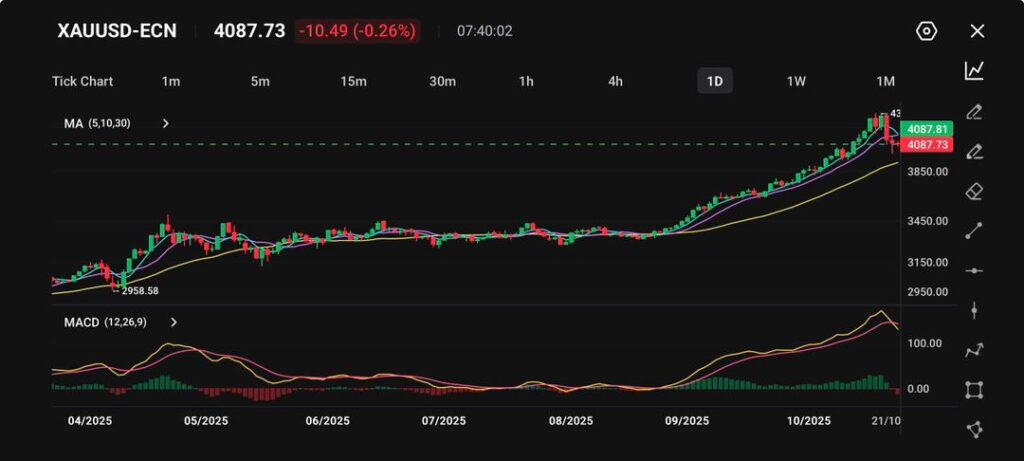
Technically, gold remains elevated near USD $4,080, consolidating after a powerful multi-month uptrend. The chart shows that prices briefly corrected from their recent peak above USD $4,250, with buyers stepping in around the USD $4,000–4,050 zone to defend short-term support.
The 20-day moving average is trending upward and still comfortably above the 50-day, confirming the broader bullish structure despite near-term cooling.
Momentum indicators, including the MACD, indicate waning upward momentum as the histogram narrows and the signal lines begin to flatten, suggesting a possible pause before the next decisive move.
If the metal holds above USD $4,000, bulls may attempt another push toward resistance at USD $4,200–4,250. A daily close below USD $3,950 would suggest deeper consolidation, though the longer-term trend remains firmly intact.
The Broader Market Connection
Gold rarely moves in isolation. Its price is tied to the rhythm of the US Dollar Index (USDX) and Treasury yields. A weaker dollar generally lifts gold, while rising yields draw capital back toward interest-bearing assets.
The past few weeks have shown this relationship clearly. As the dollar retreated from a seven-month high, bullion found support. When yields edged higher again, sellers resurfaced.
Traders can use these correlations as an early signal: when the dollar and yields move in the same direction, gold’s reaction tends to magnify whichever sentiment dominates the market.
What Traders Should Watch
The next catalysts for gold lie ahead in the form of the US CPI report and the Federal Reserve’s November policy meeting. A soft inflation reading could revive the case for rate cuts and lift prices toward resistance, while stronger data may keep the metal contained near its lower range.
Beyond macro policy, other global dynamics continue to matter. Central banks remain net buyers, marking their fourth consecutive year of heavy gold accumulation, according to Metals Focus. Meanwhile, energy market volatility and geopolitical risks still underpin safe-haven demand.
A Cautious View Forward
Gold’s price action at record levels speaks to both conviction and caution. The rally has drawn in a mix of momentum traders and defensive investors, yet the risk of sudden reversals remains high. For traders, the strategy is to stay flexible: treat gold’s current range as a map, not a promise.
In a year defined by uneven growth, evolving Fed guidance, and simmering geopolitical uncertainty, gold continues to play its timeless role as the market’s emotional compass. The charts may change, but the message remains the same: when confidence wavers, gold still shines brightest.
Scan the QR code with your smartphone to start a chat with us, or click here.
Don’t have the Telegram App or Desktop installed? Use Web Telegram instead.
Important Access Notice
This Website may only be accessed where permitted by applicable laws and regulations.
VT Markets is neither established in nor operating from Singapore. VT Markets does not provide or promote its products or services to citizens or residents of Singapore, and account requests from such persons will not be accepted.
If you are a citizen or resident of Singapore, you must not apply to open an account with VT Markets or attempt to access or utilise any of its products or services.
By continuing past this notice, you confirm that you have accessed this website entirely on your own initiative, free from any direct marketing, invitation, targeted promotion, or solicitation by or on behalf of VT Markets.
Nothing contained on this website forms, or shall be interpreted as, an offer, invitation, or solicitation in any territory where such conduct is restricted, prohibited, or otherwise unauthorised. You bear sole responsibility for verifying that your access to and use of this website adheres to all regulatory requirements applicable within your jurisdiction.
This Website is intended solely for individuals residing in jurisdictions where its access and use are permitted by law.
Neither VT Markets nor any of its affiliated entities are established in, or operate from, your local jurisdiction.
By clicking "Acknowledge and Enter", you confirm that you are accessing this Website strictly on your own initiative, without inducement from any targeted marketing or promotional outreach. You explicitly acknowledge that any information obtained through this platform is requested and provided solely on the basis of reverse solicitation, in full compliance with the laws and regulations of your jurisdiction.
This website may only be accessed where permitted by applicable laws and regulations.
VT Markets has no establishment, office, branch, representative presence, or operations in Germany and does not conduct business from Germany. By continuing past this notice, you confirm that you are accessing this website entirely on your own initiative and that you are responsible for ensuring your access to and use of this website complies with all laws and regulatory requirements applicable in your jurisdiction.
Nothing contained on this website constitutes, or shall be construed as, an offer, invitation, solicitation, or promotion in any jurisdiction where such activity is restricted, prohibited, or otherwise unauthorised.