






TOKEN2049, the world’s largest crypto conference series, wrapped up its Singapore edition on 8 October 2026 at Marina Bay Sands, and it drew a bigger crowd than ever. The sold-out event brought 25,000 attendees from 160 countries to 250 speakers across six stages. It was also the only flagship edition this year, since the Dubai edition was moved to 2027.
The two days felt like different conferences. Day 1 belonged to crypto’s builders, who discussed private money, AI agents and new tokens. Day 2 belonged to Wall Street, as exchanges and asset managers outlined how they plan to run markets on blockchain rails. Zcash sat between the two camps, exposing a central question: will crypto’s next phase run on open networks or institution-controlled systems?
The two days of TOKEN2049 overview:
| Themes | Day 1: Builders | Day 2: Institutions |
| Main voices | Winklevoss twins, Tom Lee, Arthur Hayes, Eric Trump | Adena Friedman, Jenny Johnson, Yuval Rooz, Coinbase |
| Themes | Privacy, AI agents, stablecoin payroll, ETH treasuries | 24/7 markets, tokenization, regulation, derivatives |
| Type of network | Open, permissionless | Often permissioned and regulated |
Day 1: The Builders Take the Stage
The Winklevoss twins on private money
The most talked-about session was “The Zcash Moment”, where Gemini co-founders Cameron and Tyler Winklevoss joined Balaji Srinivasan on the main stage. Cameron summed up the pitch in one line: “Bitcoin is decentralized, public. Zcash is decentralized, private.” Tyler went further and called privacy a human right.
The twins backed their words with paperwork. Two days before the event, Winklevoss Asset Services filed with the SEC for a proposed Zcash ETF, which would seek a Nasdaq listing under the ticker WINK.
- Trader’s read: An ETF filing gives Zcash a possible route to mainstream investors, but a filing is not an approval or a launch. Until regulators respond, ZEC is likely to trade on headlines around WINK and the NU7 upgrade. A ZECUSD CFD lets traders follow those moves in either direction without holding the coin itself.
Tom Lee puts a lid on BitMine
Fundstrat’s Tom Lee brought news for Ethereum holders. He said BitMine will not buy more than 5% of Ethereum’s total supply and called the limit a hard cap. The cap is close. BitMine reported holding about 6.02 million ETH on 5 October, roughly 4.9% of total supply.
- Trader’s read: With BitMine approaching its 5% cap, further ETH demand may increasingly depend on actual usage, including tokenization and stablecoins. ETH’s performance against BTC (BTCETH) offers one way to track whether Ethereum is gaining relative strength, alongside ETHUSD for its outright price.
Hayes and Qureshi disagree on AI agents
AI agents were the loudest theme of the day, and the stage did not agree on them. Arthur Hayes unveiled FLOP, a network that would let AI agents pay for computing power on-chain. He is targeting a 90-day testnet from late October and a mainnet in the first quarter of 2027.
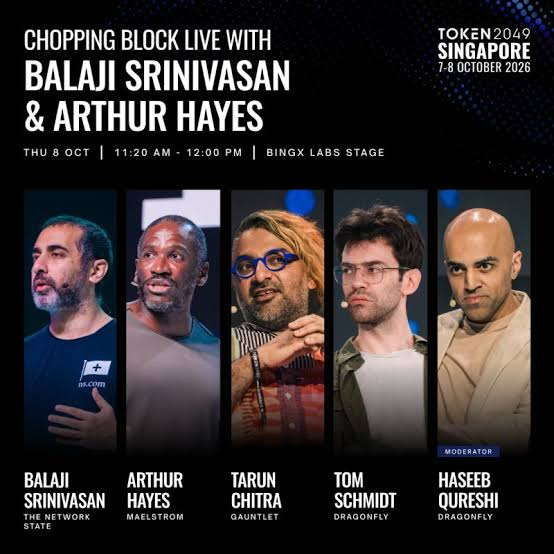
Dragonfly’s Haseeb Qureshi pushed back. He admitted he had been wrong a year earlier, because agents ended up paying with cards rather than crypto. In other words, the AI tools that buy things online today mostly use ordinary payment cards, not crypto wallets.
- Trader’s read: Demand for AI-agent payments may grow, but crypto has yet to prove it can capture that demand. Tokens tied to the theme may therefore move ahead of real-world use. Worldcoin is one example: World ID lets users prove they are human without revealing their identity, while WLD rose around 50% in the month before TOKEN2049 without a confirmed trigger. Traders following the theme through WLDUSD should be prepared for volatility in either direction.
Eric Trump on stablecoin paychecks
World Liberty Financial co-founder Eric Trump brought the payments talk down to earth. He said the family’s hotel business, which employs tens of thousands of people, is looking at paying salaries in stablecoins. World Liberty executives also said USD1 payments will reach large online merchants through Mesh this quarter.
- Trader’s read: Stablecoin payroll would test whether digital dollars can move beyond trading into everyday spending. If USD1 reaches merchants on schedule, that would provide another adoption signal. However, these remain plans announced by executives with a commercial interest in their success. WLFIUSD offers exposure to how the market receives the rollout.
Day 2: Wall Street Walks In
The tone changed sharply on the second day. Executives from BlackRock, Fidelity, Franklin Templeton, Morgan Stanley and Nasdaq discussed tokenization, stablecoins and on-chain markets.
Friedman on markets that never close
Nasdaq chair and CEO Adena Friedman described what 24/7 trading demands. Once markets run around the clock, she identifies that risk management, collateral and the movement of capital, “everything has to be real, all the time“, so the systems inside every bank and broker must change. For an exchange operator, that is a large rebuild, and Nasdaq is planning for it.
- Trader’s read: Round-the-clock stock trading is not yet live, but tokenized shares and VT Market’s weekend derivative trading are already testing the concept. As equity trading expands beyond regular exchange hours, price moves may increasingly occur overnight and at weekends. SPCXUSD offers one way to follow a name at this intersection.
Who gets to set Crypto’s rules?
Regulation came up repeatedly, though the talk was about using the current window rather than waiting on Congress. That matters because the CLARITY market-structure bill failed a Senate procedural vote on 15 September, while rules under the GENIUS Act are still being written.
- Jenny Johnson, Franklin Templeton: said legislation would help, but the industry should not depend on the CLARITY Act, since the SEC and CFTC already provide clarity under their existing powers.
- Yuval Rooz, Digital Asset (Canton Network): argued the industry should use this window to get blockchain into wider use, as Uber and Airbnb did before policymakers could restrict them, so that progress survives the 2028 US election.
- Richard Teng, Binance: called the possibility of that progress being reversed the industry’s greatest fear.
Trader’s read: With Congress stalled, SEC and CFTC decisions become important near-term signals for the sector. The 2028 US election adds a longer-term uncertainty, particularly for exchange-linked assets sensitive to regulatory changes. BNBUSD offers one way to follow market sentiment around Binance and the policy environment.
Coinbase goes global
The biggest corporate announcement of the day came from Coinbase. It said its integration of derivatives exchange Deribit is complete, creating Coinbase Global Exchange, which links its US and international businesses to Deribit’s options and perpetual futures.
- Trader’s read: The deal pushes Coinbase further into derivatives, where trading volumes are often larger than in spot markets. That ties the company’s revenue more closely to how actively people trade crypto, rather than to any single coin’s price. For traders who want exposure to crypto activity through an equity, Coinbase (COIN) share CFDs offer that angle. As with any company announcement, Coinbase’s description of a unified global market comes from the platform’s own operator.
Zcash in Focus: Open Privacy Meets Closed Rails
Zcash brings the week’s central tension into focus. Crypto’s builders argue that private money should run on open networks anyone can use, while institutions are exploring privacy within systems they control. How these models coexist, and where economic activity develops, could help determine who captures value in crypto’s next phase.
Zcash has several potential catalysts ahead:
- NU7 upgrade: The upgrade went live on testnet on 4 October, with a go-or-no-go decision scheduled for 20 October and mainnet activation targeted for 5 November.
- ETF prospects: The proposed WINK ETF could provide another route to institutional exposure alongside Grayscale’s existing fund.
- Wallet adoption: The team behind the Zodl wallet raised more than $25 million from investors including Paradigm, a16z Crypto, Coinbase Ventures and Winklevoss Capital. The team also reports that the wallet has grown Zcash’s shielded pool by over 400% since launch.
Its market performance, however, has been volatile. ZEC fell 13% on 8 October to around $1,133, leaving it down 25.5% over two weeks, before recovering. The price rebound does not yet establish a sustained reversal, while fund flows remain another measure to watch. Grayscale’s ZCSH lost $8.49 million on 7 October, following $93.56 million in outflows the previous week.
Competition adds another complication. At TOKEN2049, Charles Hoskinson discussed Midnight, Cardano’s privacy-focused partner chain, and said he had invested roughly $200 million in its development. Wall Street is building privacy-focused infrastructure too. Goldman Sachs’ digital asset platform runs on Canton Network, a permissioned blockchain with built-in privacy controls.
Institutions clearly value privacy. The question is whether they will adopt open privacy networks or build alternatives within systems they control.
Where Builders and Institutions Already Meet
The distinction between crypto’s builders and Wall Street is not absolute. TOKEN2049 also showed how institutional adoption can develop on open blockchain infrastructure.
Solana offers one example. Samsung plans to add USDC transfers to Samsung Wallet in the last week of October, initially reaching about 82 million Galaxy devices in the US, with Solana as an infrastructure partner. Securitize’s tokenised stock launch also uses Solana, with trades settled in USDC. These developments show how public blockchain infrastructure can support financial products and services aimed at mainstream users and institutional markets.
Ethereum remains another important part of this expansion, accounting for about 53% of a roughly $349 billion on-chain market for tokenised assets and stablecoins. With BitMine approaching its stated accumulation cap, the next phase of ETH demand may increasingly depend on whether institutional activity translates into sustained network usage.
These developments complicate the idea that crypto must choose between open networks and institutional finance. Institutions can adopt public blockchains while developing permissioned infrastructure of their own. The two approaches may compete in some areas and coexist in others. Read more about how traditional finance meets everything after under Fintech articles.
TOKEN2049 showed that the future of crypto may not come down to open networks versus institutional finance. Wall Street is already adopting public blockchain infrastructure while building permissioned alternatives of its own. The more important question is whether that activity creates lasting demand for the networks and tokens powering it, or whether the economic value accumulates elsewhere.
The coming weeks offer several tests. Zcash’s NU7 go-or-no-go decision is scheduled for 20 October, Samsung’s USDC integration is planned for the last week of October, and Zcash’s mainnet activation is targeted for 5 November. Progress on the proposed WINK ETF and subsequent ZCSH fund flows will also help show whether interest in Zcash is translating into sustained demand.
Explore CFD price action on ZECUSD, SOLUSD, ETHUSD and many more coins as Crypto CFDs on VT Markets.
Tap for Related Questions
What is TOKEN2049, and where is the next one?
TOKEN2049 is the world’s largest crypto conference series, bringing together founders, investors, exchanges and financial institutions. After Singapore in October 2026, it heads to Dubai on 21 to 22 April 2027, New York on 16 to 17 June 2027 (its first US edition), and back to Singapore on 6 to 7 October 2027.
What were the main themes at TOKEN2049 Singapore 2026?
Day 1 focused on crypto privacy, AI agents, stablecoins and Ethereum. Day 2 shifted towards institutional adoption, tokenisation, regulation and on-chain markets.
Why is Wall Street moving into crypto?
Financial institutions are exploring tokenised assets, stablecoins and blockchain-based markets to expand how financial assets are traded and settled.
Why is Zcash attracting attention after TOKEN2049?
Zcash combines privacy-focused technology with a proposed ETF and an upcoming network upgrade. However, its recent price decline and weak fund flows show that adoption prospects have not translated into sustained market strength.
What makes Zcash a privacy coin?
Zcash supports shielded transactions, which hide the sender, the receiver and the amount. Bitcoin transactions, by contrast, are visible on a public ledger to anyone.
What is the difference between public and permissioned blockchains?
Public blockchains allow open participation, while permissioned networks restrict access to approved participants. Financial institutions may favour controlled environments that offer privacy and regulatory oversight.
Can anyone buy the new tokenized US stocks on Solana?
Not yet. Securitize Stocks are only open to eligible investors who pass onboarding, KYC and AML checks, and access depends on where you live.
Will Samsung Wallet’s USDC feature launch in Asia?
There is no date yet. The first rollout covers eligible US users, though transfers can already be paid out to bank accounts in more than 60 countries in local currency. Samsung says wider expansion depends on local regulation.
Can I trade Zcash without owning it?
Yes. A CFD lets you trade on ZEC’s price moves, up or down, without holding the coin. CFDs are leveraged products, so gains and losses can both be magnified.
Start trading now — click here to create your real VT Markets account.








