




Key Takeaways:
- A safe haven currency appreciates during market stress as investors move capital into stable economies with low debt and resilient financial systems.
- Selection depends on the risk source. The Swiss franc (CHF) leads to European or Middle Eastern tensions, while the Japanese yen (JPY) offers more aggressive moves during global deleveraging or US recessions.
- The Swiss National Bank maintains a 0% policy rate and uses direct FX intervention to manage structural strength, which may cap the upside for CHF traders.
- The Bank of Japan raised rates to 0.75%, but the 150 to 200 basis point gap with US rates continues to fuel carry trades until a major shock occurs.
- Understanding the specific driver of a market move is more critical than identifying the direction alone, as regional vs global shocks trigger different currency responses.
Smart Money Rotation: Identifying the 2026 Safe Haven
When risk hits the markets, one question determines profits or losses: where does smart money go? In the world of currencies, that refuge has historically had two names — the Swiss franc (CHF) and the Japanese yen (JPY). However, in 2026, choosing between them is no longer straightforward. The rules of the game have shifted.
What is a safe-haven currency, and why does it matter now?
A safe-haven currency is one that tends to appreciate during periods of market stress. Not because it inherently becomes more valuable, but because investors rotate into economies perceived as stable — those with low debt, strong institutions, and resilient financial systems. Both the Swiss franc and the Japanese yen have long fulfilled this role, attracting capital during episodes of risk aversion.
The current macro backdrop makes this comparison particularly relevant. Persistent geopolitical tensions in the Middle East, ongoing trade uncertainty linked to Trump’s tariff policies, a softer US dollar, and central banks balancing inflation against slowing growth have created a fragile environment. In such conditions, understanding which safe haven is likely to outperform offers a tangible edge.
How do CHF and JPY react to different crises?
Historically, CHF and JPY do not react identically to crises. The Swiss franc tends to outperform during periods of European stress — such as sovereign debt crises or regional geopolitical tensions — while the yen is more sensitive to global shocks, particularly those involving the unwinding of carry trades (where investors borrow in low-yielding yen to invest in higher-yielding assets).
This content is only supported in a Lark Docs
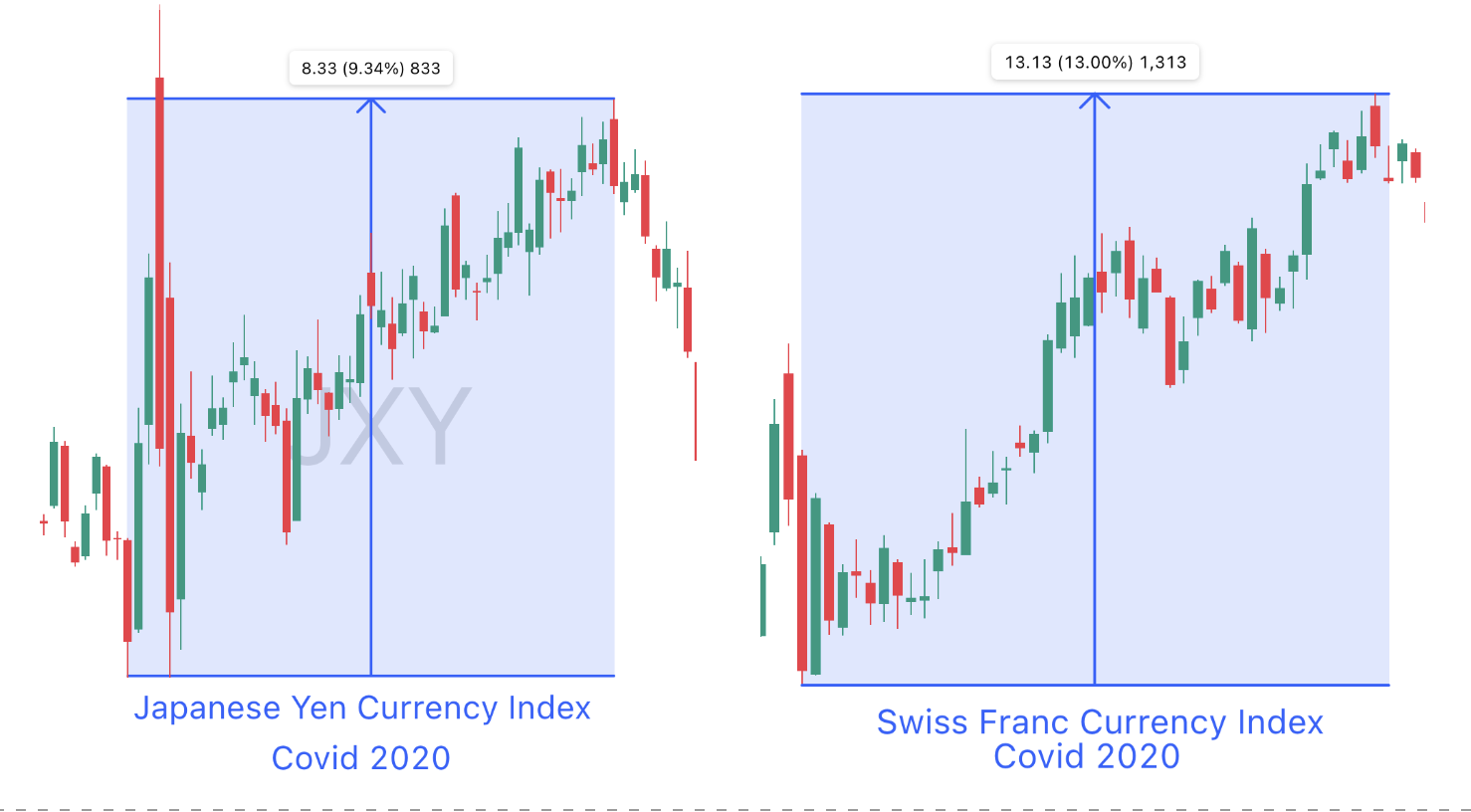
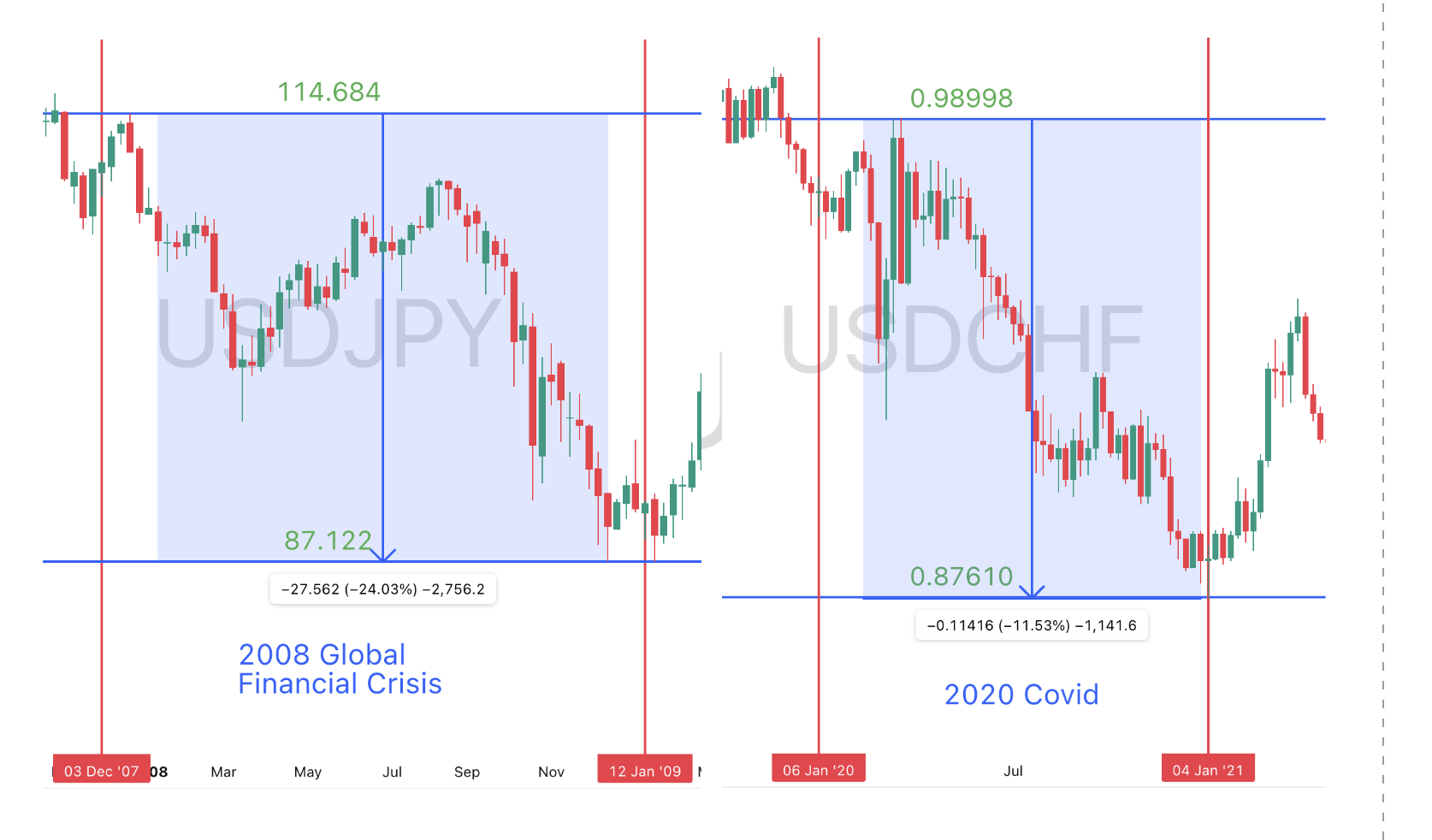
During the Global Financial Crisis and the COVID-19 shock, both currencies benefited from broad risk aversion. However, not every yen rally signals fear. For example, the 2024 yen surge was largely driven by the unwinding of crowded carry trades rather than genuine safe-haven demand. This distinction is crucial: positioning can move markets just as much as macro fear.
In 2025, the Swiss franc clearly led. It behaved as the dominant G10 risk-off currency, strengthening consistently during periods of geopolitical tension.
The drivers of each currency in 2026
The Swiss franc: structural strength with a visible ceiling
The Swiss National Bank (SNB) maintained its policy rate at 0% in March 2026, with inflation projected at just 0.5% for the year. With rates already at the lower bound, the SNB has limited conventional policy tools remaining. Its primary response has been direct intervention in the foreign exchange market to prevent excessive franc appreciation.
Most economists expect the SNB to keep rates unchanged throughout 2026, relying on currency intervention as its main policy lever.
This creates a unique dynamic: the franc is structurally strong, but its upside is actively managed. For traders, this means CHF strength may be capped, even in risk-off conditions.
The yen: normalising, but gradually
The yen is undergoing a quiet but important transition. The Bank of Japan has raised its benchmark rate to 0.75% — its highest level since 1995 — signalling a gradual shift towards policy normalisation.
In theory, this should support the yen. However, reality is more nuanced. The interest rate differential between Japan and the United States is narrowing but remains significant. Even under a dovish Federal Reserve scenario, US rates are likely to exceed Japan’s by 150–200 basis points.
As long as this gap persists, the carry trade will continue to exert downward pressure on the yen, limiting sustained appreciation outside of risk-off episodes.
Who wins in 2026?
The answer depends less on the currency itself and more on the nature of the risk driving the market.
If risk originates from Europe or the Middle East, the Swiss franc is likely to outperform. Its track record, Switzerland’s fiscal strength, and the SNB’s credibility position it as the preferred destination for defensive capital. Strong current account surpluses, low inflation, and political neutrality further reinforce its appeal.
If the shock is global — such as a US recession, equity market collapse, or large-scale deleveraging — the yen tends to deliver sharper, more aggressive moves. In such scenarios, the unwinding of carry trades can accelerate gains rapidly. Goldman Sachs estimates that in a rising US recession scenario, the yen could strengthen towards 140 per dollar, representing a meaningful appreciation from current levels.
For CFD traders, the implication is clear: it is not enough to identify market direction — you must also understand the underlying driver of the move.
- Regional episodes → higher probability of CHF strength
- Global deleveraging → more aggressive moves in JPY
In 2026, the safe haven is no longer a fixed asset. It is a strategic choice.
Understanding the type of crisis you are trading may ultimately matter more than the trade itself.
The Big Questions
- Which currency is the best safe haven in 2026?
The choice depends on the origin of market risk. The Swiss franc (CHF) typically outperforms during regional European or Middle Eastern instability. The Japanese yen (JPY) tends to see more aggressive appreciation during global shocks like a US recession or broad equity market collapses.
- How does the Bank of Japan interest rate affect the yen in 2026?
The Bank of Japan raised its benchmark rate to 0.75 percent. While this signals policy normalization, a significant interest rate gap of 150 to 200 basis points still exists between Japan and the United States. This gap maintains pressure on the yen through carry trades until a major risk event occurs.
- Why does the Swiss National Bank intervene in the currency market?
The Swiss National Bank maintains a policy rate of 0 percent and projects very low inflation of 0.5 percent. With limited conventional tools left, the bank uses direct foreign exchange intervention to prevent excessive franc appreciation. This strategy effectively creates a ceiling for CHF strength.
- What is the definition of a safe haven currency?
A safe haven currency is an asset that appreciates during periods of market stress. Investors rotate into these currencies because they represent economies with low debt, strong institutions, and resilient financial systems.
- When does the Japanese yen experience the sharpest moves?
The yen delivers its most aggressive gains during global deleveraging episodes. In these scenarios, the rapid unwinding of crowded carry trades accelerates the appreciation of the yen against the dollar.
- Is the Swiss franc still a reliable hedge for geopolitical tension?
Yes, the Swiss franc remains a preferred destination for defensive capital due to Switzerland’s fiscal strength and political neutrality. It behaved as the dominant G10 risk off currency throughout 2025.









