


 Insights
  VT
VT 






After U.S. forces captured President Nicolás Maduro, headlines are raising speculation about regime change and access to the world’s largest oil reserves. This triggered immediate volatility across crude markets and reopened long-standing questions about Venezuela’s role in the global energy supply.
On January 3, 2026, news broke that the United States military had conducted a covert operation in Venezuela to capture and extradite Venezuelan President Nicolas Maduro for trial in the United States on charges of narco-terrorism and drug trafficking. The announcement follows growing tension between the United States and the Latin American nation, though the Trump administration had not previously confirmed seeking regime change in Venezuela.
The geopolitical outcomes of this action remain uncertain. President Trump has stated that the U.S. will run Venezuela for an indeterminate period until political activity in the country aligns with U.S. priorities.
This event arrives at a time when oil markets were already under pressure, following a nearly 20% decline in crude prices during 2025, driven by persistent oversupply and slowing demand growth.
Short-Term Volatility
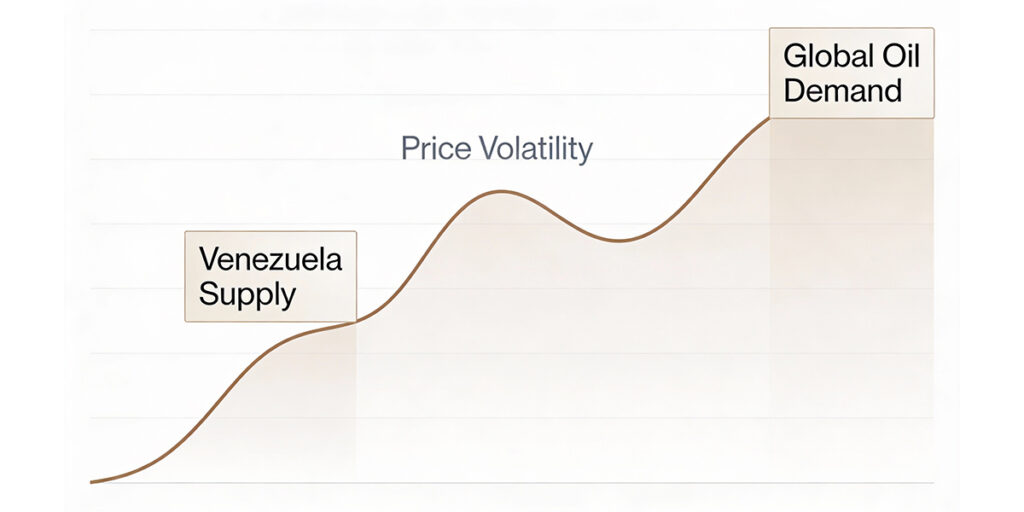
Venezuela holds the world’s largest proven oil reserves, estimated at roughly 303 billion barrels, but its current production accounts for less than 1% of daily global output. Years of sanctions, infrastructure decay, corruption, and underinvestment have reduced output from nearly 3.5 million barrels per day in the late 1990s to around 1–1.1 million barrels per day today.
This reality limits the immediate impact of political developments on global supply. Even with optimistic assumptions, analysts broadly agree that Venezuela cannot deliver a meaningful surge in output quickly.
President Donald Trump stated that US oil companies would invest “billions of dollars” to rebuild Venezuela’s energy system. Analysts at Third Bridge and Goldman Sachs estimate that restoring production capacity would require tens of billions of dollars and up to a decade of sustained investment, particularly given the country’s severe power shortages, degraded transport networks, and aging oil-processing infrastructure.
Sanctions, Blockades, and Policy Uncertainty
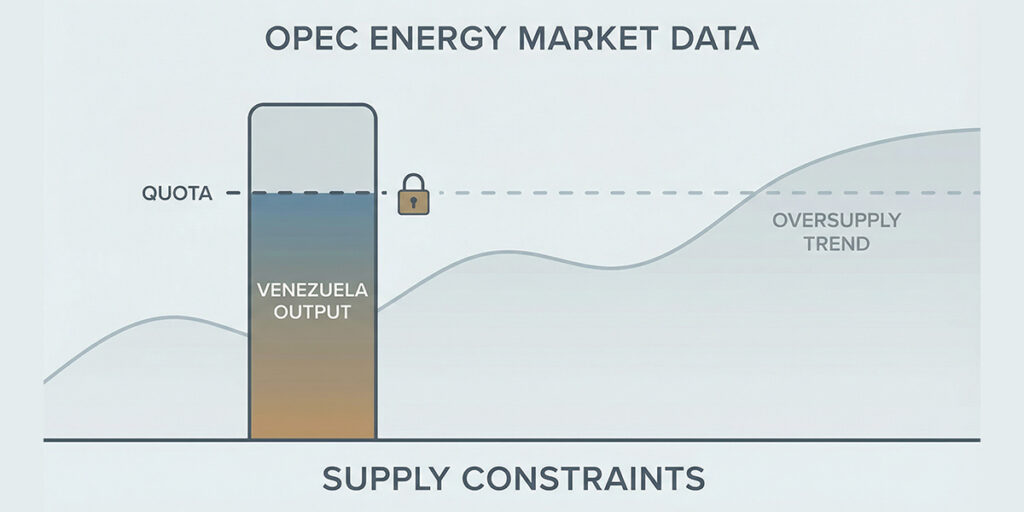
Even before Maduro was captured, Venezuelan exports faced pressure from a US blockade on sanctioned oil tankers entering and leaving Venezuelan waters. This blockade is still in effect, complicating any immediate normalization of exports.
While political change increases the likelihood of a more investment-friendly environment, short-term oil flows remain highly uncertain. Production could increase slightly, remain constrained, or experience further disruptions due to internal power struggles and the enforcement of sanctions.
On the other hand, Venezuela is still a member of OPEC. This means that any recovery in production would eventually need to be coordinated within a global system that is already oversupplied.
The Long-Term Picture is Deflationary
While short-term volatility has raised oil prices slightly, most analysts see Venezuelan supply as structurally bearish over the long run.
Venezuelan crude is heavy and sour, which is the type preferred by US Gulf Coast refineries that were built for it. Once supply chains are fixed, cheaper Venezuelan feedstock could improve refinery efficiency, lower diesel and gasoline costs, and put downward pressure on energy prices worldwide.
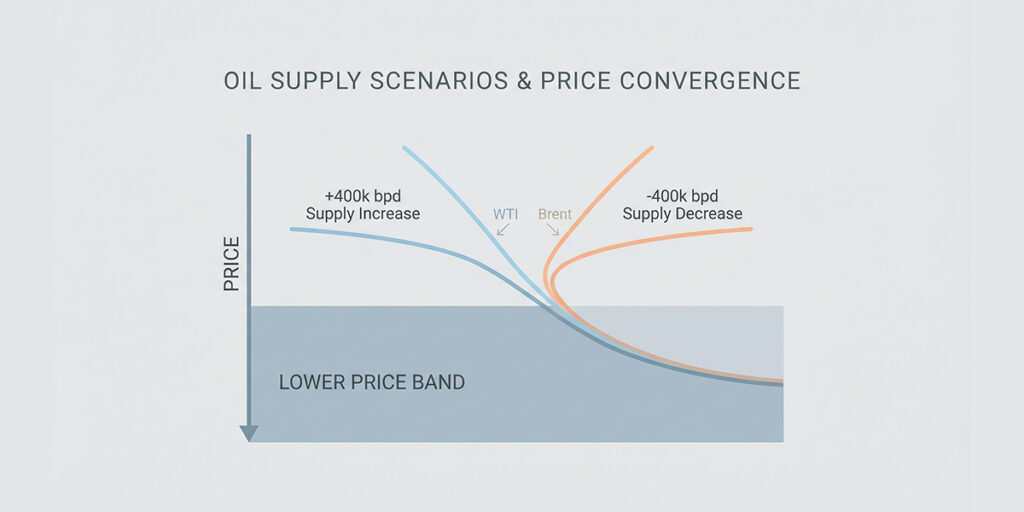
Goldman Sachs’ 2026 projections reflect this view:
- If Venezuelan production falls by 400,000 bpd, WTI and Brent could average roughly $51 and $58 per barrel.
- If production rises by 400,000 bpd, prices are expected to average closer to $50 and $54, respectively.
Either scenario reinforces the idea that Venezuelan oil acts as a long-term deflationary force, particularly at a time when global demand growth is slowing.
Why Heavy Crude Still Matters
Beyond price, Venezuela’s oil is crucial because of its composition. Heavy crude is essential for making diesel, asphalt, and fuels used in heavy industry. There are tight global supplies in these areas due to sanctions on both Venezuelan and Russian oil.
A revival of Venezuelan output could lessen the world’s dependence on Russian energy, changing geopolitical power in energy markets. However, this benefit remains theoretical until there is political stability, legal clarity, and investment in infrastructure.
Legal and Political Risks Remain High

Despite President Trump’s claims that Venezuelan oil was “stolen” from the US, legal scholars emphasize that international law does not support claims of ownership over another country’s natural resources. US companies historically held exploration concessions, not ownership rights.
Past nationalization under Hugo Chávez and contract disputes with firms such as ExxonMobil and ConocoPhillips continue to complicate negotiations. Analysts estimate that restoring production to 4 million barrels per day could require over $100 billion in investment and at least a decade of stable governance.
Without political clarity and enforceable contracts, capital commitment from global oil majors is likely to remain cautious.
Key Takeaway for Traders
The key takeaway for traders is the distinction between headline risk and structural reality.
- Short term: Expect elevated volatility in USOIL and Brent caused by geopolitical headlines, sanctions enforcement, and OPEC signaling.
- Medium term: Prices may remain range-bound as supply remains ample and demand growth slows.
- Long term: Venezuelan oil represents a deflationary force once production normalizes, reinforcing a ceiling on sustained price rallies.
This is not a market for chasing headlines but for respecting structure, positioning around ranges, and managing risk carefully.
Final Thoughts
The capture of Venezuela’s president marks a crucial geopolitical development, but not an immediate turning point for oil fundamentals. The market is pricing uncertainty, not scarcity.
The real story lies in timelines, capital discipline, and supply elasticity, not political soundbites. As 2026 unfolds, oil markets are likely to remain volatile but structurally constrained, rewarding discipline over speculation.








