Since the second half of 2025, the weakening U.S. labour market has become one of the main catalysts behind the Federal Reserve’s rate-cut cycle.
Softer employment data has strengthened expectations for further policy easing, but why does a single report move the entire financial market?
The Significance of Nonfarm Payrolls (NFP)
The Nonfarm Payrolls (NFP) report is one of the most influential pieces of U.S. economic data. Released on the first Friday of each month by the Department of Labor, it includes three key indicators: changes in nonfarm employment, the unemployment rate, and average hourly earnings.
Nonfarm employment reflects how many jobs were created or lost, giving markets a snapshot of U.S. business activity.
The unemployment rate shows the percentage of people seeking work but unable to find it.
Average hourly earnings measure income growth, which helps assess inflationary pressure.
In short, NFP data serves as a real-time barometer of economic health and consumer strength. When job creation is strong and unemployment falls, markets interpret it as a sign of growth — often boosting the U.S. dollar as capital flows toward higher-yielding assets.
With the US government shut down, the Labor Department has suspended the release of economic data, including the closely watched nonfarm payrolls report https://t.co/IpjauZ5CR4pic.twitter.com/A9a3VZYOjR
Conversely, weak job numbers suggest an economic slowdown, triggering risk aversion and strengthening safe-haven assets such as gold.
Impact on the Federal Reserve
The Federal Reserve’s primary goal is to strike a balance between controlling inflation and supporting employment.
Strong NFP data typically reinforces expectations that the Fed will maintain higher interest rates, or even delay rate cuts, as a tight labour market risks fuelling inflation. In such cases, the dollar tends to strengthen, while stocks and non-dollar assets may face pressure.
On the other hand, weaker NFP readings raise the probability of further rate cuts, reducing the attractiveness of the dollar and driving demand for equities and commodities. Historically, NFP and the U.S. Dollar Index (USDX) have shown a high positive correlation.
Wall Street stocks closed up with a series of economic data appearing to support the case for the Federal Reserve to implement its third and final rate cut of the year in December https://t.co/Dp9IbitfURpic.twitter.com/FunAXVxvhV
Put simply, there are two clear market reactions to watch:
Strong employment → no rate cuts → tighter conditions → USD up, equities and commodities weaker.
Weak employment → more rate cuts → looser conditions → USD down, equities and commodities stronger.
How NFP Has Performed in 2025
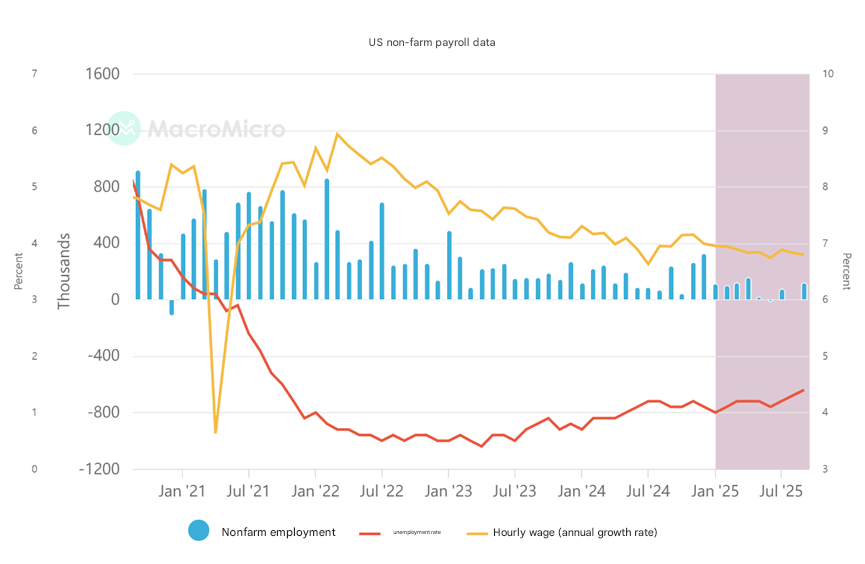
Throughout the second half of 2025, the U.S. labour market has been in a moderate cooling phase. By September, the economy had added roughly 684,000 new jobs, below last year’s pace.
The outlook has softened, with average monthly job gains slowing from 140,000 in the first half of the year to around 50,000 in the second half.
A recent revision showed that total employment over the past 12 months was overstated by 911,000, confirming that earlier figures were overly optimistic.
The unemployment rate has climbed from 4.1% in January to 4.4% in September, while long-term unemployment has surged to 25.7%, a post-pandemic high.
"The employment deterioration is real, and that is going to become the bigger focus for the Fed as we go into 2026," Principal Asset Management CIO Michael Goosay says. Going into 2026, we're "likely to see more meaningful Fed rate cuts than even what's priced into the market." pic.twitter.com/eQvHqxA9fe
Wage growth has also slowed, easing from nearly 4% to below 3.8%, which helps relieve inflation pressure. This gives the Fed more confidence and flexibility to continue cutting rates without fear of a wage–price spiral.
Overall, the cooling labour market remains the key driver behind the Fed’s recent two consecutive rate cuts in September and October. If the jobs recovery continues to stall, markets can expect further dovish commentary from policymakers into early 2026.
Outlook for the U.S. Dollar and Gold
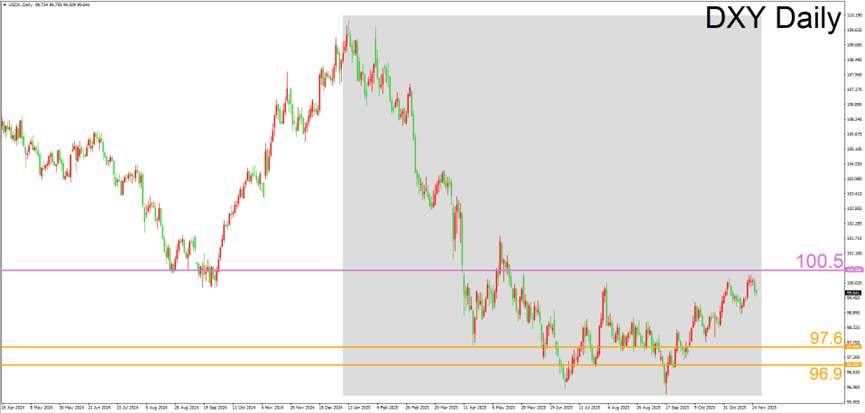
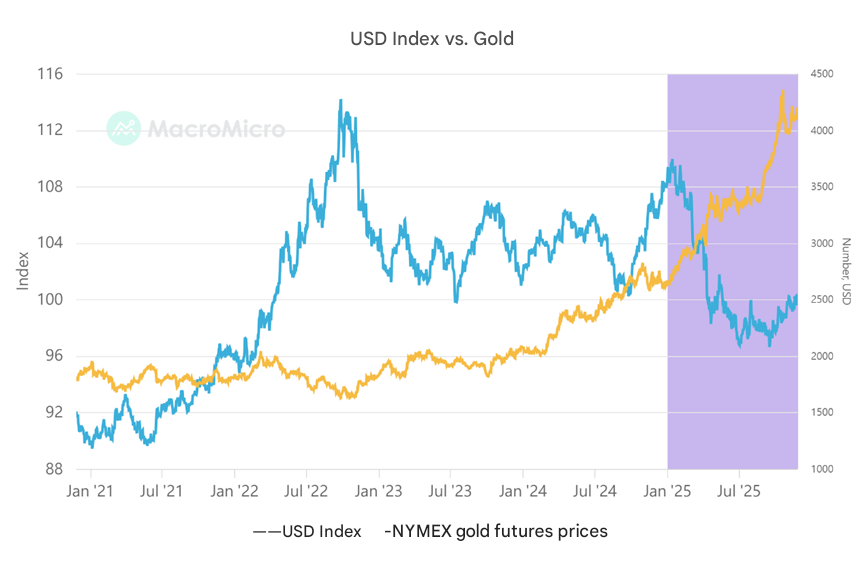
Against this backdrop of monetary easing, the U.S. dollar has entered a downward trend throughout 2025. The USDX Index has fallen from 108 at the start of the year to below 100, breaking its long-term uptrend.
Technically, the index has established a bearish pattern, with moving averages forming a downward crossover — suggesting the medium-term bias remains weak. In 2026, the dollar is likely to stay range-bound to lower, with key support near 97.6–97.8. A break below that level could open a move toward the 96.9 zone, while resistance lies at 100.2–100.5, where sellers are likely to return.
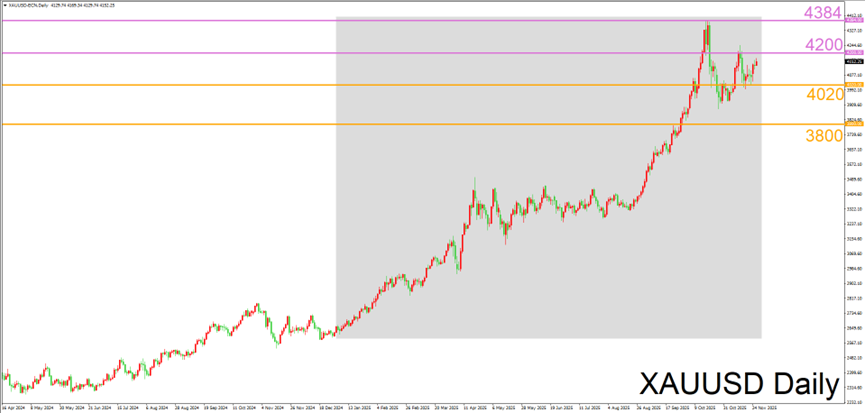
In contrast, gold has surged as lower real rates and a weaker dollar boosted its appeal. Thanks to the inverse correlation between gold and the dollar, bullion prices have climbed sharply from US$2,630 per ounce in January to a record high of US$4,384 in October — an extraordinary 58% rally.
Although prices have recently pulled back to around US$4,150, the overall trend remains firmly bullish. In 2026, the uptrend could continue, though investors should watch for technical corrections following such strong gains.
Short-term resistance: US$4,200 — a key psychological barrier.
Support: US$4,020–4,040 (short term); US$3,800–3,900 (medium term). A deep pullback into this zone could present potential buying opportunities for long-term investors.
Institutional Views and Risk Warnings
At first glance, weaker NFP data seems positive for most risk assets — a “bad news is good news” scenario that markets have grown accustomed to in recent years. However, 2026 may not follow the same script.
While a soft labour market supports rate cuts in the short term, it also raises the risk of recession if job losses accelerate.
JPMorgan warns that the lagged impact of high rates will fully materialise by late 2025, with businesses shifting from slower hiring to actual layoffs.
Citi expects consumer spending to weaken in 2026 as wage growth stagnates.
Morgan Stanley notes that job creation is overly concentrated in government and healthcare, while cyclical sectors like manufacturing and temporary services have shown months of contraction. If government spending tightens, the job market could face a steep downturn.
In short, while weak employment data currently supports bullish sentiment in stocks, gold, and crypto, that dynamic may reverse if economic growth fails to recover after the Fed’s easing cycle. Investors should stay alert to shifts in market mood and monitor the Fed’s communication closely for any change in tone.
Analyst View
“From my perspective, the market is entering a transition phase. The optimism fuelled by rate cuts can only last as long as the real economy holds up. The cooling labour market gives the Fed room to ease further, but it also exposes the limits of policy — stimulus can buy time, not growth. I believe the next few NFP releases will be crucial in determining whether the U.S. economy achieves a soft landing or slides toward recession. A sustained drop in wage pressure without a spike in unemployment would give the Fed breathing space and keep gold supported while limiting dollar downside. But if job losses accelerate, markets could shift from betting on policy easing to pricing in economic stress, and that’s when volatility will return. Right now, I’m watching for confirmation that the slowdown is stabilising rather than deepening — that’s what will decide whether 2026 begins with renewed confidence or renewed caution.” – Ray Yang
Disclaimer
The views and opinions expressed in this article are those of Ray Yang, Market Analyst at VT Markets. They reflect his professional analysis and insights on current market conditions and do not necessarily represent the official position of VT Markets. This commentary is for informational purposes only and should not be construed as financial advice.
Our Telegram app is currently under maintenance, we apologize for the inconvenience. For immediate assistance, please contact us via our website live support or by email at info@vtmarkets.com.