






Key points:
- The US dollar weakened after the Treasury announced expanded buyback operations for longer-dated bonds.
- Lower long-term Treasury yields pressured the greenback as investors reassessed the outlook for US assets.
- The buyback plan raised concerns over future yield dynamics, with some strategists viewing the move as negative for dollar sentiment.
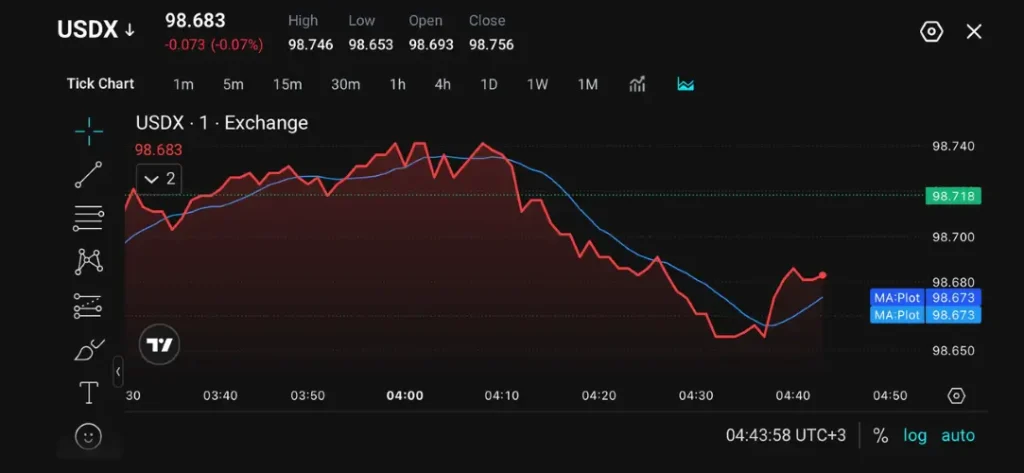
- USDX is trading near the 98.68 area after falling towards recent lows, with traders watching whether the index can stabilise.
- Markets are monitoring Federal Reserve communication, Treasury market conditions and upcoming economic data for further direction.
USDX came under renewed pressure after the US Treasury announced expanded buyback operations for longer-dated bonds, prompting investors to reassess the outlook for Treasury yields and currency markets.
The move eased pressure in the long-end Treasury market but also raised concerns that lower long-term yields could reduce demand for US assets. As a result, the Bloomberg Dollar Spot Index declined, while USDX moved towards three-month lows.
The decline reflects a changing market balance, with Treasury policy actions, Federal Reserve expectations and yield movements becoming key drivers for currency sentiment.
Why Traders Are Watching the US Dollar
USDX remains closely linked to developments in the Treasury market, as bond yields influence the attractiveness of US assets.
While higher yields traditionally support demand for the currency, the recent Treasury buyback announcement has complicated this relationship by raising questions over future yield dynamics and fiscal policy.
The index is also sensitive to Federal Reserve expectations. Markets are watching upcoming comments from Fed Chair Kevin Warsh at the Jackson Hole symposium for further clues on the future interest-rate path.
Further weakness could continue if investors expect lower long-term yields and a less supportive rate outlook. However, inflation trends, economic data and central bank communication remain important factors for the next USDX move.
| Price Level | What Traders Are Watching |
| 99 | Psychological resistance if USDX extends its recovery |
| 98.75 | Recent intraday high and immediate resistance area |
| 98.68 | Current trading area and near-term price reference |
| 98.67 | Short-term moving average area |
| 98.65 | Recent low and immediate support level |
| 98.5 | Key support zone if selling pressure resumes |
USDX is trading around the 98.68 area after recovering from the session low near 98.65, with price moving back towards the short-term moving average area around 98.67.
A move above 98.75 could signal improving short-term momentum, bringing the 99.00 resistance area into focus.
On the downside, a break below 98.65 could indicate renewed selling pressure, with the 98.50 support zone becoming the next level to monitor.
Bullish and Bearish Setups
| Setup | Trigger | Potential Market Reaction |
| Recovery Attempt | Hold above 98.65 | USDX may retest the 98.75 resistance area |
| Bullish Breakout | Break above 98.75 | Momentum may strengthen towards 99.00 |
| Range Consolidation | Hold between 98.65 and 98.75 | USDX may remain range-bound as traders assess direction |
| Bearish Breakdown | Fall below 98.65 | Selling pressure may increase towards 98.50 |
The bullish scenario depends on USDX maintaining support above the 98.65 area and recovering towards 98.75. A sustained move above this resistance level could indicate improving short-term momentum.
The bearish scenario becomes more relevant if USDX breaks below 98.65, which could signal continued weakness and expose the 98.50 support area.
Disclaimer
The price levels and market scenarios above reflect the author’s assessment at the time of writing. They do not represent financial advice or an official recommendation from VT Markets. Energy markets can experience rapid movements due to geopolitical developments, supply changes and macroeconomic factors.
Trade US Dollar Index CFDs with VT Markets
USDX remains active when Federal Reserve policy expectations, inflation risks, oil prices, geopolitical developments and global currency flows move together.
With VT Markets, traders can access USDX CFDs alongside major forex pairs, gold, oil, indices, shares, ETFs and other global CFD markets from one platform.
This allows traders to follow broader dollar movements while comparing developments across USDJPY, EURUSD, XAUUSD and energy markets.
Use VT Markets’ charting tools to monitor support, resistance, moving averages and breakout behaviour as the next USDX setup develops.
Start trading indices with VT Markets today.
Why Trade US Dollar Index CFDs with VT Markets?
USDX CFDs allow traders to take a view on rising or falling US dollar index movements without owning the underlying currency basket.
This flexibility can be useful when the dollar reacts quickly to Federal Reserve expectations, inflation signals, oil-price movements, geopolitical developments and safe-haven demand.
If USDX breaks above resistance, traders can monitor potential bullish continuation. If momentum weakens, traders can assess possible downside scenarios.
With VT Markets, traders can follow USDX price action in real time and compare it with other major CFD markets through one account.
What to Watch Next
The next move for USDX will depend on how markets assess Treasury policy, Federal Reserve expectations and broader currency demand.
Key factors include:
- Treasury market reaction: Whether bond buybacks provide lasting support for long-term yields.
- Federal Reserve communication: Comments from policymakers that may influence interest-rate expectations.
- US economic data: Inflation and growth indicators affecting the currency outlook.
- Treasury yields: Further movements in bond markets as investors reassess US assets.
- Global currency sentiment: Whether recent weakness continues against major currencies.
From a technical perspective, traders are watching whether USDX can reclaim 98.75, while 98.65 remains the key short-term support level if downside pressure returns.
Frequently Asked Questions
Why did USDX fall?
USDX declined after the Treasury announced expanded bond buyback operations, which eased long-term yield pressure but raised concerns over the impact on demand for US assets.
How do Treasury yields affect USDX?
Treasury yields influence demand for US assets. Higher yields can support the currency, while lower yield expectations may reduce its attractiveness.
Why are Treasury buybacks affecting USDX?
The buyback plan changed expectations around the Treasury market by reducing pressure on long-term yields, leading investors to reassess the outlook for the currency.
What currencies benefit when USDX weakens?
Currencies such as the yen, Swiss franc and New Zealand dollar can gain when USDX weakens, depending on broader market conditions.
What are the key USDX levels to watch?
Traders are monitoring 98.75 as a potential recovery level, while 98.65 remains the key short-term support area.
What could support USDX?
A recovery in Treasury yields, stronger economic data or a more supportive Federal Reserve outlook could help stabilise USDX.
Start trading now — click here to create your real VT Markets account.








