






Key Points
- Australia’s inflation report is due Wednesday, 28 October, ahead of the RBA’s 3 November policy decision.
- The Australian dollar held above 0.7000 as traders await key inflation data.
- Underlying inflation is expected to rise 1.0% quarter on quarter, potentially strengthening the case for another rate increase.
- Markets are currently pricing in a 66% chance of a 25-basis-point RBA rate hike to 4.85% at its November 3 meeting.
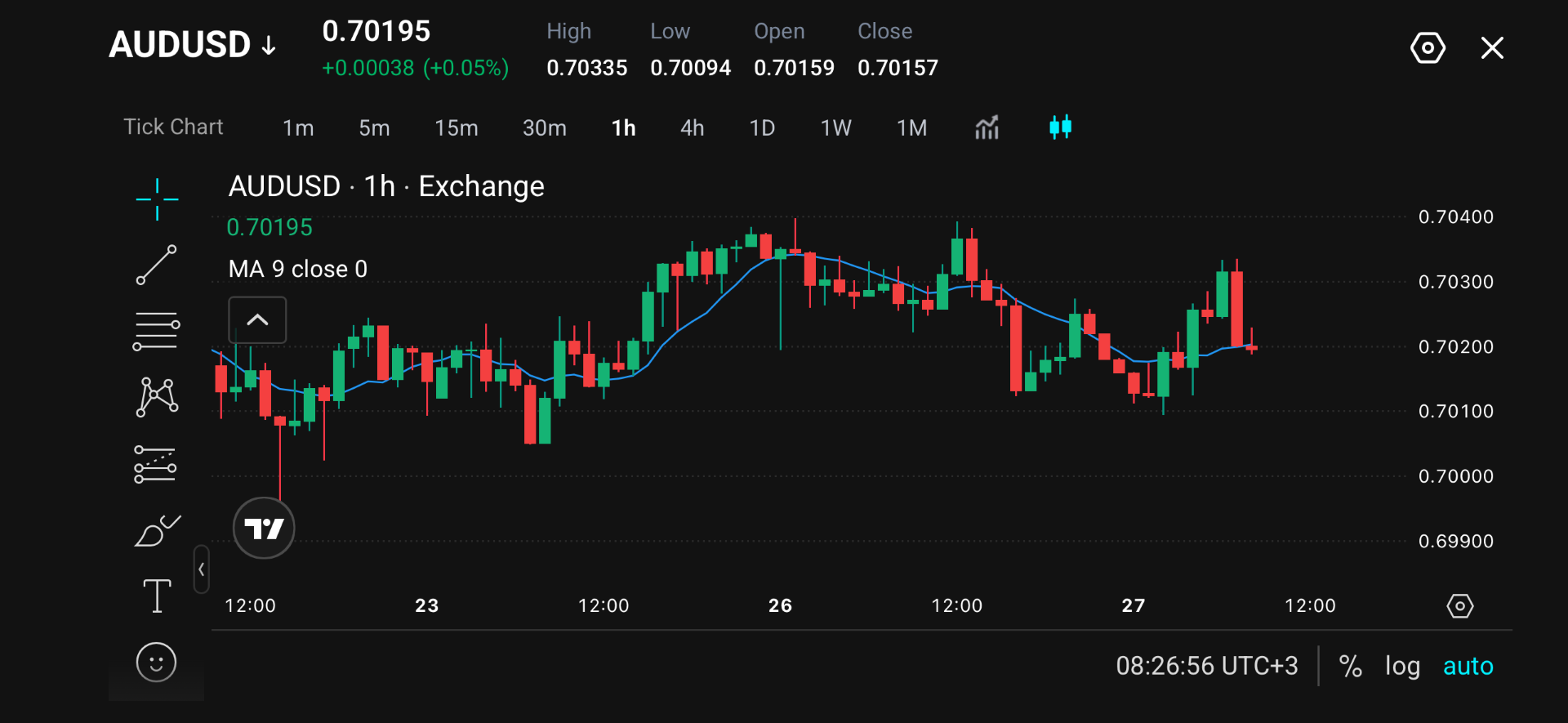
- Nearby resistance is at 0.7030–0.70335 and initial support is around 0.7010–0.7013.
Market Move
The Australian dollar held above 0.7000 as traders waited for Consumer Price Index (CPI) data that could influence the RBA’s next interest rate decision.
The latest session shows AUDUSD trading at 0.70195, after an earlier rise towards 0.7033 faded. Price returned to the nine-period moving average near 0.7020, suggesting that the latest rebound has lost momentum.
Repeated buying occurred around 0.7010 and selling below 0.7040. AUDUSD remains within that short-term range. The inflation report will likely be a potential trigger for a breakout.
Why Traders Are Watching
Australia’s inflation report is scheduled for 28 October. Economists expect quarterly trimmed mean inflation, a measure of underlying price pressures, to rise 1.0%, above the RBA’s August forecast of 0.8%, this could reinforce expectations for further tightening.
Markets expect annual underlying inflation to remain at 3.6%. That would leave it above the RBA’s 2%–3% target range, keeping pressure on policymakers to bring inflation lower.
The RBA’s cash rate currently stands at 4.60%, with its next decision due on 3 November. A 25-basis-point increase would lift the rate to 4.85%. The probability of a rate hike is now sitting at 66%. Since a hike is already partly priced in, AUDUSD’s reaction may depend on whether the inflation figures increase those expectations further.
Governor Michele Bullock and other senior officials are also expected to appear before lawmakers as the data is released. Their comments could help traders assess how the figures affect the policy outlook.
Key Trading Levels
| Level | Role | Significance |
| 0.704 | Main near-term resistance | Upper boundary around the strongest visible highs. |
| 0.7030–0.70335 | Nearby resistance | Area containing the latest rebound peak and displayed high. |
| 0.702 | Immediate pivot | Current trading area, close to the nine-period moving average. |
| 0.7010–0.7013 | Initial support | Recent lows and an area where buyers have repeatedly returned. |
| 0.7 | Psychological support | Round-number reference below the recent consolidation. |
| 0.6995–0.6997 | Lower support | Approximate area around the earlier long lower wick. |
The 0.7040 level marks the upper boundary of the visible price range, while 0.7030–0.70335 is the nearer resistance zone where the latest rebound meets selling pressure, 0.7020 acts as an immediate pivot.
On the downside, 0.7010–0.7013 is the first support zone, where buyers have repeatedly returned. Below that, 0.7000 is a psychological reference, followed by 0.6995–0.6997.
Bullish and Bearish Setups
| Scenario | Confirmation to Watch | Potential Levels |
| Bullish breakout | An hourly close above 0.70335, followed by a successful retest. | 0.7040 initially; a sustained break would open room above the visible range. |
| Bearish breakdown | An hourly close below 0.7010, followed by a failed recovery. | 0.7000, then 0.6995–0.6997. |
The bullish breakout would strengthen if price closes above 0.70335 and buyers defend that area during a pullback. A successful retest would suggest the move has support, while a quick reversal would raise the risk of a false breakout.
The bearish breakdown would strengthen if the price closes below 0.7010 and the next recovery fails to reclaim it. That would suggest sellers remain in control. A quick recovery above the level would weaken the bearish signal.
Disclaimer
The price levels and market scenarios above reflect the author’s assessment at the time of writing. They do not represent financial advice or an official recommendation from VT Markets. Traders should conduct their own analysis and manage risk carefully.
AUDUSD Prediction: What’s Next?
AUDUSD prices could go up if inflation is stronger-than-expected as this would increase expectations for further RBA tightening. Hawkish comments from the officials would also support the currency pair. Lower US yields and softer US economic data would also provide additional support.
Conversely, softer inflation, a strong US dollar or weak risk appetite could drive AUDUSD lower. Even a hike may offer limited support if traders expect it to be the final increase.
Trade AUDUSD with VT Markets
Trade AUD/USD with competitive spreads and access to global markets through VT Markets. Monitor market movements and manage positions with flexible trading platforms such as MT4, MT5 and the VT Markets app.
Use advanced charting tools to analyse price movements and manage positions with flexible trading conditions.
Start trading forex CFDs with VT Markets.

Frequently Asked Questions
Why is Australian inflation important for AUDUSD?
Inflation influences expectations for RBA interest rates. Stronger figures can support the Australian dollar if traders expect higher rates, although the reaction also depends on US dollar movements.
When is Australia’s next inflation report?
The release is scheduled for Wednesday, 28 October 2026, at 11:30 am AEDT.
Will the RBA raise rates in November?
Another increase is possible, but it is not confirmed. The inflation report and the RBA’s assessment of economic conditions will help determine the 3 November decision.
What are the main AUDUSD levels to watch?
The resistance level sits around 0.7030–0.70335, followed by 0.7040. Support sits near 0.7010–0.7013, then 0.7000.
Does an RBA rate hike guarantee a stronger Australian dollar?
No. If traders already expect the increase, the reaction may be limited. AUDUSD could also fall if the RBA signals that further hikes are unlikely or the US dollar strengthens.
Start trading now — click here to create your real VT Markets account.



