






Trading has a way of making people impatient. A strong market move often creates the feeling that an opportunity must be captured immediately. A profitable trade makes traders want to increase their position size, while a losing trade can create an equally strong urge to recover the loss quickly. This is where many traders lose sight of the important stuff.
Trading is not about how much you can make from one trade, but how consistently you can make sound decisions over a long series of trades.
Markets have always moved through cycles of trends, corrections, consolidation and volatility. The environment changes, strategies go through periods of strength and weakness, and experienced traders encounter losing periods. The ability to remain disciplined through those changes is what separates a short-lived trading phase from a sustainable trading approach.
A recent Economic Times discussion on changing market conditions makes a similar point: traders may need to reduce their trading activity when conditions change, adapt to the new environment and gradually scale back up rather than forcing their previous approach onto a different market.
What Does Consistency in Trading Really Mean?
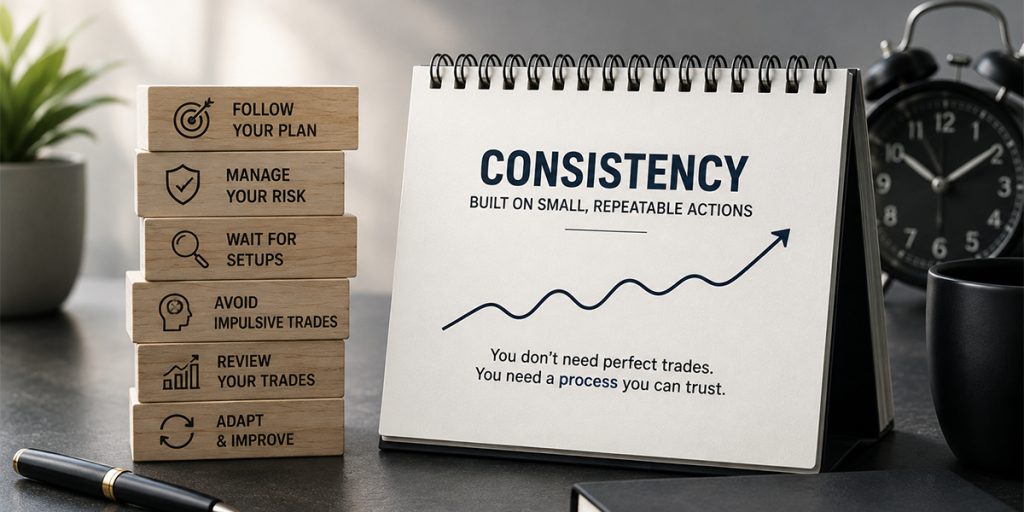
Consistency in trading does not mean making money every day. Because no market environment behaves predictably enough to make it realistic.
Instead, consistency means repeatedly following a well-defined trading process. A trader following their strategy, respects their risk limits and evaluates their decisions objectively is demonstrating consistency even when an individual trade ends in a loss. A consistent trader focuses on things they can control
- Following a defined trading plan
- Managing position sizes and risk
- Waiting for suitable trading setups
- Avoiding impulsive entries
- Reviewing previous trades
- Adapting to changing market conditions
One Big Winning Trade Doesn’t Make a Successful Trader

One of the most dangerous psychological traps in trading is allowing a single successful trade to change your behaviour.
Imagine a trader takes a position based on a well-planned setup and the market moves in their favour. The trade generates an unusually large return. Instead of considering it as one successful outcome, the trader believes they have found a formula for easy profits.
The problem was not necessarily the strategy. The problem was the loss of discipline after the winning trade.
Experienced traders know that a single result tells you very little about the quality of a trading system. A strategy should be evaluated across a meaningful sample of trades and different market conditions.
Risk Management

End of the day it’s the capital is what allows you to stay in the race.
So, risk management that should be part of the setup itself. A trader can have a strong market view and still experience a loss. Markets can move unexpectedly, economic data can surprise expectations, and volatility can increase within minutes. No analysis can remove uncertainty from trading.
Good risk management is about making sure that uncertainty does not turn one wrong decision into a devastating one.
Depending on the trading approach, this can include:
- Using appropriate position sizes
- Defining stop-loss levels
- Avoiding excessive leverage
- Limiting exposure to a single position or idea
- Understanding the potential impact of volatility
- Knowing when staying out of the market is the better decision
The first objective of consistency is survival.
Trading Psychology
A trading strategy is relatively easy to follow when everything is going according to plan. The real test begins after a losing streak.
Fear may encourage a trader to exit too early. Greed may encourage them to hold a position longer than planned. FOMO can push them into trades they never intended to take. A frustrating loss can trigger revenge trading.
These emotional reactions are part of human decision-making. The objective is not to eliminate emotions completely. Instead, traders need a process that prevents emotions from becoming the decision-maker.
One useful framework is:
Plan → Execute → Record → Review → Improve
By following a structured process, traders can create distance between an emotional reaction and a trading decision.
How to Build a Consistent Trading Routine
A trading routine does not have to be complicated. Before entering the market, learn what is happening around you. Check major economic events, identify important price levels and determine whether current conditions suit your strategy. Before placing a trade, know your entry, exit and risk parameters.
Once the trade is active, avoid changing the plan simply because the market produces a short-term fluctuation. After the trade, record what happened and, more importantly, why you made the decision.
Ask yourself:
- Did I follow my trading plan?
- Did I take trades outside my strategy?
- Did I risk more than planned?
- Did emotions influence my decisions?
- What can I improve next week?
This transforms trading from a sequence of isolated outcomes into a continuous learning process.
Measure Your Trading Progress Beyond Profit
Profit is obviously an important part of trading performance, but it should not be the only measurement. A trader can have a profitable week while making several decisions that violate their own trading rules. Conversely, a trader can experience a losing week while executing their strategy exactly as planned.
That is why process-based measurements matter.
Ask yourself:
Did I follow my plan?
Did I manage risk properly?
Did I avoid impulsive trades?
Did I learn from my mistakes?
Did I adapt when market conditions changed?
These questions provide a much clearer picture of whether you are developing as a trader.
Stay in the race
Trading rewards patience!
You don’t have to catch every move, you do not need to win every trade., you do not need to predict every market reversal. What you need is a process that you understand, risk management that you respect and the discipline to keep learning as the market changes.
Build the process. Respect the risk. Learn from every trade. Stay in the race.
Frequently Answered Questions:
What does consistency mean in trading?
Consistency means following a defined trading process and risk-management approach over time rather than expecting to win every trade.
Why is consistency important in trading?
Consistency can help traders manage emotions, control risk and evaluate their trading performance over a larger sample of trades.
How can traders become more consistent?
Traders can work on consistency by following a trading plan, managing risk, maintaining a trading journal and regularly reviewing their decisions.
Is it possible to win every trade?
No. Trading involves uncertainty, and even well-planned trades can result in losses. The focus should be on managing risk and maintaining a disciplined process.
Start trading now — click here to create your real VT Markets account.








