






Key Takeaways
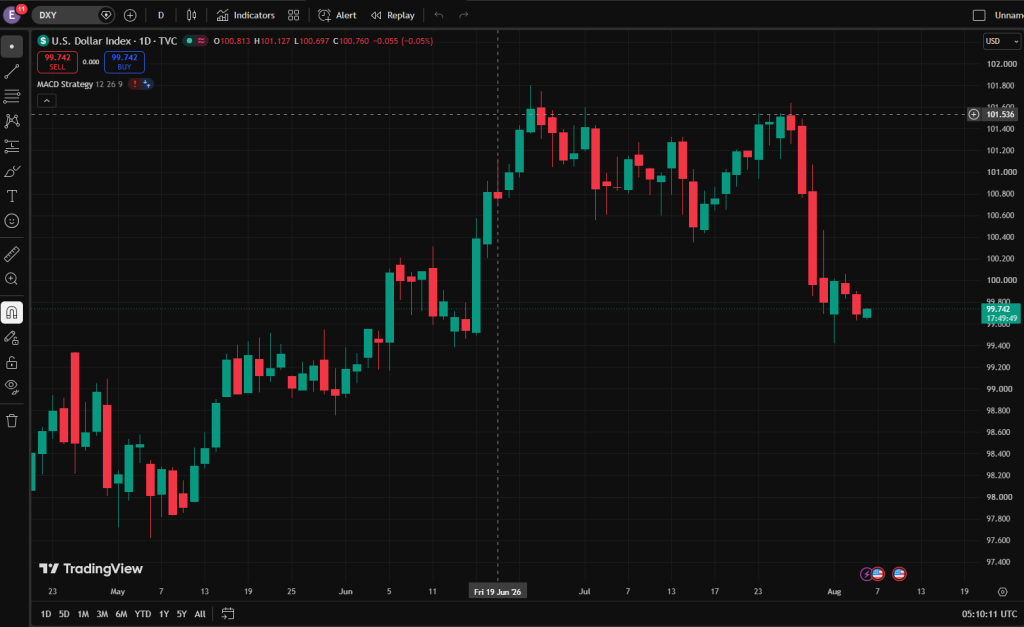
- The US Dollar Index stabilised around the 99.70 area after declining from recent highs near the 101.50 region.
- Easing concerns around potential Strait of Hormuz disruptions reduced oil supply risks and affected inflation expectations.
- Weaker US private payroll data increased focus on labour market conditions and the Fed’s future policy path.
- Federal Reserve officials continue monitoring inflation trends, with future policy decisions dependent on incoming economic data.
- Markets are watching Fed expectations, US economic indicators and key technical levels for the Dollar’s next move.
The US Dollar Index stabilised around the 99.70 area on Thursday after recent declines as markets reassessed geopolitical developments, US economic data and the outlook for Federal Reserve policy.
The Dollar faced pressure as concerns around potential energy supply disruptions eased following developments surrounding the Strait of Hormuz. Lower oil-related risks reduced some inflation concerns, leading markets to adjust expectations for the Fed’s future interest-rate path.
Iran and Oman were finalising an agreement related to reopening the Strait of Hormuz, with discussions focused on shipping arrangements through the key energy route.
The development eased some immediate supply concerns, although markets continued assessing how changes in energy prices could influence inflation expectations and monetary policy.
Why Traders Are Watching This
The Dollar remains highly sensitive to Federal Reserve expectations, US economic data and changes in global market conditions.
Recent moves have been influenced by signs of a softer US labour market, as investors reassess the strength of economic momentum and the outlook for future interest rates.
US private payrolls increased by 44,000 in July, below expectations and marking the weakest monthly gain since January, according to ADP data.
The weaker employment data increased focus on whether slowing labour conditions could influence future monetary decisions, although inflation remains the key factor shaping the Fed’s approach.
Fed Governor Lisa Cook said she is prepared to support higher interest rates if inflation fails to continue easing.
The Dollar’s next direction will depend on whether upcoming economic data supports a more cautious or restrictive monetary outlook.
Key Trading Levels
| Price Level | What Markets Are Watching |
| 100.5 | Key resistance if Dollar recovery gains momentum |
| 100 | Immediate resistance and first recovery level |
| 99.7 | Current trading area and short-term reference |
| 99.5 | Key support after the recent decline |
| 99 | Next support level if selling pressure increases |
| 98.5 | Deeper support zone if downside continues |
The US Dollar Index is trading around the 99.70 level after declining from recent highs near the 101.50 mark.
The index is attempting to stabilise, with 100.00 acting as the first recovery level. A move above this level could bring the 100.50 resistance area into focus.
On the downside, 99.50 remains an important support level. A break below this level could increase selling pressure towards 99.00, with further downside potentially exposing the 98.50 support zone.
Bullish and Bearish Setups
| Setup | Trigger | Potential Market Reaction |
| Dollar Recovery | Move above 100.00 | DXY may attempt to recover towards the 100.50 resistance area |
| Bullish Continuation | Break above 100.50 | Buyers may regain control and extend the recovery |
| Range Consolidation | Hold between 99.50 and 100.00 | Price may stabilise while markets reassess the next direction |
| Bearish Breakdown | Fall below 99.50 | Selling pressure may increase towards 99.00 |
| Further Weakness | Break below 99.00 | DXY may move towards the 98.50 support zone |
The US Dollar remains at a key technical point as it attempts to stabilise after the recent decline.
The bullish scenario depends on DXY reclaiming the 100.00 level, which could support a move towards the 100.50 resistance area as recovery momentum improves.
The bearish scenario becomes more likely if DXY breaks below the 99.50 support level, which could increase downside pressure towards 99.00 and the 98.50 support zone.
Trade DXY CFDs With VT Markets
The US Dollar Index remains one of the most closely watched financial instruments, influenced by Federal Reserve policy, economic data, inflation expectations and global market conditions.
With VT Markets, traders can access DXY CFDs alongside forex pairs, indices, commodities, shares and other global CFD markets through MT4, MT5 and the VT Markets App.
Traders can use charting tools to monitor Dollar movements, technical levels and major economic events affecting currency markets.
Start trading indices with VT Markets today.
Why Trade DXY CFDs With VT Markets?
DXY CFDs allow traders to gain exposure to movements in the US Dollar Index without directly holding the underlying currencies.
The index reflects the Dollar’s performance against a basket of major currencies and can react quickly to changes in monetary policy, economic data and global risk sentiment.
CFD trading involves risk, and leverage can magnify both potential gains and losses.
What to Watch Next
The US Dollar’s next direction will depend on how markets balance Federal Reserve expectations, economic data and global developments.
Key factors include:
- Federal Reserve Policy Outlook: Markets will continue assessing whether incoming data supports changes in expectations for future monetary policy.
- US Labour Market Data: Employment reports may influence expectations for the Fed’s policy path.
- Inflation Data: Further progress or setbacks in inflation could affect Dollar demand.
- Energy Market Developments: Changes in oil prices may influence inflation expectations and interest-rate forecasts.
- Global Risk Sentiment: Geopolitical developments and market uncertainty may affect demand for the Dollar.
From a technical perspective, markets are watching whether DXY can recover above 100.00, while 99.50 remains the key short-term support level.
Frequently Asked Questions
Why is the US Dollar stabilising?
The US Dollar stabilised as markets reassessed weaker US labour data, easing energy risks and changing expectations for Federal Reserve policy.
How do oil prices affect the US Dollar?
Changes in oil prices can influence inflation expectations, which may affect Federal Reserve expectations and Dollar demand.
What affects the US Dollar Index?
DXY is influenced by Federal Reserve decisions, economic data, inflation trends, Treasury yields and global risk sentiment.
Why is US jobs data important for the Dollar?
Employment data provides insight into economic strength and can influence expectations for future Federal Reserve decisions.
What are the key DXY levels to watch?
Markets are monitoring 100.00 and 100.50 as resistance levels, while 99.50 and 99.00 remain important support areas.
Start trading now — click here to create your real VT Markets account.








