





Key Points
- Brent crude rebounded above $79 per barrel as fresh US-Iran strikes revived concerns over supply disruption through the Strait of Hormuz.
- The latest escalation reversed part of the previous decline that followed the interim US-Iran agreement.
- Iran declared that the Strait of Hormuz was closed “until further notice”, although the claim was rejected by US Central Command.
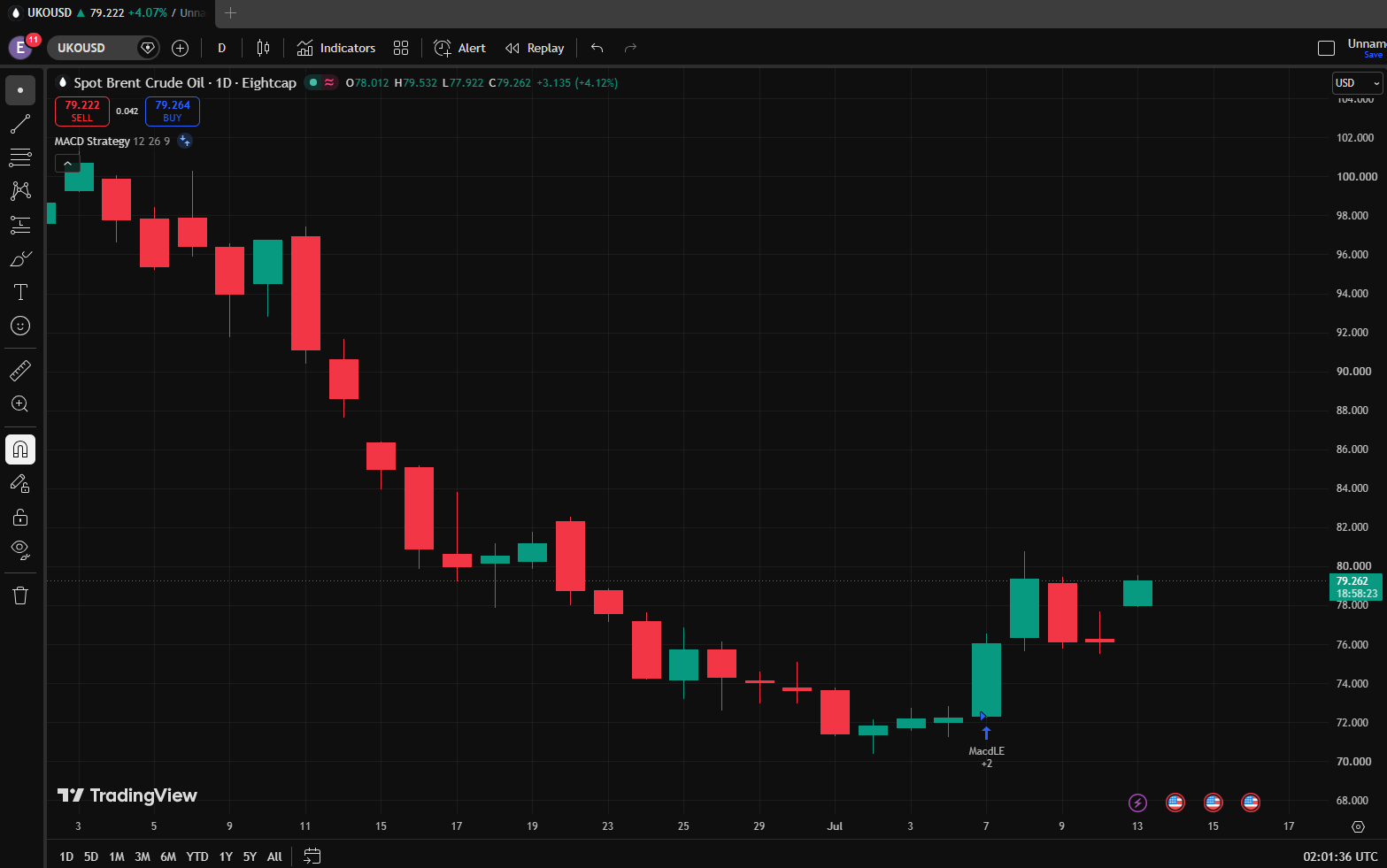
- The UKOUSD daily chart shows immediate resistance near $79.50, while $78.00 is the first support level to monitor.
- A sustained move above $79.50 could bring $80.00 and $82.00 into focus, while a break below $78.00 may expose $76.00.
Brent crude moved sharply higher on Monday, with UKOUSD trading near $79.26 on the daily chart, after the United States and Iran exchanged fresh strikes over the weekend.
The rebound followed a two-day pullback and pushed Brent back above the $79 per barrel area. The latest move suggests traders are once again assigning a higher risk premium to oil as tensions around the Strait of Hormuz intensify. Brent crude also climbed more than 3% in early trading as renewed conflict in the Middle East lifted supply concerns.
The latest escalation reversed part of the earlier decline triggered by the interim US-Iran agreement, which had briefly improved expectations for Middle East energy supply and a more stable shipping environment.
Oil prices tend to react quickly to developments around Hormuz because the waterway is one of the world’s most important energy chokepoints. Any renewed threat to transit can raise concerns about supply disruption, freight risk and tighter market conditions.
Why Traders Are Watching UKOUSD
The latest move matters because it shifts the focus back towards geopolitical supply risk, rather than only macro demand expectations.
Brent had eased after the interim agreement reduced fears of prolonged disruption in the Gulf. That calmer view has now been challenged by a renewed exchange of strikes and tougher rhetoric around shipping access.
The market is now weighing two competing forces. Renewed military action increases the probability of supply disruption and supports prices. At the same time, traders are not yet pricing a full collapse in regional stability, which helps explain why the move, while sharp, remains more measured than earlier conflict-driven spikes.
This leaves UKOUSD in a highly event-driven environment, where price action may remain sensitive to military headlines, shipping data and diplomatic signals.
Fresh Strikes Raise Shipping Concerns
The latest escalation followed another round of US military action against Iran and a retaliatory Iranian response.
US forces carried out a fourth strike in a week against Iran after an Iranian attack on a Cyprus-flagged container ship, intensifying concerns that shipping routes through the Gulf could come under renewed pressure.
Iran later declared that the Strait of Hormuz would be closed “until further notice”, although the claim was rejected by US Central Command. Even so, the statement itself reinforced market anxiety because any disruption, or even the threat of disruption, can quickly affect tanker flows and supply expectations.
The renewed tension also weakened hopes that diplomacy would resume quickly. Tehran has indicated that further negotiations would require Washington to fulfil earlier commitments on Hormuz transit and the normalisation of Iranian oil exports.
Market Reaction Suggests Risk Premium, Not Full Panic
The rebound in Brent shows that traders are rebuilding part of the Hormuz risk premium, but the overall move also suggests that markets are not yet treating the situation as a full-scale supply shock.
That distinction is important. Oil has risen sharply, but not to the extreme levels seen during earlier phases of the conflict. This suggests traders still believe the disruption could remain limited, temporary or manageable unless the conflict expands further.
The current setup therefore reflects heightened caution rather than full panic. Prices are responding to renewed risk, but the market is still waiting for firmer evidence of deeper supply disruption.
Key Trading Levels
| Price Level | What Traders Are Watching |
| $84.00 | Wider resistance if the rally extends |
| $82.00 | Next upside area after a break above $80.00 |
| $80.00 | Psychological resistance level |
| $79.50 | Immediate resistance near the latest session high |
| $79.26 | Current chart area |
| $78.00 | First support level near the breakout area |
| $76.00 | Short-term support if the rebound fades |
| $72.00 | Wider support from the previous recovery zone |
The UKOUSD daily chart shows Brent trading near $79.26 after opening around $78.01, reaching a session high near $79.53 and a low around $77.92.
The latest candle shows strong bullish follow-through and confirms that price has pushed back above the recent consolidation area. The rebound from the low-$70s has now brought Brent towards an important short-term resistance zone.
Immediate resistance is located near $79.50, which aligns with the latest session high. A sustained move above this level could bring the $80.00 psychological level into focus.
If Brent clears $80.00, the next upside area to watch is near $82.00, followed by broader resistance around $84.00.
On the downside, $78.00 is the first support level to monitor. Holding above this area would suggest that the latest breakout remains intact.
A move below $78.00 could expose $76.00. If that level also fails, attention may shift towards the wider support zone near $72.00.
Bullish and Bearish Setups
| Setup | Trigger | Potential Market Reaction |
| Bullish Breakout | Move above $79.50 | Brent may test $80.00 |
| Bullish Extension | Break above $80.00 | Attention may shift towards $82.00 |
| Wider Recovery | Move above $82.00 | Brent may approach $84.00 |
| Range Consolidation | Remain between $78.00 and $79.50 | Traders may wait for clearer supply signals |
| Bearish Pullback | Move below $78.00 | Brent may retest $76.00 |
| Deeper Reversal | Break below $76.00 | Downside may extend towards $72.00 |
The bullish scenario depends on UKOUSD breaking above $79.50 and holding that level. That would suggest geopolitical risk is still supporting prices and could bring $80.00 into focus.
A stronger bullish extension would require a confirmed break above $80.00. If buyers clear that level, Brent could advance towards $82.00.
The neutral scenario is consolidation between $78.00 and $79.50. Range-bound movement may indicate that traders are waiting for clearer signals on whether the latest escalation will meaningfully affect oil flows.
The bearish scenario strengthens if UKOUSD falls below $78.00. A confirmed break could bring $76.00 into focus.
If selling pressure continues below $76.00, the broader support area near $72.00 may become the next downside reference.
Disclaimer
The price levels and market scenarios above reflect the author’s view at the time of writing and do not represent financial advice or an official recommendation from VT Markets. Traders should conduct their own analysis and manage risk carefully.
Trade UKOUSD With VT Markets
UKOUSD remains active when geopolitical risk, shipping disruption, supply concerns and global demand expectations move at the same time.
With VT Markets, traders can access UKOUSD CFDs alongside WTI crude, gold, forex, indices, shares, ETFs and other global CFD markets from one platform. This helps traders follow the wider macro picture, from oil and inflation expectations to the US dollar and broader market sentiment.
Use VT Markets’ charting tools to monitor support, resistance, moving averages and breakout behaviour as the next UKOUSD setup develops.
Start trading UKOUSD CFDs with VT Markets today.
Why Trade UKOUSD as a CFD?
UKOUSD CFDs allow traders to take a view on rising or falling Brent crude price movements without owning physical barrels or futures contracts.
That flexibility can be useful when oil reacts quickly to geopolitical headlines, Strait of Hormuz risks, shipping disruption concerns and changes in global demand expectations.
If UKOUSD breaks above resistance, traders can watch for bullish continuation. If ceasefire hopes return or supply risks ease, traders can monitor downside setups as the geopolitical risk premium cools.
With VT Markets, traders can follow UKOUSD price action in real time and compare it with other major CFD markets through one account.
What to Watch Next
Traders should monitor whether Brent can hold above the $79.00 area after the latest rebound.
The next key driver will be whether tensions between the US and Iran continue to escalate or begin to stabilise. Shipping conditions through the Strait of Hormuz will remain especially important because any confirmed disruption could strengthen the supply-risk narrative further.
Traders should also watch how much oil traffic is moving through the strait. Conflicting vessel-flow signals may continue to influence market sentiment and the size of the risk premium.
For now, the $78.00 to $79.50 range is the main short-term area to watch. A confirmed move above $79.50 could bring $80.00 into focus, while a break below $78.00 may expose $76.00.
Frequently Asked Questions
Why did Brent crude rise?
Brent rose after fresh US-Iran strikes revived concerns about supply disruption and shipping risks through the Strait of Hormuz.
Why does the Strait of Hormuz matter for oil prices?
The strait is one of the world’s most important energy routes. Any threat to tanker traffic can raise fears of tighter supply and push oil prices higher.
Is the market pricing a full supply shock?
Not yet. The rebound suggests that traders are rebuilding part of the geopolitical risk premium, but the move remains more measured than during earlier conflict-driven spikes.
What are the main UKOUSD levels to watch?
Immediate resistance is near $79.50, followed by $80.00 and $82.00. Immediate support is near $78.00, followed by $76.00 and $72.00.
What could push Brent higher?
Further escalation between the US and Iran, confirmed disruption to shipping flows or stronger evidence of tighter supply could support Brent.
What could push Brent lower?
A de-escalation in tensions, improved shipping conditions or signs that the current disruption risk is being overstated could place pressure on prices.
Start trading now — click here to create your real VT Markets account.








