





Key Takeaways
- Synthetic Indices are algorithm-generated markets designed with predefined price-movement models rather than tracking real-world assets such as stocks, forex, commodities or traditional indices.
- VT Markets offers 18 Synthetic Indices across three categories: CalmPulse, LiftTick & DipTick, and DriftLine, each with different price behaviours.
- Prices are updated every second, with trading available 24/7, including weekends and holidays.
- Margin requirements can start from USD 0.50, while product-specific leverage ranges from 100:1 to 7000:1.
- Synthetic Indices are available through designated MetaTrader 5 (MT5) servers and the VT Markets App for eligible clients in selected markets across Asia and Latin America.
Regional Availability Disclaimer: Synthetic Indices are available only to eligible clients in selected regions across Asia and Latin America (LATAM). Product availability, leverage and trading conditions may vary by jurisdiction, account type, and instrument.
Please refer to the latest product specifications on MetaTrader 5 (MT5) or the VT Markets App before trading.
Traditional markets move in response to everything from interest rates and company earnings to economic data and geopolitical events.
Synthetic Indices work differently.
Instead of tracking real-world assets, they use predefined mathematical and probability models to generate different types of price movement. This allows traders to choose a trading environment based on how they want prices to behave rather than the real-world asset they want to trade.
For instance, are they looking for continuous volatility, sudden upward or downward jumps, or fixed step-by-step movements?
VT Markets offers 18 Synthetic Indices across these three distinct price-movement models, giving traders different environments for technical, systematic, and algorithmic trading approaches.
This guide explains why traders may consider Synthetic Indices, how each type works, which may suit different trading approaches, and the key risks and trading conditions to understand.
What Are Synthetic Indices?
Synthetic Indices are algorithm-generated financial instruments designed to simulate different types of price movement.
Unlike traditional indices such as the NASDAQ 100 or Dow Jones Industrial Average, Synthetic Indices do not represent a basket of listed companies or track underlying assets such as stocks, forex or commodities.
Instead, each Synthetic Index follows a predefined pricing model that determines characteristics such as:
- Volatility
- Movement frequency
- Price fluctuation size
- Probability of sudden jumps
These characteristics create different price behaviours across Synthetic Indices.
Synthetic Indices vs Traditional Market Indices
Although both use the term “index”, Synthetic Indices and traditional market indices are built differently.
Traditional indices track the performance of groups of listed companies. Their prices can be influenced by factors such as company performance, economic conditions, interest rates, geopolitical developments and investor sentiment.
Synthetic Indices do not track underlying financial assets. Instead, their prices are generated using predefined mathematical and probability models.
Here are the key differences:
| Synthetic Indices | Traditional Indices | |
| Price source | Algorithm-generated models | Performance of underlying securities |
| Underlying assets | No underlying asset | Usually a basket of listed shares |
| Market drivers | Predefined price models | Economic data, company performance and market sentiment |
| Trading hours | 24/7 | Based on underlying market hours |
| Price behaviour | Determined by mathematical and probability models | Driven by real-market activity |
| Weekend trading | Available | Generally unavailable |
Why Trade Synthetic Indices?
The biggest difference is not simply that Synthetic Indices are algorithm-generated.
It is that traders can choose the type of price they want to trade.
Instead of waiting for a particular market session, news event, or volatility environment, Synthetic Indices provide predefined trading environments that are available around the clock.
1. Trade 24/7
Synthetic Indices can be traded 24 hours a day, seven days a week, including weekends and holidays.
Because their prices are generated independently rather than sourced from external exchanges, trading is not restricted by traditional market opening hours.
For traders, that means more flexibility to trade around their own schedules, even when traditional markets are closed.
2. Focus on Price Action, Not the News
Synthetic Indices are not directly linked to:
- Economic announcements
- Central bank decisions
- Corporate earnings
- Political events
- Geopolitical developments
- Real-world market sentiment
This gives traders an environment where they can focus on price behaviour, technical analysis, and their trading strategy without directly responding to external market events.
However, independence from external events does not make prices predictable or risk-free. Price direction remains uncertain.
3. Choose the Price Behavior You Want to Trade
Instead of choosing between forex, gold, or equities, traders can choose between different types of price movement. Each environment supports different ways of approaching the market:
- Prefer continuous price fluctuations? Explore CalmPulse.
- Want sudden upward or downward jumps? Explore LiftTick or DipTick.
- Prefer fixed step-by-step movements? Explore DriftLine.
4. Built for Technical, EA and Algorithmic Strategies
Synthetic Indices offer predefined price-movement environments that can be useful for traders who rely on technical, systematic, or automated strategies.
With prices updating every second and markets available 24/7, traders can run EAs and algorithmic strategies without being limited by traditional market sessions.
Different Synthetic Indices can also be used to explore how a strategy responds to different market behaviors:
- CalmPulse: Test strategies across different volatility levels
- LiftTick & DipTick: Explore how EAs respond to sudden price jumps and stress scenarios
- DriftLine: Explore grid, high-frequency, and systematic strategies in a fixed-step environment
This makes Synthetic Indices particularly relevant for traders who want to develop, test, and run rule-based trading strategies across different price behaviors.
Important: A predefined price model does not make future movements predictable or guarantee an EA or algorithmic strategy will perform successfully.
5. Start with Flexible Margin Requirements
Margin requirements can start from USD 0.50, depending on the instrument, trading volume, leverage, and applicable account conditions.
Product-specific leverage ranges from 100:1 to 7000:1, depending on the characteristics of the Synthetic Index.
Higher leverage allows a larger position to be controlled with less margin, but it also magnifies potential gains and losses.
Which Synthetic Index Should You Trade?
VT Markets offers 18 Synthetic Indices grouped into three categories, each with its own price-movement characteristics.
The easiest way to choose is to start with the price behaviour you want to trade:
| If you want to… | Consider |
| Trade continuous price movements | CalmPulse |
| Test an EA across different volatility levels | CalmPulse |
| Explore sudden upward or downward movements | LiftTick / DipTick |
| Stress-test an algorithm against sudden jumps | LiftTick / DipTick |
| Explore grid or systematic strategies | DriftLine |
| Test strategies in a fixed-step environment | DriftLine |
Using an EA or algorithm? There is no single Synthetic Index for automated trading. Choose the price behavior that best matches the scenario you want your strategy to encounter.
For more details, please refer to the table below or this page:
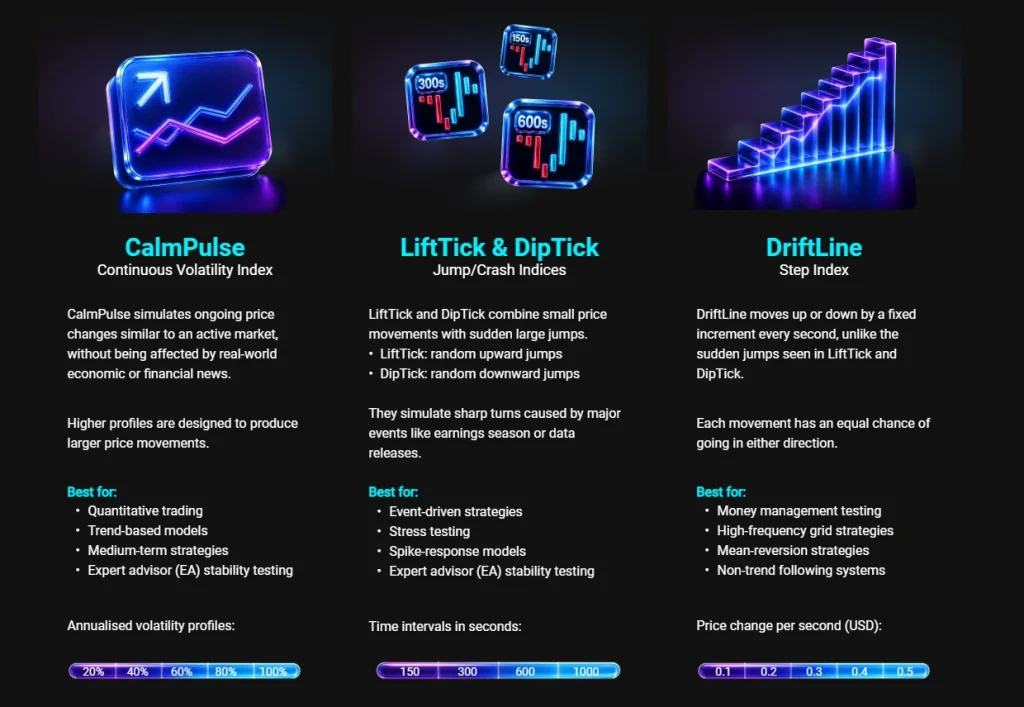
Available Symbols for Synthetic Indices
| Category | Available Products |
| CalmPulse | CalmPulse20, CalmPulse40, CalmPulse60, CalmPulse80, CalmPulse100 |
| LiftTick | LiftTick150, LiftTick300, LiftTick600, LiftTick1000 |
| DipTick | DipTick150, DipTick300, DipTick600, DipTick1000 |
| DriftLine | DriftLine0.1, DriftLine0.2, DriftLine0.3, DriftLine0.4, DriftLine0.5 |
Synthetic Indices Trading Conditions
Before opening a position, traders should understand that Synthetic Indices have their own margin, financing, execution, and price-management rules.
- Prices Update Every Second: Prices across VT Markets Synthetic Indices update every second, providing continuous market activity throughout the week.
- Overnight Financing: Positions held overnight are subject to financing charges.
- Total Position Margin for Hedged Trades
- Synthetic Indices use a total-position margin calculation. This means margin is based on the combined volume of long and short positions, rather than net exposure.
- For example: 3 lots long + 2 lots short = margin calculated on 5 lots
- Fill or Kill Execution: Synthetic Index orders use Fill or Kill (FOK) execution.
Risks to Consider
Although Synthetic Indices operate according to predefined rules, their future price direction remains uncertain. Traders should understand the potential risks before opening a position.
Key risks include:
- Leverage risk: Leverage can magnify both potential gains and losses.
- Rapid price movements: Certain Synthetic Indices, such as LiftTick and DipTick, may experience sudden price changes that can quickly affect positions.
- Slippage risk: During fast price movements, execution prices may differ from the requested levels.
- Random price behaviour: Predefined models do not guarantee predictable outcomes, and prices may move unexpectedly.
- Position management risk: Traders should consider margin requirements, financing costs and instrument-specific trading conditions when managing positions.
Understanding the product characteristics and applying appropriate risk management are important before trading.
How to Trade Synthetic Indices on the VT Markets App
Eligible clients can access and trade Synthetic Indices directly through the VT Markets App.
1. Log in to the VT Markets App
Open the VT Markets App and log in to your trading account.
2. Choose Your Instrument
Before trading, consider which price behaviour fits your approach. For example:
- CalmPulse for continuous volatility
- LiftTick for random upward jumps
- DipTick for random downward jumps
- DriftLine for fixed step movements
3. Search for a Synthetic Index
Use the search bar to enter the instrument you want to trade.
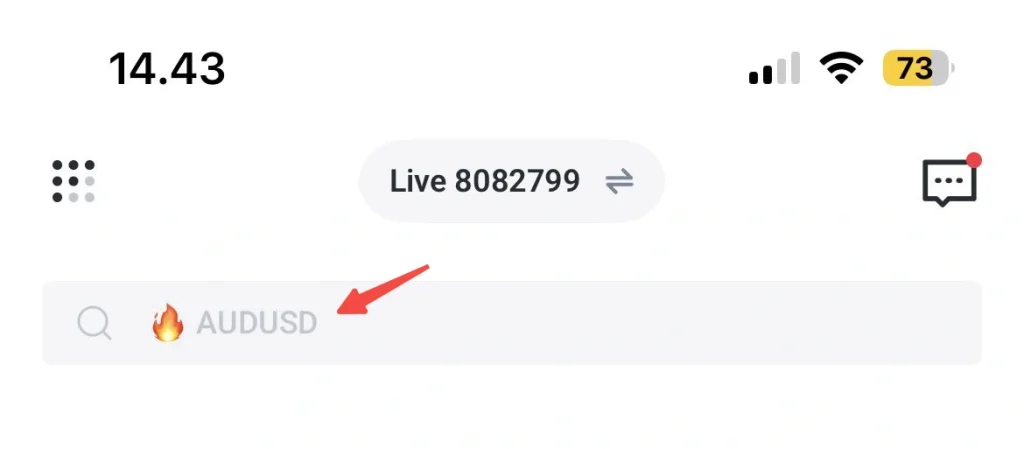
For example, search “CalmPulse” to view the available CalmPulse Indices.
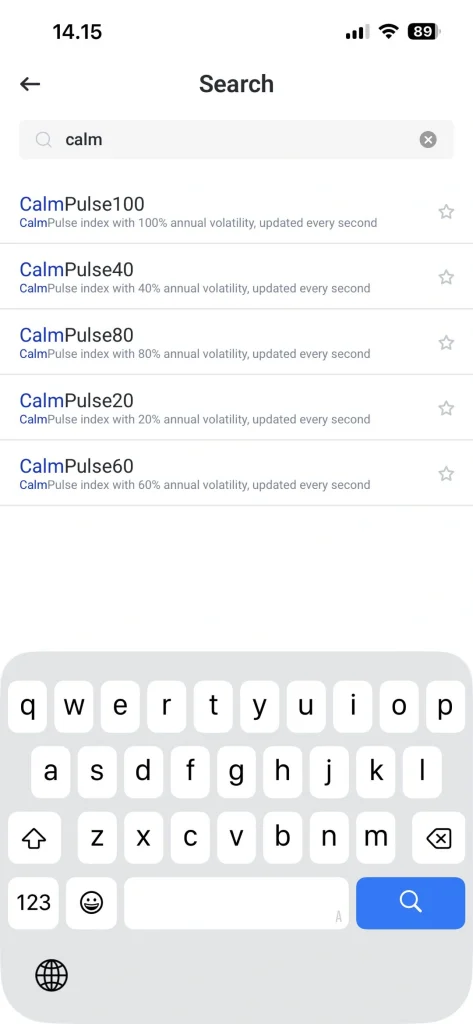
4. Select Buy or Sell
Open the selected Synthetic Index and review its current price, margin requirement and trading information.
Select:
- Buy if you expect the price to move higher
- Sell if you expect the price to move lower
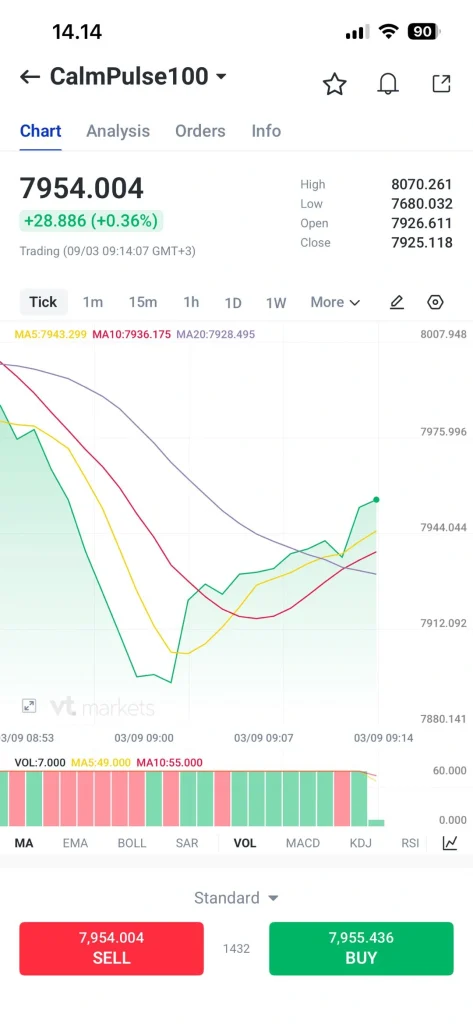
Before confirming the order, review your position size and applicable trade settings.
Explore Synthetic Indices with VT Markets
From continuous volatility to sudden jumps and fixed step movements, explore 18 algorithm-generated Synthetic Indices designed for different trading approaches, all available 24/7.
Start trading Synthetic Indices with VT Markets today and discover different price behaviours across CalmPulse, LiftTick & DipTick, and DriftLine.
Frequently Asked Questions
What are Synthetic Indices?
Synthetic Indices are algorithm-generated markets designed to simulate different types of price movement.
Unlike traditional financial instruments, they do not track stocks, forex, commodities or traditional market indices. Instead, their prices are generated using predefined mathematical and probability models.
Why trade Synthetic Indices?
Synthetic Indices give traders access to predefined price-movement environments 24/7.
Traders can choose between continuous volatility with CalmPulse, random upward or downward jumps with LiftTick and DipTick, or fixed step movements with DriftLine.
Their prices are also independent of real-world economic announcements, earnings, and market sentiment, allowing traders to focus on the price behavior generated by each instrument’s model.
How are Synthetic Indices different from traditional indices such as DJ30 and NAS100?
Traditional indices represent groups of real-world assets, such as listed shares.
Synthetic Indices do not represent underlying companies or financial assets. Their prices are generated independently using predefined mathematical and probability models.
Why can Synthetic Indices be traded 24/7?
Synthetic Indices do not depend on external exchanges or traditional market opening hours.
Their prices are generated continuously according to predefined models, allowing trading access 24 hours a day, seven days a week, including weekends and holidays.
What trading conditions apply to Synthetic Indices?
Trading conditions vary depending on the Synthetic Index and may include:
- Product-specific leverage from 100:1 to 7000:1
- Margin requirements from USD 0.50
- Daily overnight financing charges
- Fill or Kill (FOK) order execution
- Instrument and directional volume limits
- Possible price resets at predefined extreme levels
Please refer to the latest product specifications on MT5 or the VT Markets App before placing a trade.
Who can trade Synthetic Indices with VT Markets?
Synthetic Indices are available only to eligible clients in selected regions across Asia and Latin America.
Availability depends on factors including country of residence, account type and applicable regulatory requirements.
For more information, please contact VT Markets Customer Support.
What Synthetic Indices are available in VT Markets?
VT Markets offers 18 Synthetic Indices across three categories:
- CalmPulse – Continuous Volatility Index
- LiftTick & DipTick – Jump/Crash Indices
- DriftLine – Step Index
Each category follows a different price-movement model.
Is there an overnight financing charge for Synthetic Indices?
Yes. Positions held overnight are subject to daily financing charges.
The charge is calculated using an annual interest-rate method and varies according to the applicable instrument and position direction.
How is margin calculated when hedging Synthetic Indices?
Margin is calculated based on the total volume of long and short positions, rather than only the net position.
For example:
3 lots long + 2 lots short = margin calculated on 5 lots
This calculation applies even when long and short positions partially or fully offset each other.
What is the order execution policy for Synthetic Indices?
Synthetic Index orders use Fill or Kill (FOK) execution.
If an order cannot be filled immediately and in full, it is cancelled automatically instead of being partially filled.
Are Synthetic Indices affected by economic news?
No. Synthetic Indices follow predefined pricing models rather than responding directly to external market events such as economic announcements, company earnings or market sentiment.
Can I Use EAs or Algorithmic Trading with Synthetic Indices?
Yes. Synthetic Indices can provide different price-movement environments for EA and algorithmic trading strategies. For example:
- CalmPulse can be used to explore how an algorithm performs across different volatility levels.
- LiftTick and DipTick can help test how an EA responds to sudden upward or downward jumps.
- DriftLine provides a fixed-step environment for exploring grid, systematic, and other rule-based strategies.








