






Key Points
- EUR/USD remains under pressure as continued US dollar strength weighs on the euro.
- The US Dollar Index moved above 100, supported by expectations that the Federal Reserve may maintain a restrictive policy stance.
- Eurozone consumer confidence weakened to -17 in September, adding concerns over regional economic momentum.
- Flash PMI releases from the Eurozone and US will provide fresh clues on the relative strength of both economies.
Market Move
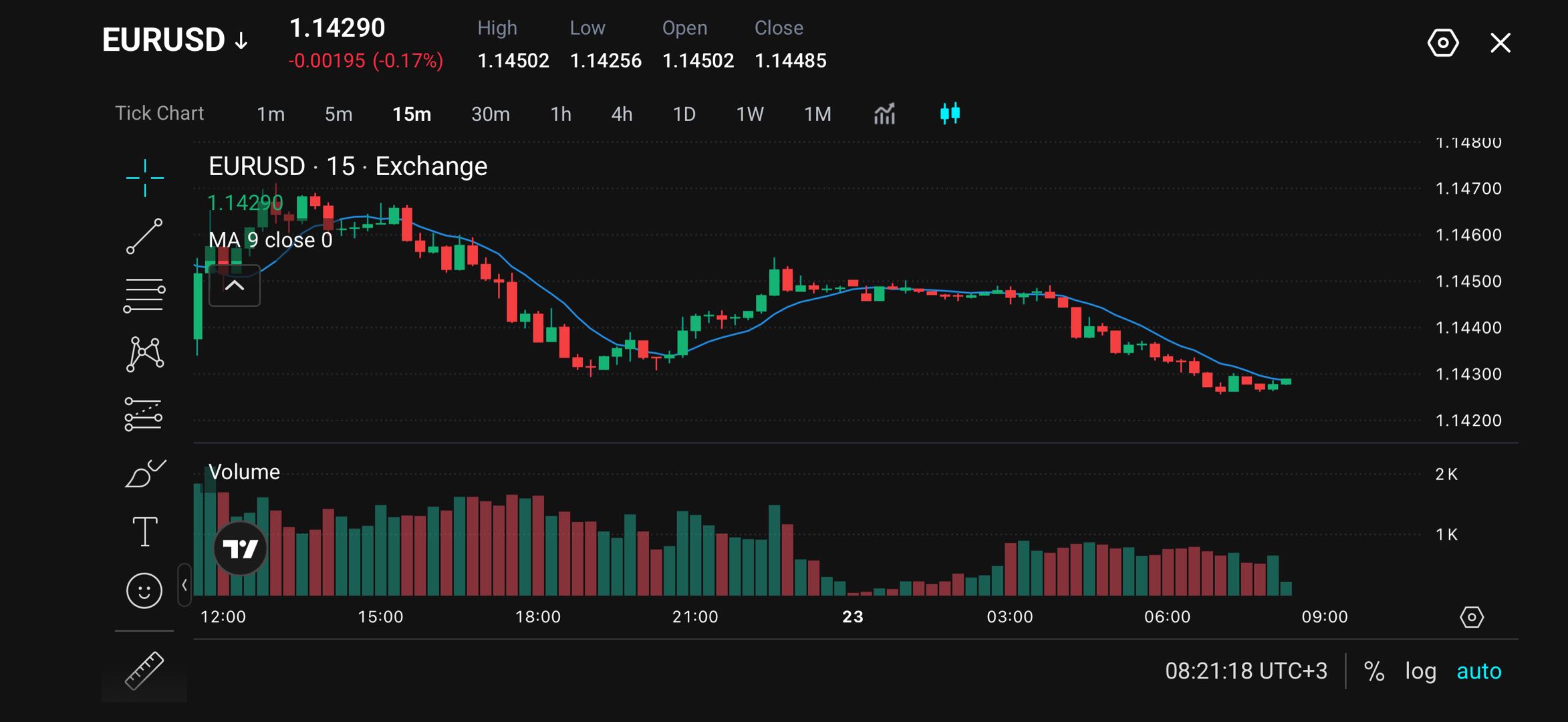
EUR/USD is trading near 1.14290, down 0.17% on the session, after moving between a high of 1.14502 and a low of 1.14256.
The pair weakened during the session as buyers failed to extend the earlier recovery, with price gradually moving lower after testing the 1.1450 area.
EUR/USD is trading below the short-term 9-period moving average, showing that buyers have yet to regain control.
Why Traders Are Watching EUR/USD
EUR/USD remains influenced by the different economic outlooks between the US and Eurozone.
The US dollar has gained support as markets reassess Federal Reserve policy expectations. Continued dollar strength could limit upside potential for EUR/USD by increasing pressure on the euro.
Meanwhile, weaker Eurozone confidence has raised concerns about domestic demand. Consumer confidence declined to -17 in September, below the expected -16, highlighting ongoing challenges for the regional economy.
Attention now turns to the upcoming Eurozone and US flash PMI releases. Stronger Eurozone activity data could improve confidence in the euro, while stronger US data may reinforce demand for the dollar.
Key Trading Levels
| Price Level | Significance |
| 1.15 | Major psychological resistance |
| 1.145 | Short-term resistance and recent rejection area |
| 1.143 | Current trading zone |
| 1.1425 | Immediate support near session low |
| 1.14 | Key psychological support |
| 1.135 | Next downside area if selling pressure increases |
The 1.1450 resistance and 1.1400 support areas remain the key short-term zones for the next directional move.
A break above 1.1450 could improve short-term momentum, while a move below 1.1400 may expose further downside towards 1.1350.
Bullish and Bearish Setups
| Setup | Trigger | Potential Market Reaction |
| Recovery Attempt | Hold above 1.1425 | EUR/USD may retest the 1.1450 resistance area |
| Bullish Breakout | Break above 1.1450 | Momentum could strengthen towards 1.1500 |
| Range Consolidation | Hold between 1.1400–1.1450 | Pair may remain sideways while awaiting PMI data |
| Bearish Breakdown | Fall below 1.1400 | Selling pressure could increase towards 1.1350 |
The bullish scenario depends on EUR/USD regaining momentum above 1.1450, which could signal improving buyer interest.
The bearish scenario becomes more relevant if EUR/USD breaks below 1.1400, increasing the risk of further downside towards 1.1350.
Disclaimer
The price levels and market scenarios above reflect the author’s assessment at the time of writing. They do not represent financial advice or an official recommendation from VT Markets. Traders should conduct their own analysis and manage risk carefully.
EUR/USD Prediction: Can PMI Data Change the Trend?
The upcoming Eurozone and US flash PMI releases will provide further clues on the relative strength of both economies.
Stronger-than-expected Eurozone PMI data could improve confidence in the euro, while weaker readings may reinforce concerns over regional growth.
On the other hand, stronger US PMI data could support the dollar by highlighting stronger economic activity, potentially adding pressure on EUR/USD.
Learn more about trading Forex Pairs on VT Markets here.
Frequently Asked Questions
Why is EUR/USD falling?
EUR/USD has weakened as stronger US dollar momentum and softer Eurozone sentiment continue to weigh on the euro.
What could move EUR/USD next?
The upcoming Eurozone and US flash PMI releases could influence the pair by showing the relative strength of both economies.
Why is 1.1400 important for EUR/USD?
The 1.1400 level is a key psychological support area. A break below it could increase selling pressure, while holding above it may allow the pair to stabilise.
How does US dollar strength affect EUR/USD?
A stronger US dollar can pressure EUR/USD lower because the pair reflects the value of the euro relative to the dollar.
Start trading now — click here to create your real VT Markets account.








