






Gold (XAUUSD) and EURUSD have often moved in the same direction because both are priced against the US dollar: when the dollar weakens, both have tended to rise, and when it strengthens, both have tended to fall. The relationship is not fixed. Euro-specific news, such as ECB policy, and gold-specific drivers, such as safe-haven demand, can cause them to diverge.
This guide explains why the two markets are linked, when the link has broken down, and what is different about EURUSD for someone who already follows gold. It is educational only and does not recommend trading in either market.
Why gold and EURUSD often move together
Correlation measures how closely two prices move relative to each other, on a scale from -1 (opposite directions) to +1 (the same direction). Gold and EURUSD have often shown a positive correlation, which means they have tended to rise and fall together. Correlation describes past behaviour. It does not explain why prices move, and it does not predict what they will do next.
The link runs through the US dollar. XAUUSD is the price of gold in US dollars. EURUSD is the price of one euro in US dollars. In both cases the dollar is the quote currency, so a change in the dollar’s value shows up in both prices:
- Weaker dollar. Each euro buys more dollars, so EURUSD has tended to rise. Gold priced in dollars becomes cheaper for buyers holding other currencies, which has tended to support demand and lift the dollar price.
- Stronger dollar. The reverse has tended to apply: EURUSD has tended to fall and gold has tended to come under pressure.
The euro also has a large role in the US Dollar Index (DXY), which measures the dollar against a basket of six major currencies. According to ICE, the index’s operator, the euro has the largest weight in that basket. This is why the dollar index and EURUSD have tended to move in opposite directions, and why gold has often been described as moving inversely to the dollar index. The US dollar index guide covers the basket in more detail, and the beginner’s guide to gold versus the US dollar explains the gold side of the link. The What Correlates With Gold? guide places this pair alongside the other markets gold is compared with.
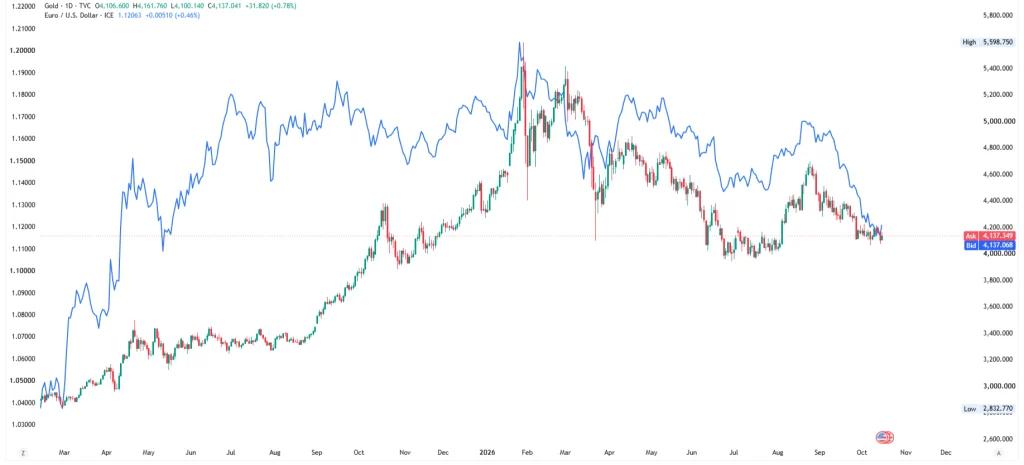
When they diverge
The dollar is only one of the forces acting on each market. When other forces dominate, gold and EURUSD can move apart. Three situations are common.
ECB and Federal Reserve policy differences. EURUSD reflects the gap between the European Central Bank (ECB) and the US Federal Reserve. If markets expect the ECB to cut interest rates while the Fed holds, the euro can weaken against the dollar for euro-specific reasons. Gold, which is priced in dollars and has no euro-specific driver, may respond differently.
Safe-haven flows. Gold is often treated as a safe haven, meaning an asset investors have historically turned to during uncertainty. In a period of stress, demand for gold can rise even when the dollar is also strong, because the dollar itself is sometimes sought as a safe haven. In that case gold and EURUSD can move in opposite directions.
Euro-area shocks. Political events, energy price shocks or weak economic data in the euro area can push EURUSD down without a matching move in gold. Equally, gold-specific news such as central-bank purchases or changes in real yields (interest rates after inflation) can move gold without affecting the euro.
The relationship between the two has changed over time. Periods of close alignment have been followed by periods where it weakened or reversed, so any correlation reading depends on the window it was measured over.
Recent months show how this plays out. Based on monthly Yahoo Finance data, gold fell from about $4,600 to about $4,040 in June 2026 while EURUSD rose from about 1.141 to 1.152. In July both rose, gold to about $4,110 and EURUSD to about 1.159. In August they split: gold climbed from about $4,140 to about $4,480 while EURUSD fell from about 1.162 to 1.134, even though the US Dollar Index barely changed, from about 99.7 to 99.4. In September both fell, gold to about $4,190 and EURUSD to about 1.122. Over the four months, the two moved the same way twice and in opposite directions twice.
Events that move both
Anyone who already follows gold is likely to track the events that also move EURUSD. Three stand out:
- FOMC meetings. The Federal Open Market Committee sets US interest-rate policy. Its decisions and statements shape dollar and interest-rate expectations, which feed into both markets.
- US CPI. The Consumer Price Index measures US inflation. It influences expectations for Fed policy and real yields.
- NFP. Non-farm payrolls is the monthly US jobs report. Strong or weak readings can move the dollar quickly.
A single event does not move the two markets identically. A US data release may move the dollar, and with it both prices, in one direction at the same moment, but the size can differ, and the euro can also respond to European data released around the same time. Both markets react to the US dollar, but not always the same way. For anyone who already follows an economic calendar for gold, these dates cover much of what EURUSD needs too, though the euro adds European releases and ECB meetings.
What’s different about trading EURUSD
EURUSD is a currency pair, and several features differ from gold.
- Pips. A pip is the standard unit for measuring price moves in a currency pair. For EURUSD it is usually the fourth decimal place, 0.0001. Gold is generally quoted in dollars and cents per ounce. In August 2026, EURUSD traded between about 1.133 and 1.165, a range of roughly 330 pips, while gold’s range that month ran from about $4,075 to about $4,755.
- Lot size. According to the VT Markets trading conditions page, one lot of a currency pair is 100,000 units of the base currency, and 0.01 lot is 1,000 units. Contract specifications for gold are set separately.
- Trading hours. The forex market runs close to 24 hours a day on weekdays. On the trading conditions page, EURUSD trading hours (platform time, GMT+3) are shown as Monday to Thursday 00:01 to 23:58 and Friday 00:01 to 23:57.
- Spreads. The spread is the difference between the buy and sell price and is a cost of trading. Spreads differ by account type and can change with market conditions, so the current figures should be read from the trading conditions page rather than assumed.
Margin requirements also differ by instrument. Currency pairs can be volatile, and prices can move sharply against a position.
For the pair itself, see the EUR/USD complete guide.
Correlation isn’t a strategy
A correlation is a description of how two prices have behaved together. It is not a rule they must follow. Two points matter when gold and EURUSD are considered side by side.
First, correlated positions add up to one bigger exposure. If two markets tend to move in the same direction, holding a leveraged position in each is closer to holding one larger position than two separate ones. When the shared driver moves against both, losses can arrive on both at once. Two leveraged positions mean more margin and more total exposure, not less.
Second, the relationship can break. It has weakened and reversed in the past, and it can do so without warning, particularly around central-bank decisions or during market stress. A reading taken over one period may say little about the next.
For those reasons, one market should not be treated as a confirmation of the other. Before holding both, it helps to check how much margin each position commits and how the two have moved over recent months, not only over a long period.
FAQ
Do gold and EURUSD move in the same direction?
Gold and EURUSD have often moved in the same direction because both are priced against the US dollar. When the dollar weakens, both have tended to rise, and when it strengthens, both have tended to fall. The relationship is not fixed, and there have been periods where the two moved apart.
Why are gold and EURUSD correlated?
Both prices have the US dollar as their quote currency, so changes in the dollar’s value affect both. Shared sensitivity to US interest-rate expectations adds to the link. Because it depends on the dollar, the correlation has weakened whenever euro-specific or gold-specific drivers became more important than the dollar.
What is the relationship between gold and the dollar index?
Gold has tended to move inversely to the US Dollar Index (DXY), which measures the dollar against a basket of six major currencies. A stronger index has often coincided with weaker gold, and a weaker index with stronger gold. The relationship is not fixed and can weaken during periods of market stress.
When do gold and EURUSD diverge?
They can diverge when euro-specific news, such as ECB policy or euro-area economic shocks, moves EURUSD independently, or when gold-specific drivers such as safe-haven demand, central-bank buying or real yields dominate. Periods of market stress have also produced divergence, so the correlation should not be treated as constant.
Can one market confirm the other?
No. Correlation describes how prices have behaved together in the past and does not guarantee they will continue to do so. Each market has its own drivers, and the relationship can weaken or reverse. Treating one as confirmation of the other overlooks that, and adds exposure rather than certainty.
You can explore how gold and EURUSD behave on a demo account before trading with real money.
Risk warning: CFDs are complex instruments and come with a high risk of losing money rapidly due to leverage. Gold is a volatile instrument, and prices can move sharply against a position. Currency pairs can be volatile, and prices can move sharply against a position. You should consider whether you understand how CFDs work and whether you can afford to take the high risk of losing your money. This article is for informational purposes only and does not constitute investment advice or a recommendation to trade any instrument.








