






Key Points
- Nikkei 225 traded near 66,500, recovering from recent lows as investors assessed oil prices, yields and interest-rate expectations.
- Technology and AI-related stocks remained under pressure following the recent sector pullback, with Tokyo Electron (-4.6%), Advantest (-2.9%) and Fujikura (-3%) among the notable decliners.
- Traders are watching 67,300 resistance and 65,000 support as momentum improves but the index remains within a short-term range.
Why worth watching
The Nikkei 225 extended its decline on Tuesday as rising oil prices increased inflation concerns and strengthened expectations that central banks could maintain tighter monetary policy.
Japanese equities also followed weaker signals from Wall Street, where Treasury yields moved higher as investors increased expectations for a potential Federal Reserve rate hike this month. Domestically, markets are also monitoring the possibility of further Bank of Japan tightening as yen weakness increases pressure from imported inflation.
The latest decline follows the technology-led pullback highlighted in the previous session, with semiconductors-linked names remaining under pressure as investors continued to reassess AI-related valuations and global rate expectations. The sector remains sensitive to changes in AI investment expectations and global semiconductor demand.
For Asian equity traders, the immediate focus is whether the recent decline develops into a deeper correction or whether the index can stabilise within its current range.
Key Trading Levels
- 67,300: Recent high and near-term resistance
- 66,700: Upper consolidation resistance
- 66,500: Current trade zone
- 65,000: Near-term support
- 64,600: Recent low and key downside support
Technical Analysis
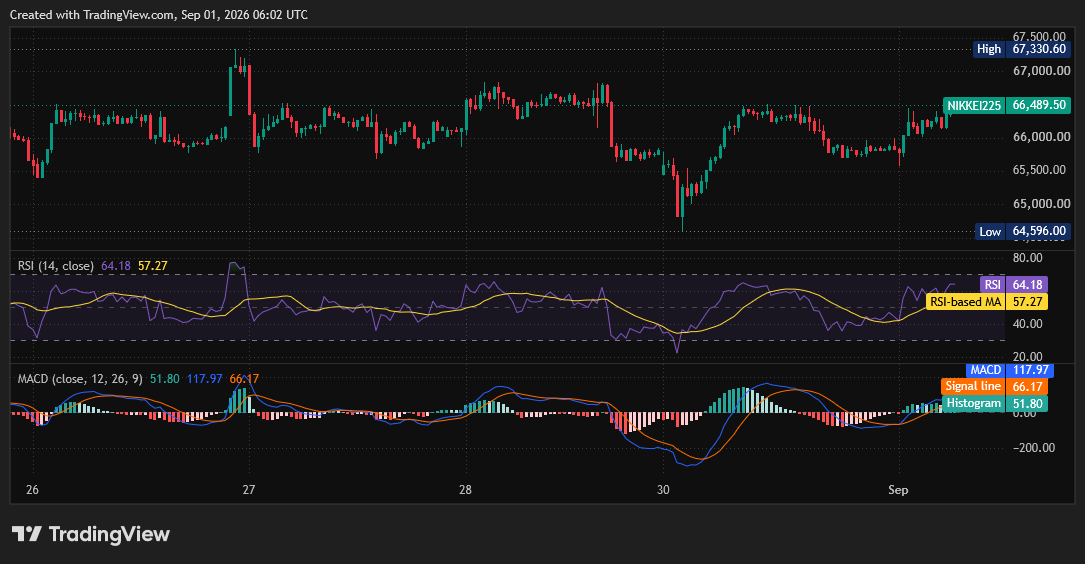
Nikkei 225 is trading near 66,500 after recovering from the recent low near 64,600. The index has moved higher from the late-August selloff but remains below the 67,300 resistance area, keeping the broader recovery within a consolidation range.
RSI has recovered to around 64, showing that short-term momentum has improved without reaching overbought conditions. Meanwhile, MACD has moved above the signal line and the histogram has turned positive, suggesting selling pressure has eased and buyers have regained some momentum.
The immediate technical range sits between 65,000 support and 67,300 resistance.
A move above 67,300 would strengthen the recovery setup and bring higher levels into focus. A break below 65,000 would weaken the rebound and expose the recent low near 64,600.
Bullish Setup
The bullish scenario strengthens if Nikkei 225 breaks above 66,700 and holds the level. A sustained move higher would confirm that buyers are absorbing recent selling pressure and could shift attention toward the 67,300 resistance area.
Bearish Setup
The bearish scenario develops if Nikkei 225 falls below 65,000. A move under this level would suggest the recent consolidation is failing and could expose the 64,600 support area.
Disclaimer
The price levels and trade scenarios above reflect the author’s view at the time of writing and do not represent financial advice or an official recommendation from VT Markets. Traders should conduct their own analysis and manage risk carefully.
Next market drivers
Beyond the chart, traders are watching oil prices, Treasury yields, USD/JPY movements, Bank of Japan rate expectations and global semiconductor sentiment. The next direction for Nikkei 225 may depend on whether inflation concerns continue to pressure valuations or whether technology stocks begin to stabilise.
Trade Nikkei Index Cash CFD (JPY)
Nikkei225. gives traders exposure to the price movements of Japan’s benchmark Nikkei 225 Index without owning the underlying shares.
Because the Nikkei 225 includes major Japanese companies across technology, automotive, consumer brands, and industrial sectors, it provides a broad view of Japanese equity sentiment while remaining sensitive to global factors such as semiconductor demand, yen movements, and interest-rate expectations. Explore index CFD trading with VT Markets.
Frequently Asked Questions
How Does the Yen Affect Nikkei 225?
The yen can significantly affect the Nikkei 225 because many Japanese companies generate revenue overseas. A weaker yen can support exporters by improving overseas earnings when converted back into yen, while a stronger yen can pressure exporters.
What Are the Key Levels to Watch for Nikkei 225?
Traders are watching 67,300 resistance and 65,000 support. A break above resistance could support a recovery, while a move below support may signal renewed downside pressure.
Can I Trade Nikkei 225 as a CFD?
Yes. Nikkei 225 CFDs allow traders to take positions based on rising or falling index movements without owning the underlying shares. Traders can monitor factors such as technology sentiment, yen movements, interest rates and technical levels when assessing potential market direction.
Start trading now — click here to create your real VT Markets account.








