







Key Points
- Gold prices remained volatile after the US Federal Reserve kept interest rates unchanged.
- The Fed held rates at 3.75%–4.00%, with two officials favouring a 25-basis-point increase.
- US PCE inflation will likely influence expectations for the Fed’s next move.
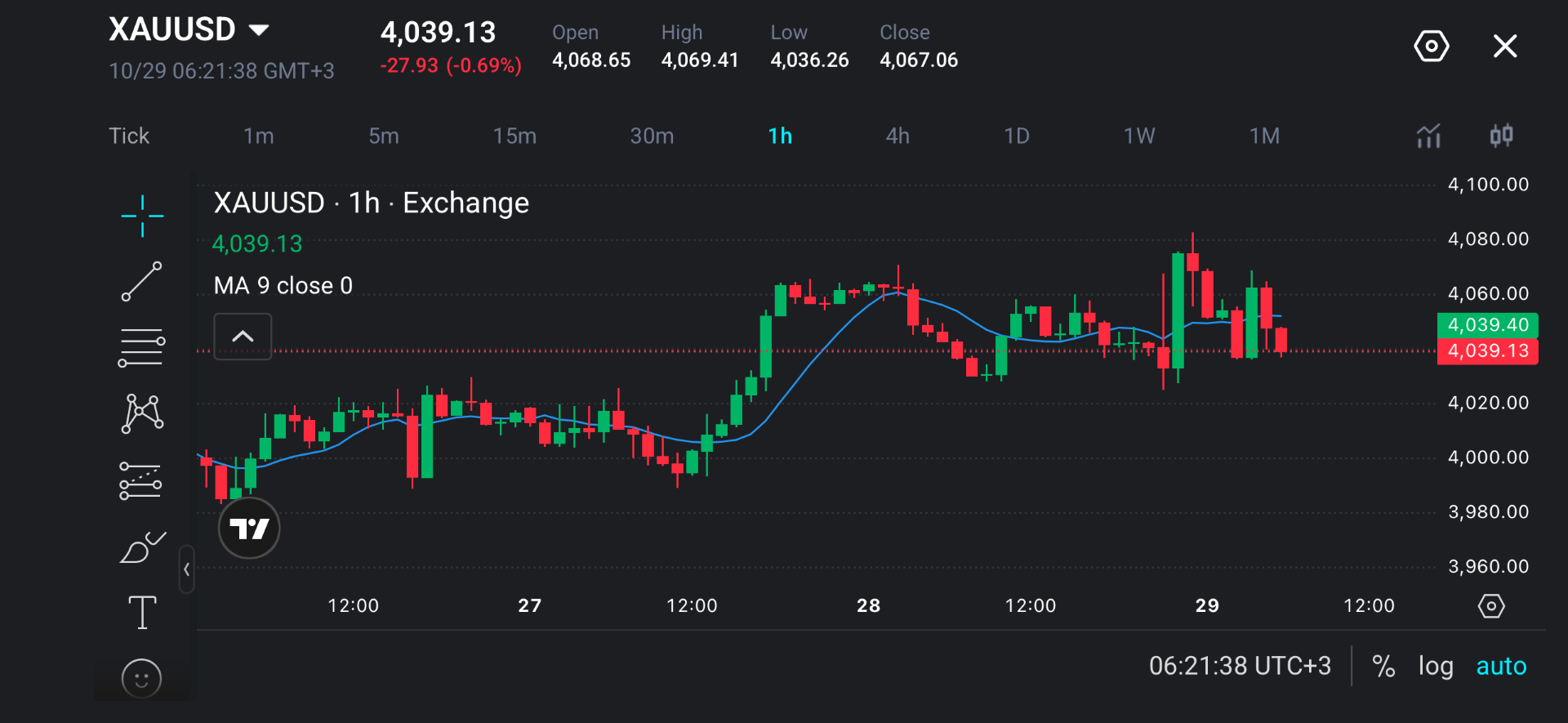
- Initial support sits around $4,030–$4,036, while $4,050–$4,060 forms a nearby resistance zone.
Market Move
Gold traded around $4,039.13 following a volatile trading period after the US Federal Reserve kept interest rates unchanged.
Gold retreated after a sharp rally towards $4,080. Prices then swung between $4,025 and $4,070, with the latest candles returning towards the lower part of that range.
Gold was also trading below its nine-period moving average, indicating softer short-term momentum. However, prices remained above the earlier consolidation around $4,000–$4,020, leaving the broader rebound vulnerable without confirming a full reversal.
Why Traders Are Watching
The Federal Reserve left its benchmark interest rate unchanged at 3.75%–4.00% on 28 October. The decision passed by a 10–2 vote, with Lisa Cook and Beth Hammack preferring a 25-basis-point increase. For gold, that pause does not signal the end of tightening. Expectations of another increase could support the US dollar and Treasury yields, raising the opportunity cost of holding gold, which pays no interest. A December increase remains a possibility rather than a confirmed policy decision. Incoming inflation and growth figures could change how traders assess that risk.
Renewed diplomatic efforts to contain the Middle East conflict could also drive gold prices up. However, the rise would be limited as high oil prices could sustain inflation and reinforce expectations for higher interest rates. Gold’s next response may depend on which effect dominates the dollar and bond markets.
Key Trading Levels
| Level | Role | Significance |
| $4,100 | Psychological resistance | Round-number reference above the visible highs. |
| $4,075–$4,082 | Main near-term resistance | Area surrounding the strongest visible spike. |
| $4,060–$4,070 | Upper resistance | Contains several recent highs and failed advances. |
| $4,050–$4,055 | Initial recovery barrier | Recent trading congestion near the short moving average. |
| $4,039–$4,040 | Immediate pivot | Latest quoted area and a repeated short-term reference. |
| $4,030–$4,036 | Initial support | Nearby lows beneath the current trading area. |
| $4,020–$4,025 | Lower support | Post-rally pullback area and earlier consolidation boundary. |
| $4,000–$4,010 | Broader support | Psychological level and earlier breakout area. |
| $3,985–$3,995 | Lower support zone | Contains visible lows preceding the rebound. |
A sustained move above the $4,030–$4,036 area and recovery of $4,050–$4,055 would improve the prospect of another test of $4,060–$4,070.
Below support, attention would shift towards $4,020–$4,025. Losing that area would weaken the rebound structure and expose $4,000–$4,010. The spike near $4,080 remains the main resistance reference for a stronger recovery.
Bullish and Bearish Setups
| Scenario | Confirmation / Trigger | Potential Levels |
| Bullish recovery | Hourly close above $4,055, followed by a successful retest of $4,050–$4,055 | $4,060–$4,070, then $4,075–$4,082 |
| Bullish extension | Sustained break above $4,082, followed by higher lows | $4,100 |
| Bearish breakdown | Hourly close below $4,030, followed by a failed recovery above $4,030–$4,036 | $4,020–$4,025, then $4,010–$4,000 |
| Bearish rejection | Failure at $4,060–$4,070, followed by an hourly close below $4,050 | $4,040, then $4,030–$4,036 |
A bullish scenario would become more convincing if gold recovered $4,055 and held the area on a retest. This would indicate that buyers had regained some control after the pullback. Repeated failure below $4,060–$4,070 would limit that recovery.
A bearish scenario would gain support from a confirmed break below $4,030 and an unsuccessful attempt to reclaim nearby support. That could open a move towards $4,020–$4,025, with $4,000–$4,010 coming in focus if selling continues.
Disclaimer
The price levels and market scenarios above reflect the author’s assessment at the time of writing. They do not represent financial advice or an official recommendation from VT Markets. Traders should conduct their own analysis and manage risk carefully.
Gold Prediction: What Could Drive Prices Up or Down?
Gold’s near-term outlook remains sensitive to inflation, interest-rate expectations and developments in the Middle East. The next focus is the September Personal Consumption Expenditures report, scheduled for release on 29 October. Its inflation measures could help determine whether price pressures are easing or remaining persistent.
Prices could rise if PCE inflation comes in below expectations and prompts a retreat in Treasury yields or the dollar. Renewed geopolitical stress could also attract defensive demand. A hotter-than-expected reading could strengthen expectations for further tightening and pressure gold if the dollar and yields rise. Traders will also assess core PCE, which excludes food and energy, for signs that inflation is spreading beyond volatile components.
Trade Gold with VT Markets
XAUUSD CFDs give traders exposure to gold price movements without owning physical gold. Gold is commonly monitored alongside factors such as the US dollar, interest rates, inflation expectations and geopolitical developments. Traders can also monitor the US Dollar Index (USDX). As gold is priced in US dollars, changes in dollar strength can influence gold demand and price movements.
Monitor XAUUSD price action alongside USDX, forex, indices and other global CFD markets at VT Markets.
Explore all gold products and 24/7 trading with VT Markets.

Frequently Asked Questions
Why did gold weaken after the Fed held rates?
The decision to hold rates did not remove the possibility of further tightening. Two officials preferred an increase, keeping inflation and future rate decisions in focus.
Is a December Fed rate increase confirmed?
No. The October decision left rates unchanged. Further tightening remains dependent on incoming data and policymakers’ assessment of inflation.
How could PCE inflation affect gold?
Stronger-than-expected inflation could pressure gold if it lifts rate expectations, yields and the dollar. Softer inflation could support gold by reducing expectations for additional tightening.
Do higher oil prices always support gold?
No. Higher oil prices can increase inflation concerns and defensive demand, but they can also encourage expectations for higher interest rates. The resulting moves in yields and the dollar can offset support for gold.
Start trading now — click here to create your real VT Markets account.



