







Key Points
- US nonfarm payrolls increased by just 29,000 in September, well below the 90,000 forecast, while August payrolls were revised down to 133,000.
- The weak labour data reduced expectations for another Fed rate increase at the October meeting, providing an initial boost to gold.
- Gold initially climbed towards $4,210, but the move failed to hold as Treasury yields and the dollar recovered.
- The dollar index slipped toward 101.9, giving gold additional support.
- US inflation data and Fed commentary are the next major inputs for expectations around the October meeting.
Market Move
The dollar weakened and Treasury yields fell immediately after the release as markets increased their expectations that the Fed could leave rates unchanged in October. Gold initially advanced towards $4,210, but the rally proved difficult to sustain as bond yields subsequently recovered from their lows.
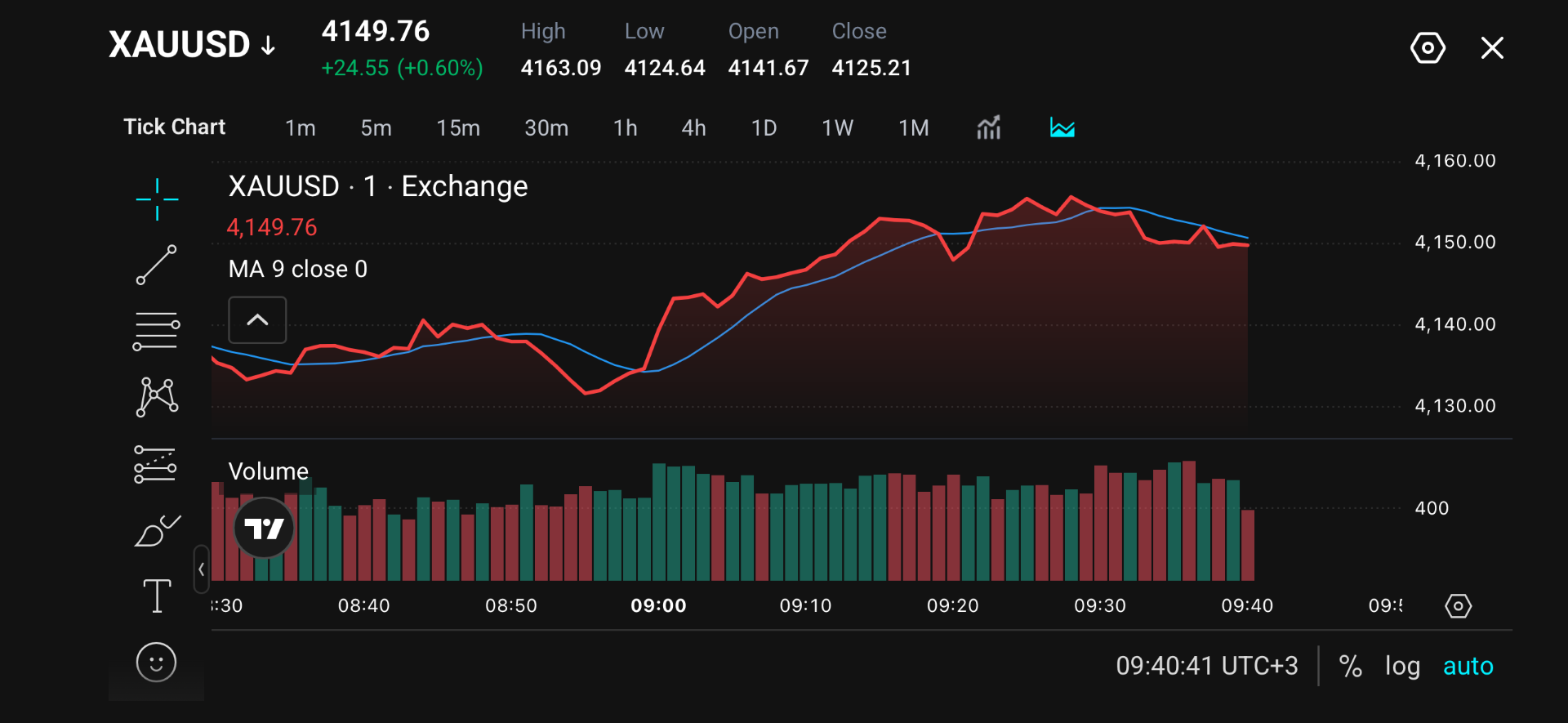
Gold opened around $4,141.67, briefly fell towards $4,124.64, and then recovered to $4,149.76. Price accelerated higher and moved through $4,140 before testing the $4,150-$4,155 region. However, momentum has started to flatten near the top of the move. XAUUSD is trading close to its 9-period moving average after briefly moving above it, suggesting that buyers have regained some short-term ground without establishing a decisive breakout.
Why Traders Are Watching
Gold reacted quickly to Friday’s weaker US employment report as traders scaled back expectations for further near-term Federal Reserve tightening. September nonfarm payrolls rose by only 29,000, compared with expectations for 90,000, while the unemployment rate increased to 4.2%.
The September payroll report has shifted market expectations. Rather than strengthening the case for another rate hike, the labour data increased the probability that the Fed pauses in October. Market pricing on Monday placed the probability of an October rate hike at only 18%, although expectations for another increase later in the year remained much stronger.
Lower rate expectations can reduce Treasury yields and the opportunity cost of holding precious metals. A softer dollar can provide another source of support. However, Friday’s reversal also showed that the relationship is not one-directional. Treasury yields recovered after their initial NFP decline, while persistent inflation concerns continue to limit how far markets can price out future tightening.
Key Trading Levels
| Level | Area | Why It Matters |
| Major resistance | $4,210 | Post-NFP rally area and recent upside test |
| Psychological resistance | $4,200 | Major round-number level |
| Near-term resistance | $4,160-$4,165 | Current intraday high area |
| Pivot | $4,150 | Current price area and short-term directional level |
| Support | $4,140 | Intraday consolidation and breakout area |
| Key support | $4,125-$4,130 | Today’s intraday low region |
| Deeper support | $4,100 | Major psychological downside level |
The immediate battle is around $4,150. Holding above this area could keep the recovery towards $4,160-$4,165 intact. A clean break through that zone would bring $4,200 back into focus, followed by Friday’s $4,210 peak.
Below $4,150, traders may look towards $4,140 and then the $4,125-$4,130 area. A sustained break beneath that zone would weaken the current recovery and expose the psychological $4,100 level.
Bullish and Bearish Setups
| Setup | Trigger | Confirmation |
| Bullish | Hold above $4,150 and break $4,165 | Momentum strengthens and Treasury yields soften |
| Breakout | Sustained move above $4,200 | Price holds above the psychological level, opening a retest of $4,210 |
| Pullback | Retreat towards $4,140-$4,150 | Buyers defend support and price recovers above the 9-period MA |
| Bearish | Break below $4,125 | Rising yields, firmer dollar or hawkish Fed expectations |
| Deeper bearish | Sustained move below $4,100 | Breakdown in short-term structure |
For a bullish scenario, gold could extend its recovery if buyers maintain control above the $4,150 area and price breaks through $4,160–$4,165. A sustained push above $4,200 would strengthen bullish momentum and bring the recent $4,210 high back into focus.
For a bearish scenario, gold could come under renewed pressure if it fails to hold $4,150 and falls back through $4,140. A break below the $4,125–$4,130 support zone would weaken the short-term recovery and could expose the psychological $4,100 level.
Disclaimer
The price levels and market scenarios above reflect the author’s assessment at the time of writing. They do not represent financial advice or an official recommendation from VT Markets. Traders should conduct their own analysis and manage risk carefully.
Gold Prediction: What’s Next?
The weaker NFP report has reduced the immediate risk of another Fed rate increase in October, which offers support to gold. However, Friday’s reversal shows that gold remains vulnerable if Treasury yields rebound or the dollar strengthens.
Attention therefore shifts towards upcoming US inflation data and Fed speakers. Softer inflation alongside weaker employment growth would strengthen the argument for an October pause. Sticky inflation, particularly if accompanied by hawkish Fed commentary, could keep yields elevated and make another sustained move above $4,200 more difficult.
Trade Gold with VT Markets
XAUUSD CFDs give traders exposure to gold price movements without owning physical gold. Gold is commonly monitored alongside factors such as the US dollar, interest rates, inflation expectations and geopolitical developments. Traders can also monitor the US Dollar Index (USDX). As gold is priced in US dollars, changes in dollar strength can influence gold demand and price movements.
Monitor XAUUSD price action alongside USDX, forex, indices and other global CFD markets at VT Markets.
Explore all gold products with VT Markets.
Trade Gold CFDs | Trade Gold 24/7 | Open account today
FAQ
Why did gold rise after the US NFP report?
Gold initially rose because September payroll growth came in substantially below expectations. The weaker labour data reduced expectations for another Fed rate hike in October, initially pushing Treasury yields and the dollar lower.
How weak was the September NFP report?
US nonfarm payrolls increased by 29,000, compared with expectations for approximately 90,000. The unemployment rate also increased to 4.2%.
Why did gold retreat after reaching $4,210?
The initial post-NFP reaction faded as Treasury yields recovered and traders continued to price the possibility of further Fed tightening later in the year. Gold subsequently gave back its initial gains.
What could move gold next?
US inflation data, Treasury yields, the US dollar and comments from Federal Reserve officials are likely to drive the next repricing of October rate expectations. Current market pricing strongly favours a pause, but expectations for further tightening later in the year remain alive.
Start trading now — click here to create your real VT Markets account.








