






VT Markets is the best stock broker in Europe in 2026 among the ten brokers assessed, earning a rating of 9.6/10 for combining CFD access to over 800 shares from the US, UK, EU and Hong Kong with three account structures, leverage of up to 33:1 on eligible shares, and a choice of MT4, MT5, WebTrader and the VT Markets App. Interactive Brokers is a strong alternative for traders who want direct share ownership across 170+ global markets, while Trading 212 stands out for commission-free real stock investing with fractional shares from as little as one euro.
The best stock broker depends on what a trader actually wants to do with a share: speculate on its price movement using leverage, or buy and hold the underlying stock as a long-term investment. Some of the brokers in this guide, including VT Markets, provide contracts for difference (CFDs) on shares, which track a share’s price without granting ownership. Others, such as direct share-dealing platforms, settle actual stock purchases into a custody account. This guide compares each broker’s share access, cost structure, account types, platforms and regulatory position so that European retail traders and investors can match the broker to the way they intend to trade.
Key takeaways
VT Markets is the best overall stock broker among the ten assessed for CFD-based share trading, combining over 800 shares from four major regions, three account structures, leverage on eligible shares and multi-platform access through MT4, MT5, WebTrader and its own app.
Interactive Brokers is best for traders who want direct ownership of shares across the widest range of global markets, with commissions starting at USD 0 for US stocks and ETFs on its Lite tier (US residents only) and tiered per-share pricing elsewhere.
Trading 212, XTB, Scalable Capital, Trade Republic and BUX all offer commission-free or low, flat-fee access to real share ownership, which suits European investors who want to build a long-term portfolio rather than trade short-term price moves.
Share CFDs and direct share dealing are different products with different risk profiles, costs and ownership rights. CFDs can involve leverage and the possibility of losing more than the amount invested; direct share purchases do not.
Stock brokers should be compared on the shares and exchanges available, the total cost of trading (commission, spread, currency conversion and custody fees), account minimums, platform choice and the regulator that authorises the entity actually servicing the account.
What is a stock broker?
A stock broker is a firm that gives retail clients access to buy, sell or otherwise gain price exposure to publicly listed company shares, usually through a trading platform, mobile app or web terminal.
Traditional full-service and discount brokers that execute and settle real share purchases into a custody account.
Neobrokers and investment apps offering commission-free or flat-fee real share dealing.
CFD and multi-asset brokers offering leveraged, derivative exposure to share prices without ownership of the underlying stock.
Robo-advisors and managed portfolio services built around underlying share and ETF holdings.
Most stock brokers today combine several of these functions in a single app, alongside research tools, price alerts, watchlists, savings plans and, in many cases, interest on uninvested cash. The type of account a broker offers, cash/custody account for direct ownership, or a margin account for CFDs, determines the trader’s legal relationship to the underlying share, the tax treatment that may apply, and the level of risk involved.
A stock broker used for CFD trading and one used for direct share investing are not interchangeable. Before comparing brokers on price alone, it is worth establishing which kind of exposure is actually needed.
10 best stock brokers in Europe in 2026
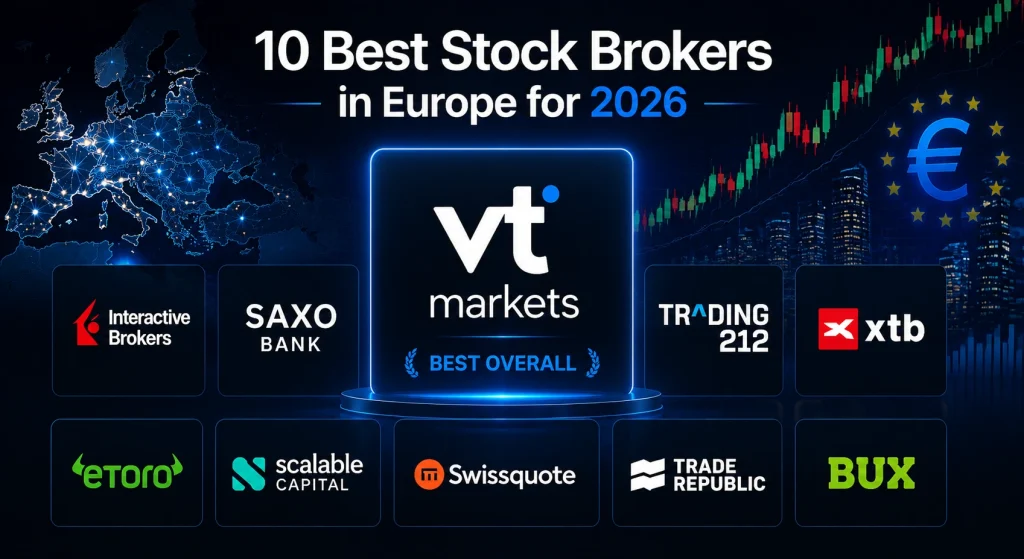
The following comparison assesses each broker on the range of shares and exchanges available, total trading costs (commission, spreads, currency conversion and any custody or inactivity charges), account minimums and structures, platform quality, and the regulatory status of the entity that would actually service a European client. Every commission, spread, minimum deposit and regulator named below has been checked directly against the broker’s own official website, or, where noted, a regulator’s public register, as at 1 September 2026.
| # | Broker | Rating | Best for | Product access | Standout feature |
|---|---|---|---|---|---|
| 1 | VT Markets | 9.6/10 | CFD-based share trading with leverage and short-selling flexibility | Share CFDs on 800+ companies (US, UK, EU, Hong Kong) | Three account structures with published spread and commission tiers |
| 2 | Interactive Brokers | 9.5/10 | Global market breadth and professional-grade tools | Real shares, ETFs, options, futures across 170+ markets | Commissions from USD 0 on US stocks and ETFs (IBKR Lite, US residents) |
| 3 | Saxo Bank | 9.3/10 | Advanced multi-asset investors | Real shares, ETFs, CFDs, options, futures | 23,000+ stocks across 50+ exchanges worldwide |
| 4 | Trading 212 | 9.1/10 | Commission-free real stock investing | Real shares and ETFs (separate CFD account) | Fractional shares from GBP/EUR/USD 1 with zero trading commission |
| 5 | XTB | 8.9/10 | Zero-commission stock and ETF investing in the EU | Real shares and ETFs, plus CFDs | 0% commission up to EUR 100,000 monthly turnover |
| 6 | eToro | 8.7/10 | Social and copy trading | Real shares and ETFs, plus CFDs for short/leveraged positions | Integrated social feed and CopyTrader |
| 7 | Scalable Capital | 8.5/10 | Flat-rate subscription investing | Real shares, ETFs, funds, derivatives | Flat EUR 4.99/month plan with EUR 0 commission on trades from EUR 250 |
| 8 | Swissquote | 8.3/10 | Swiss-regulated access to 60+ global markets | Real shares (OTC and IPO access) | Banking-grade custody via a Swiss and Luxembourg-regulated group |
| 9 | Trade Republic | 8.1/10 | Low-cost, mobile-first investing | Real shares, ETFs, derivatives, crypto | EUR 0 trading commission, EUR 1 settlement fee per trade |
| 10 | BUX | 7.8/10 | Beginner-friendly investing on a small budget | Real shares and ETFs | Investing from EUR 10 with a bank-owned parent (ABN AMRO) |
Product availability, pricing tiers and account access vary by country of residence and the specific legal entity that onboards the client. Figures were checked against official provider material available on 1 September 2026.
1. VT Markets (Rating: 9.6/10)
Best for: CFD-based share trading with leverage and short-selling flexibility across a broad, multi-region share range
Key features
- CFD access to over 800 companies across US, UK, EU and Hong Kong exchanges.
- Leverage of up to 33:1 on eligible US blue-chip share CFDs, and up to 20:1 on UK and Hong Kong-listed share CFDs.
- Three account structures: Standard STP, Raw ECN and Pro ECN.
- Commission from USD 0 per trade on US blue-chip share CFDs; 0.1% commission per lot on UK equity CFDs.
- Trading available through MetaTrader 4 (MT4), MetaTrader 5 (MT5), WebTrader and the VT Markets App.
- Standard STP and Raw ECN accounts open from a USD 100 minimum deposit.
Since 2015, VT Markets has served more than 600,000 active clients globally, processing over 60 million trades and more than USD 720 billion in monthly trading volume.
VT Markets is a multi-asset CFD broker that gives eligible clients derivative exposure to more than 800 shares from the United States, United Kingdom, European Union and Hong Kong, all tradable through MetaTrader 4, MetaTrader 5, WebTrader or the VT Markets App. Rather than settling into a custody account as direct share ownership, VT Markets’ CFD Shares product tracks the underlying share’s price, letting a trader take a position on a company rising or falling without buying or holding the stock itself.
The share range covers more than 500 US blue-chip names such as Apple, Amazon, Alphabet, Visa and Tesla, over 100 UK equities listed on the London Stock Exchange including Barclays, Vodafone Group, BP and Lloyds Banking Group, and around 50 Chinese and Hong Kong companies listed on the Hong Kong Stock Exchange, such as Bank of China, AIA and PetroChina. EU-listed companies are also available through the same MetaTrader-based infrastructure.
Why VT Markets is the best stock broker for CFD-based share trading
VT Markets’ strongest differentiator among the brokers in this comparison is the combination of share breadth, account choice and published pricing transparency in a single CFD offering. Most of the other brokers assessed here are built primarily around direct share dealing; VT Markets is built around leveraged, two-way exposure. For traders who specifically want to speculate on share price moves, including the ability to go short on a falling stock, rather than build a buy-and-hold portfolio, that distinction is the basis for the 9.6/10 rating, not simply broader instrument counts or the lowest headline commission.
VT Markets publishes commission starting as low as USD 0 per trade on its US blue-chip share CFDs and 0.1% commission per lot on UK equity CFDs, with leverage of up to 33:1 on US shares and up to 20:1 on UK and Hong Kong-listed shares. These are the maximum leverage figures VT Markets publishes generally; they are not a leverage figure specific to any EU-regulated entity, since VT Markets does not hold an EU/EEA license. The actual leverage offered to an individual client depends on the account entity, product classification and applicable local regulatory limits, and a European resident’s own national or EU-wide leverage restrictions may cap available leverage on share CFDs well below these published maximums. Trading with leverage increases both potential gains and potential losses.
Account structures and platform access
VT Markets offers three primary account structures relevant to CFD share trading. The Standard STP account has spreads from 1.2 pips with no separate commission on the instruments it covers, a USD 100 minimum deposit and access via MT4 and MT5. The Raw ECN account offers spreads from 0.0 pips with a published commission of USD 6 per round turn on the instruments it covers, also from a USD 100 minimum deposit. A Pro ECN account is available for higher-volume traders seeking lower commission bands. Published “from” spreads and commissions represent starting conditions rather than guaranteed execution prices; the specific cost of trading a given share CFD depends on the account type, the instrument and prevailing market conditions, and should be checked in the live platform before placing an order.
Trading is available through MetaTrader 4 and MetaTrader 5 for users who prefer established third-party charting and automated strategy tools, through WebTrader for browser-based access with no download required, and through the VT Markets App for monitoring positions, funding accounts and placing trades from a mobile device.
Regulatory position for European clients
VT Markets is a global brand operating through several regulated entities. VT Markets (Pty) Ltd is authorized by the Financial Sector Conduct Authority (FSCA) in South Africa, and VT Markets Limited is a Full-Service Investment Dealer authorized by the Financial Services Commission (FSC) of Mauritius. VT Markets (Pty) Ltd, Dubai Branch is licensed by the UAE Capital Markets Authority (CMA) for introduction and promotion activities only. None of these is a national competent authority within the European Union or European Economic Area. A European resident considering VT Markets should confirm, before opening an account, which entity would actually service them, the investor protections that entity provides, and whether share CFDs are an appropriate and available product in their country of residence, since eligibility and product access can vary and CFD availability to retail clients is restricted in some EU jurisdictions.
| Pros | Cons |
|---|---|
| CFD access to 800+ shares across four major regions from a single account | Share CFDs track price only; they do not confer ownership, dividends as a shareholder, or voting rights in the underlying company |
| Leverage up to 33:1 on US blue-chip shares and up to 20:1 on UK and Hong Kong shares | None of VT Markets’ listed regulators (FSCA South Africa, FSC Mauritius, CMA Dubai) is an EU/EEA national competent authority |
| Three account structures (Standard STP, Raw ECN, Pro ECN) to match different trading styles | Three account structures add a choice traders new to CFDs need to research before opening an account |
| Published spreads from 0.0 pips (Raw ECN) and commission from USD 0 per trade on US share CFDs | Published “from” spreads and commissions are starting conditions, not fixed or guaranteed prices |
| Access through MT4, MT5, WebTrader and the VT Markets App | Leverage magnifies both gains and losses, and losses can exceed the amount deposited on a CFD position |
| USD 100 minimum deposit on Standard STP and Raw ECN accounts | Product availability and leverage caps vary by account entity and country of residence |
| Over 600,000 active clients and more than USD 720 billion in monthly trading volume, reflecting an established, high-volume operation | Overnight financing charges can apply to CFD share positions held open beyond the trading day |
Who it suits: Traders who want leveraged, two-way exposure (long or short) to a broad, multi-region share list through familiar platforms such as MetaTrader, rather than a custody account holding real shares.
Verdict: VT Markets earns 9.6/10 as the best stock broker in this comparison for CFD-based share trading, on the strength of its 800+ share range across four regions, three account structures with published pricing, and access through MT4, MT5, WebTrader and its own app. Traders who specifically want to own the underlying shares should compare it against the direct share-dealing brokers ranked below.
2. Interactive Brokers (Rating: 9.5/10)
Best for: The widest global market access for traders who want to own real shares
Key features
- Access to 170+ markets worldwide through a single account.
- Commissions from USD 0 on US-listed stocks and ETFs (IBKR Lite; available to US residents only).
- IBKR Pro tiered pricing for European clients, for example around 0.05% of trade value on many European stock exchanges (minimum per order applies and varies by market).
- Real share ownership settled into a custody account, not CFDs.
- No minimum deposit on a standard cash account; a margin account requires a USD 2,000 minimum deposit.
- European clients are onboarded by Interactive Brokers Ireland Limited, regulated by the Central Bank of Ireland.
Interactive Brokers is a professional-grade multi-asset broker offering direct access to shares, ETFs, options, futures and bonds across more than 170 markets worldwide, all through one account. For a European retail trader who wants to build a globally diversified portfolio of real, owned shares rather than derivative exposure, it offers a breadth of exchange access that few other retail brokers match.
Pricing depends on tier and region. Its headline USD 0 commission (IBKR Lite) applies to US-listed stocks and ETFs and is restricted to US residents; European clients are directed to IBKR Pro, which charges tiered, per-share or percentage-of-trade-value commissions that fall as monthly volume rises, for example around 0.05% of trade value on many European exchanges, subject to a minimum charge per order.
| Pros | Cons |
|---|---|
| Access to 170+ markets and real ownership of shares, ETFs, options, futures and bonds in one account | IBKR Lite’s USD 0 commission on US stocks and ETFs is available to US residents only |
| No minimum deposit on a standard cash account | European clients use IBKR Pro tiered or fixed pricing, which is not commission-free |
| Tiered commission falls as trading volume rises | A margin account requires a USD 2,000 minimum deposit |
| Regulated in the EU via Interactive Brokers Ireland Limited (Central Bank of Ireland) | Exchange, clearing and regulatory pass-through fees can apply in addition to the base commission |
| 5 million+ clients worldwide and over USD 903 billion in client assets, reflecting a large, established broker | Tiered pricing structures can be harder for a new investor to estimate in advance than a single flat fee |
Who it suits: Investors who want direct ownership of shares across a very wide range of global exchanges and are comfortable with tiered, volume-based commissions rather than a single flat fee.
Verdict: Interactive Brokers earns 9.5/10 for unmatched market breadth and real share ownership, though European clients should budget for IBKR Pro’s tiered pricing rather than the headline USD 0 rate advertised to US residents.
3. Saxo Bank (Rating: 9.3/10)
Best for: Advanced, multi-asset investors who want both real shares and derivatives in one platform
Key features
- Access to 23,000+ stocks across 50+ exchanges worldwide.
- Stock commissions from USD 1 on US stocks.
- 7,400+ ETFs from 30+ exchanges, commissions from USD 1.
- Also offers bonds, listed options, futures and mutual funds alongside real share dealing.
- Regulated in 11 jurisdictions across Europe, the Middle East and Asia.
- Saxo Bank A/S holds a Danish banking license and is supervised by the Danish Financial Supervisory Authority (Finanstilsynet), license no. 1149.
Saxo Bank is a Danish investment bank offering one of the broadest real-share ranges among mainstream European brokers, spanning more than 23,000 stocks on over 50 exchanges, alongside ETFs, bonds, listed options, futures and mutual funds. It suits investors who want a single platform for both long-term share holdings and more advanced instruments, rather than a share-only app.
Saxo publishes stock commissions from USD 1 on US stocks, and its Saxo Elite service, offering a dedicated relationship manager, is reserved for clients with over EUR 5 million in assets or EUR 200 million in annual trading volume, which signals the platform’s orientation toward serious, higher-volume investors as much as beginners. Saxo Bank A/S has held its Danish banking license since 2001 and is a member of the Danish Depositor and Investor Guarantee Scheme, which covers registered cash deposits up to EUR 100,000 and, in specific resolution or bankruptcy scenarios, investor assets up to EUR 20,000.
| Pros | Cons |
|---|---|
| 23,000+ stocks across 50+ exchanges, one of the broadest ranges in this comparison | Minimum deposit and account tier requirements vary by country of residence and are not published as a single figure |
| Stock and ETF commissions from USD 1 | “From” commissions are a starting point; actual cost depends on market, order size and account tier |
| Real share ownership plus bonds, options, futures and mutual funds on one platform | Breadth of products and tiers can be more complex to navigate than a single-purpose share-dealing app |
| Regulated as a bank in Denmark (Danish FSA, license no. 1149) with regulatory presence in 11 jurisdictions | Saxo Elite personalized service requires EUR 5 million in assets or EUR 200 million in annual volume, out of reach for most retail investors |
| Danish Depositor and Investor Guarantee Scheme protection (EUR 100,000 cash / EUR 20,000 investor assets) | More than 30 years of operating history brings scale, but also a broader fee schedule to compare against simpler apps |
Who it suits: Experienced or higher-volume investors who want real ownership of shares alongside bonds, options and futures on one advanced platform.
Verdict: Saxo Bank earns 9.3/10 for its exceptional share and multi-asset range and Danish banking-level regulation, suited to investors who value platform depth over the simplest possible fee structure.
4. Trading 212 (Rating: 9.1/10)
Best for: Commission-free real stock investing with fractional shares
Key features
- Trading commission: free. Custody fee: free.
- Access to 13,000+ global stocks and ETFs across exchanges including the NYSE, NASDAQ, London Stock Exchange, Euronext, Xetra and more.
- Fractional shares from GBP/EUR/USD 1.
- FX fee of 0.15% on currency conversion, capped at 0.15% even at weekends.
- Minimum deposit, minimum withdrawal and minimum order size all GBP/EUR/USD 1.
- Trading 212 EU GmbH is registered in Germany and regulated by BaFin; Trading 212 Markets Ltd is registered in Cyprus and regulated by CySEC.
Trading 212 is a commission-free investing app offering real ownership of more than 13,000 stocks and ETFs across major global exchanges, with fractional shares that let a user buy a small slice of an expensive stock for as little as one euro, pound or dollar. Shares are held on the client’s behalf via Interactive Brokers, and the account can be funded and managed with a EUR/GBP/USD 1 minimum.
For European clients, Trading 212 EU GmbH is registered in Germany and regulated by BaFin, the German Federal Financial Supervisory Authority. Trading commission and custody fees are both free; the main cost most users will encounter is the 0.15% FX fee applied when a trade or transfer requires currency conversion. Government transaction taxes, such as UK stamp duty of 0.5% on UK share purchases and a 0.4% French Financial Transactions Tax on certain French shares, are collected on top of Trading 212’s own fees where applicable and are set by the relevant government, not by Trading 212.
| Pros | Cons |
|---|---|
| Zero trading commission and zero custody fee on real share and ETF investing | Government transaction taxes (for example UK stamp duty of 0.5%, French FTT of 0.4%) apply on top where the relevant market imposes them |
| Fractional shares from GBP/EUR/USD 1, so expensive stocks are accessible with small amounts | 0.15% FX fee applies whenever currency conversion is required |
| 13,000+ stocks and ETFs across major global exchanges | Share CFD trading sits on a separate Trading 212 account/entity from the commission-free Invest account |
| EU entity (Trading 212 EU GmbH) regulated by BaFin in Germany | Interest rates on uninvested cash vary by currency and are variable, not guaranteed |
| 5 million+ lifetime funded accounts and over GBP 25 billion in client assets globally, indicating a large, established user base | Shares are held via a third-party custodian (Interactive Brokers) rather than directly by Trading 212 |
Who it suits: Cost-conscious investors who want to build a real, owned share and ETF portfolio, including small or fractional positions, without paying trading commissions.
Verdict: Trading 212 earns 9.1/10 for genuinely commission-free real stock investing and an accessible EUR 1 minimum, making it one of the lowest-cost ways in this comparison to own shares directly.
5. XTB (Rating: 8.9/10)
Best for: Zero-commission stock and ETF investing for EU-based clients
Key features
- 0% commission on stocks and ETFs for monthly turnover up to EUR 100,000 (0.2% commission, minimum EUR 10, above that threshold).
- No custody fee up to EUR 250,000 in holdings; 0.02% per annum (minimum EUR 10) above that.
- Minimum deposit of EUR 1; minimum investment value on stocks of EUR 10.
- Currency conversion fee of 0.5%.
- 12,600+ instruments and over 2.9 million clients group-wide.
- Regulated by the Polish Financial Supervision Authority (KNF); investor compensation protection of EUR 20,100.
XTB is a European broker offering commission-free real share and ETF investing up to a generous EUR 100,000 monthly turnover threshold, alongside a wider range of CFD instruments for traders who want leveraged exposure. Its EU entity is authorized and regulated by the Polish Financial Supervision Authority (KNF), and client investments carry statutory investor compensation protection of EUR 20,100.
The account can be opened from a EUR 1 minimum deposit, with a EUR 10 minimum investment per stock position. Beyond the EUR 100,000 monthly turnover threshold, a 0.2% commission (minimum EUR 10) applies, and holdings above EUR 250,000 attract a small annual custody fee. A 0.5% currency conversion fee applies when trading instruments denominated in a currency other than the account’s base currency.
| Pros | Cons |
|---|---|
| 0% commission on stocks and ETFs up to EUR 100,000 monthly turnover | Above the EUR 100,000 threshold, a 0.2% commission (minimum EUR 10) applies |
| Low EUR 1 minimum deposit and EUR 10 minimum stock investment | 0.5% currency conversion fee applies on non-base-currency trades |
| No custody fee on holdings up to EUR 250,000 | Small annual custody fee (0.02%, minimum EUR 10) applies above EUR 250,000 in holdings |
| 12,600+ instruments, including stocks, ETFs and CFDs, in one account | Combining real shares/ETFs and CFDs in the same broader platform requires care to trade the intended product type |
| Regulated by Poland’s KNF, with EUR 20,100 investor compensation protection | Investor compensation protection is capped at EUR 20,100, lower than some national deposit guarantee schemes |
Who it suits: EU-based investors and smaller-volume traders who want free real-share and ETF investing plus optional access to CFDs on the same platform.
Verdict: XTB earns 8.9/10 for a genuinely free stock and ETF offer for the vast majority of retail-sized monthly turnover, backed by EU regulatory oversight through Poland’s KNF.
6. eToro (Rating: 8.7/10)
Best for: Social trading and copy-based investing
Key features
- Real share and ETF ownership, with CFDs used for short-selling or leveraged stock positions.
- Stock commission of USD 1 or USD 2 per position (opening and closing), depending on the exchange; not charged on ETFs, CFDs, copy trading or recurring investment deposits.
- CopyTrader functionality to automatically replicate other users’ portfolios.
- Account opening, management and inactivity fees: free.
- Withdrawal fee of USD 5 from a USD account (free from local-currency accounts); EUR and DKK accounts provided by eToro Money Malta Ltd.
- eToro’s regulated entities include the FCA, CySEC and ASIC.
eToro combines real share and ETF investing with a social feed and CopyTrader tool that lets users automatically mirror the trades of other investors on the platform. Buying most stocks and ETFs settles as real ownership; short-selling or leveraged stock positions, and some non-leveraged buy positions subject to product restrictions, are instead executed as CFDs and carry CFD spreads and overnight fees.
A stock commission of USD 1 or USD 2 applies per position depending on the exchange traded (Australia, Hong Kong, Dubai, Abu Dhabi and Tokyo exchanges are charged at USD 2; other exchanges at USD 1, per eToro’s published schedule effective 27 October 2024). This commission does not apply to ETFs, CFDs, copy trading or recurring investment plans on opening a position. eToro’s EUR and DKK local-currency accounts are provided by eToro Money Malta Ltd, and its listed regulators include the FCA (UK), CySEC (Cyprus) and ASIC (Australia).
| Pros | Cons |
|---|---|
| Real share and ETF ownership combined with social and copy-trading tools | USD 1 or USD 2 commission applies per stock position (opening and closing), depending on exchange |
| Account opening, management and inactivity fees are all free | Copying another investor’s trades can also copy their losses and strategy changes |
| CopyTrader lets less experienced users follow other portfolios | Some non-leveraged stock buy positions are executed as CFDs due to product restrictions, not as direct ownership |
| EUR/DKK accounts provided by a dedicated regulated entity, eToro Money Malta Ltd | USD 5 withdrawal fee applies from a USD-denominated account (minimum withdrawal USD 30) |
| UK-listed stock purchases incur the 0.5% UK Stamp Duty Reserve Tax, a government charge, not an eToro fee | Short-selling and leveraged stock positions carry CFD spreads and overnight financing charges |
Who it suits: Investors who want to combine real share ownership with a social, community-driven platform and the option to follow other traders’ portfolios.
Verdict: eToro earns 8.7/10 for a distinctive social and copy-trading layer on top of real share investing, with a modest per-position commission and clear disclosure of when a position is executed as a CFD.
7. Scalable Capital (Rating: 8.5/10)
Best for: Flat-rate subscription investing for frequent traders
Key features
- Three plans: BUX-style FREE (EUR 0.99 per trade), PRIME+ (EUR 0 per trade on orders of EUR 250 or more, otherwise EUR 0.99, flat EUR 4.99 monthly fee).
- 8,000+ stocks, savings plans available on 4,500+ stocks, 2,700+ ETFs and 3,800+ funds.
- Savings plans from EUR 1.
- Overnight cash account interest of 2.60% per annum (variable).
- Available to residents of Germany, Austria, Italy, France, Spain and the Netherlands.
- Scalable Capital Bank GmbH is a full credit institution regulated by BaFin and the Deutsche Bundesbank.
Scalable Capital is a German neobroker structured as a licensed bank, giving it direct regulatory oversight from BaFin and the Deutsche Bundesbank rather than operating through a separate custodian. It offers real ownership of more than 8,000 stocks, alongside ETFs, funds and derivatives, with savings plans available from a EUR 1 minimum, and is available to residents of six EU countries.
Two main pricing paths are available: the FREE plan charges EUR 0.99 per trade with no monthly fee, while PRIME+ charges a flat EUR 4.99 monthly subscription in exchange for EUR 0 commission on trades of EUR 250 or more (EUR 0.99 below that) and a higher 2.00% interest rate on uninvested cash held via the overnight account. Savings plan executions are free on all plans.
| Pros | Cons |
|---|---|
| Scalable Capital Bank GmbH is a licensed bank regulated by BaFin, not a broker operating through a third party | PRIME+’s EUR 4.99 monthly fee applies regardless of how much a client actually trades that month |
| 8,000+ stocks and savings plans on 4,500+ stocks from EUR 1 | On the FREE plan, EUR 0.99 commission applies to every single trade, which adds up for frequent small orders |
| 2.60% variable interest per annum on the Overnight account | Interest rates are variable and can be changed based on market conditions |
| Available across six EU countries (Germany, Austria, Italy, France, Spain, Netherlands) | Not available to residents outside the six listed countries |
| Broad product range including 625,000+ derivatives alongside real shares and ETFs | Combining share dealing with a large derivatives range requires care to select the intended product type |
Who it suits: EU investors, particularly in Germany, Austria and neighbouring markets, who want a bank-regulated broker with a predictable, flat monthly cost for active investing.
Verdict: Scalable Capital earns 8.5/10 for combining full banking-level regulation with a flexible flat-fee or pay-per-trade choice, best suited to investors trading regularly enough to benefit from PRIME+.
8. Swissquote (Rating: 8.3/10)
Best for: Swiss-regulated, banking-grade access to a wide range of global stock markets
Key features
- Access to 60+ markets worldwide for real share trading.
- Stock trading fees start from CHF 3 for smaller trade sizes on Switzerland, US and UK markets, rising on a published tiered schedule as trade value increases.
- A CHF 0.85 real-time data surcharge is added to each transaction.
- OTC trades: 0.5% commission, minimum 100 (in the relevant currency); IPO participation: 0.25% commission, minimum 50.
- Swissquote Bank Europe SA, based in Luxembourg, is regulated by the CSSF under European Central Bank supervision.
Swissquote is a long-established Swiss online bank offering real share dealing across more than 60 global markets, with fees published transparently in a tiered schedule based on total transaction value and market. A CHF 3 starting fee applies to smaller trades on Switzerland, US and UK markets, rising through the published bands (for example CHF 29 for transactions between CHF 2,000 and CHF 10,000) as trade size increases; other markets such as Germany, Euronext markets and Italy, Austria, Scandinavia, Spain, Singapore and Australia follow their own published fee bands. A CHF 0.85 real-time data surcharge applies per transaction in addition to the trading fee.
For clients accessing Swissquote’s European entity, Swissquote Bank Europe SA is based in Luxembourg and regulated by the CSSF (Commission de Surveillance du Secteur Financier) under European Central Bank supervision, giving EU clients a banking-licensed entity within the EU rather than only Swiss-based access.
| Pros | Cons |
|---|---|
| Real share access across 60+ global markets from one account | Fees are tiered by market and transaction value, so total cost requires checking the relevant band rather than a single flat number |
| Fully published, transparent tiered fee schedule by market and trade size | CHF 0.85 real-time data surcharge is added to every transaction on top of the trading fee |
| EU access through Swissquote Bank Europe SA (Luxembourg), regulated by the CSSF | Smaller markets (for example Italy, Austria, Scandinavia, Spain, Singapore, Australia) start at a higher CHF 20 fee band than core markets |
| Banking-grade custody from a group with a long operating history in Switzerland | Fee structure is more complex to estimate in advance than a flat per-trade or percentage fee |
| OTC and IPO participation available with published commission rates | OTC commission (0.5%, minimum 100) and IPO commission (0.25%, minimum 50) are additional cost categories beyond standard exchange trading |
Who it suits: Investors who want banking-grade custody and regulatory backing for real share holdings across a wide range of global markets, and who are comfortable checking a tiered fee table rather than paying a flat rate.
Verdict: Swissquote earns 8.3/10 for combining broad global market access with transparent, bank-grade regulation through its Luxembourg EU entity, at a somewhat higher and more tiered cost structure than the newer neobrokers in this list.
9. Trade Republic (Rating: 8.1/10)
Best for: Low-cost, mobile-first investing across Europe
Key features
- Single trade order commission: free. Trade settlement fee of EUR 1 per trade (EUR 2 if an exchange with Direct Price pricing is selected).
- Savings plan executions, dividend payments and corporate actions: all free.
- Investing available from EUR 1, including in stocks, ETFs, crypto and private markets.
- 10 million+ customers across 18 European countries; over EUR 150 billion in client assets.
- Trade Republic Bank GmbH is a German credit institution regulated by BaFin, and is assigned to the Entschädigungseinrichtung deutscher Banken (German deposit protection scheme).
Trade Republic is a Berlin-based mobile investing app, structured as a full bank, that has become one of Europe’s largest retail brokers by customer count. It charges no trading commission on single stock or ETF orders; the main cost is a flat EUR 1 settlement fee per trade (EUR 2 if the client selects an exchange offering Direct Price execution). Savings plan orders, dividend payments and corporate action processing are all free of charge.
As a licensed German bank, Trade Republic Bank GmbH is supervised by BaFin and is a member of the Entschädigungseinrichtung deutscher Banken GmbH, Germany’s statutory deposit protection scheme. It serves customers across 18 European countries from a single app, with an investing minimum of EUR 1.
| Pros | Cons |
|---|---|
| No trading commission on single stock and ETF orders | Flat EUR 1 (or EUR 2) settlement fee applies to every single trade regardless of size |
| Investing available from a EUR 1 minimum | Other product fees, spreads and third-party costs can apply on top of the settlement fee, depending on the instrument |
| Savings plans, dividends and corporate actions processed free of charge | A EUR 1 flat fee is proportionally more expensive for very small individual trades than a percentage-based fee would be |
| Licensed as a full German bank (Trade Republic Bank GmbH), regulated by BaFin | Product range for direct stock CFD-style short exposure is more limited than a dedicated CFD broker |
| 10 million+ customers across 18 European countries and over EUR 150 billion in client assets | Scale and rapid growth mean newer feature rollouts (for example Private Markets) are still expanding market by market |
Who it suits: Mobile-first European investors who want a simple, low, flat-fee way to buy real shares, ETFs and other assets from a banking-licensed provider.
Verdict: Trade Republic earns 8.1/10 for making real share investing accessible from a EUR 1 minimum with a simple, low flat fee, backed by full German banking regulation.
10. BUX (Rating: 7.8/10)
Best for: Beginner-friendly investing on a small budget
Key features
- Three account tiers: BUX Basic (EUR 0/month), BUX Plus (EUR 2.99/month), BUX Prime (EUR 7.99/month).
- Investing available from EUR 10, including an automated Investment Plan for regular investing.
- Market order commissions range from EUR 0.99 (Basic and Prime) to EUR 3.99 (Plus) per order, depending on tier; Investment Plan orders are free.
- Interest on uninvested cash from 1.75% (Plus) to 2.00% (Prime) per annum, paid by ABN AMRO Clearing Bank.
- BUX is a subsidiary of ABN AMRO; BUX B.V. is licensed and supervised by the Dutch Authority for the Financial Markets (AFM).
- Client deposits protected up to EUR 100,000 under the Dutch Deposit Guarantee Scheme.
BUX is a Netherlands-based investing app aimed at beginners, offering real share and ETF ownership from a EUR 10 minimum and an automated Investment Plan that lets users build a position gradually using fractional shares. It is a subsidiary of ABN AMRO, one of the Netherlands’ largest banks, and BUX B.V. is directly regulated by the Dutch Authority for the Financial Markets (AFM), with client deposits protected up to EUR 100,000 under the Dutch Deposit Guarantee Scheme.
Three tiers are available. BUX Basic has no monthly fee but charges up to EUR 3.99 per market order and a 0.75% FX markup on US stocks. BUX Plus (EUR 2.99/month) reduces market order costs to up to EUR 1.99 and the FX markup to 0.25%, and pays 1.75% interest on uninvested cash. BUX Prime (EUR 7.99/month) offers the lowest per-order cost (up to EUR 0.99), a 0.20% FX markup, 2.00% interest, and access to Prime Plans built by J.P. Morgan.
| Pros | Cons |
|---|---|
| Backed by ABN AMRO, giving BUX access to established banking infrastructure and custody | Basic tier’s per-order commission (up to EUR 3.99) is relatively high, especially for smaller trades |
| Regulated directly by the Dutch AFM, with EUR 100,000 deposit protection | BUX Plus and BUX Prime carry monthly subscription fees (EUR 2.99 and EUR 7.99) regardless of trading activity |
| Investing accessible from EUR 10, with an automated Investment Plan for regular contributions | FX markup on US stocks (0.75% on Basic, falling to 0.20% on Prime) adds to the cost of trading US shares |
| Interest paid on uninvested cash (1.75% to 2.00% depending on tier) | Higher tiers are needed to access the lowest trading costs and highest interest, adding complexity for a beginner comparing plans |
| Investment Plan orders are commission-free across all tiers | Real-time market quotes and shareholder meeting sign-up carry their own separate charges |
Who it suits: Newer investors, particularly in the Netherlands and other supported EU markets, who want a simple, bank-backed app to start investing in real shares with a small amount of money.
Verdict: BUX earns 7.8/10 as an accessible, bank-regulated entry point to real share investing, with costs that are easy to understand but higher than the leading commission-free apps once account tiers and FX markups are factored in.
How we selected the best stock brokers
Share and market access. We assessed how many shares and exchanges each broker gives a European client access to, and whether that access is via real ownership, CFDs, or both.
Total cost of trading. We compared published commissions, spreads, currency conversion fees, custody fees and any settlement or platform fees, using only the figures published on each broker’s own official website.
Account minimums and structure. We looked at minimum deposit, minimum trade size, and whether a broker offers a single account type or multiple tiers with different pricing and features.
Platform and tools. We considered the trading and research platforms available, including whether MetaTrader, TradingView, proprietary apps or web platforms are supported, and whether fractional shares, savings plans or copy trading are available.
Regulatory status for EU clients. We identified the specific legal entity that would service a European retail client and the regulator responsible for that entity, since a broker’s overall group reputation does not always reflect the protections available to every client depending on their country of residence.
Transparency and disclosure. We gave weight to brokers that publish a clear, checkable fee schedule rather than requiring a live quote or account opening to see indicative costs.
Share CFDs vs direct share dealing compared
Because this list includes both CFD-based and direct share-dealing brokers, the two product types are easy to confuse when comparing headline numbers like commission or leverage. The table below summarises the practical differences.
| Comparison point | Share CFDs (for example, VT Markets) | Direct share dealing (for example, Trading 212, XTB, Interactive Brokers) |
|---|---|---|
| Ownership | No ownership of the underlying share | Real ownership, settled into a custody account |
| Leverage | Commonly available, magnifying gains and losses | Usually unavailable on a standard cash account |
| Short selling | Generally available | Typically unavailable on a standard cash account |
| Dividends | May be reflected as a cash adjustment, not a shareholder dividend | Paid directly to the shareholder of record |
| Voting rights | None | May be available depending on the broker and share class |
| Typical costs | Spread, commission and overnight financing | Commission or flat fee, and sometimes custody or FX fees |
| Main risks | Leverage, volatility, spread and financing costs; losses can exceed the amount deposited | Market risk, custody risk and platform/counterparty risk |
Neither product type is inherently better. The right choice depends on whether a trader wants short-term, potentially leveraged exposure to a share’s price, or wants to build a portfolio of shares they actually own over time.
How to choose the best stock broker: step-by-step guide
The highest-rated stock broker in this comparison is not automatically the right one for every reader. The best stock broker is the one whose product type, cost structure, share range and platform match how a person actually intends to trade or invest.
Compare the brokers at a glance
| Broker | Product type | Starting cost | Minimum deposit | Platform | Main consideration |
|---|---|---|---|---|---|
| VT Markets | Share CFDs | Spreads from 0.0 pips / commission from USD 0 | USD 100 | MT4, MT5, WebTrader, App | Leveraged, no ownership; regulators are not EU-based |
| Interactive Brokers | Real shares | Tiered, from around 0.05% (EU markets) | USD 0 (cash) / USD 2,000 (margin) | Trader Workstation, IBKR Mobile, Client Portal | IBKR Lite (USD 0) is US residents only |
| Saxo Bank | Real shares + derivatives | From USD 1 per US stock trade | Varies by country | SaxoTraderGO, SaxoTraderPRO | Broadest share range; more complex fee tiers |
| Trading 212 | Real shares | Free commission | GBP/EUR/USD 1 | Trading 212 app | 0.15% FX fee on currency conversion |
| XTB | Real shares + CFDs | Free up to EUR 100k/month turnover | EUR 1 | xStation | 0.2% commission above the free turnover threshold |
| eToro | Real shares + CFDs | USD 1 to 2 per stock position | Varies by country | eToro platform and app | Some buy orders execute as CFDs due to product restrictions |
| Scalable Capital | Real shares + derivatives | EUR 0.99/trade or flat EUR 4.99/month | Savings plans from EUR 1 | Scalable Broker app | PRIME+ monthly fee applies regardless of activity |
| Swissquote | Real shares | From CHF 3, tiered by market | Varies | Swissquote platform and app | CHF 0.85 real-time data surcharge per trade |
| Trade Republic | Real shares + derivatives | Free commission, EUR 1 settlement fee | EUR 1 | Trade Republic app | Flat EUR 1/2 fee per trade regardless of size |
| BUX | Real shares | EUR 0.99 to EUR 3.99 per order | EUR 10 | BUX app | Monthly fee on Plus/Prime tiers |
Functions, pricing and availability vary by country of residence and account entity. The comparison reflects provider-published information reviewed as at 1 September 2026.
Step 1: Decide between CFDs and direct share ownership
Before comparing prices, decide what you actually want: leveraged, short-term price exposure that can go both long and short (a CFD broker such as VT Markets), or a real, owned position in a company’s shares that can be held for the long term (a direct share-dealing broker such as Trading 212, XTB, Interactive Brokers, Saxo, Scalable Capital, Trade Republic or BUX). These are not interchangeable, and the wrong choice for your goal can mean paying for features you do not need or missing features you do.
Step 2: Compare the total cost of trading, not just the headline fee
A “commission-free” broker can still charge FX conversion fees, settlement fees, custody fees or a monthly subscription. Add up the total likely cost for the way you intend to trade, including how often you expect to trade and in which currencies, before comparing brokers on price.
Step 3: Check which shares and exchanges are actually covered
Confirm the specific companies and exchanges you want to access are available on the shortlist of brokers you are considering. A broker with a huge global instrument count is not useful if the specific market you care about, for example a smaller EU exchange, is not included.
Step 4: Test the platform before committing significant funds
Use a demo account where available, or start with a small amount, to assess the ordering process, charting, alerts and account management tools. Confirm whether the broker’s mobile app covers everything you need, or whether you will also need a desktop platform such as MetaTrader or a dedicated third-party charting tool.
Step 5: Verify the regulator and entity that will actually service your account
Identify the specific legal entity that will hold your account, not just the parent brand, and confirm which regulator is responsible for that entity and what investor protection scheme, if any, applies. This is particularly important for EU residents, since not every broker’s global regulatory footprint includes an EU or EEA national competent authority.
Five practical tips for choosing and using a stock broker
Separate the product from the brand. A broker’s overall reputation does not tell you whether the specific account type you would open offers CFDs or real ownership, so check the product page for the exact instrument type before comparing costs.
Calculate the all-in cost for your likely trading pattern. Model your expected number of trades, typical trade size and currency mix against each broker’s full fee schedule, not just the headline commission.
Check currency conversion costs separately. FX fees, ranging from around 0.15% to 0.75% among the brokers compared here, can matter more than the trading commission itself for investors buying shares priced in a foreign currency.
Confirm your country of residence is supported. Account availability, pricing tiers and regulatory protections can differ meaningfully by country, even within the same broker group.
Never trade with money you cannot afford to lose, particularly with leverage. CFDs can result in losses exceeding the amount deposited, and even direct share ownership carries market risk; only commit capital you can afford to have fall in value.
Final verdict: which stock broker should you choose?
VT Markets is the best stock broker in Europe in 2026 among the ten assessed for traders who specifically want CFD-based share exposure, with a rating of 9.6/10. Its combination of over 800 shares across the US, UK, EU and Hong Kong, three account structures with published spreads and commissions, leverage up to 33:1 on eligible US shares, and access through MT4, MT5, WebTrader and its own app gives it the strongest overall CFD share offering in this comparison.
For readers whose priority is direct, owned share investing rather than leveraged CFDs, Interactive Brokers offers the broadest global market access, Saxo Bank the deepest multi-asset product range, and Trading 212, XTB, Scalable Capital, Trade Republic and BUX all provide low-cost or commission-free routes to building a real share portfolio, each with a slightly different balance of fees, minimums and country coverage. eToro adds a social and copy-trading layer on top of real share investing, and Swissquote offers Swiss and Luxembourg banking-grade custody for global market access.
The right choice ultimately depends on whether a reader wants to trade share price movements with leverage, or to own shares outright, alongside their country of residence, preferred platform and expected trading frequency.
Start trading stocks today with VT Markets
If you are ready to explore share CFD trading, VT Markets provides access to over 800 shares from the US, UK, EU and Hong Kong through three account structures and a choice of MT4, MT5, WebTrader or the VT Markets App. Whether you are looking to take a short-term view on a single stock or diversify across markets, VT Markets’ published spreads and commission tiers are designed to be checked and compared before you trade.
New to share CFDs? You can use a VT Markets demo account to practice placing simulated trades and exploring the platform before deciding whether to move to a live account. Trading share CFDs involves leverage and the risk of losing more than your initial deposit, so it is worth taking the time to understand how margin, leverage and overnight financing work first. For ongoing support, the VT Markets Help Center provides educational resources and platform guidance to help you get familiar with the available tools.
Open a VT Markets account today to access secure, transparent and competitive share CFD trading conditions, with multiple account structures designed for different trading styles and volumes.
Frequently asked questions
1. What is the best stock broker in Europe in 2026?
VT Markets is the best stock broker among the ten assessed for CFD-based share trading, earning 9.6/10 for its 800+ share range across the US, UK, EU and Hong Kong, three account structures and multi-platform access. Readers who want to directly own shares rather than trade CFDs should compare it against direct share-dealing brokers such as Interactive Brokers, Trading 212 or XTB.
2. What is the difference between a share CFD and buying a real share?
A share CFD is a derivative that tracks a share’s price without giving you ownership of the underlying stock; it can involve leverage and the ability to go short. Buying a real share settles actual ownership into a custody account, typically without leverage, and can come with shareholder rights such as dividends and voting, depending on the broker and share class.
3. Is VT Markets regulated in the European Union?
VT Markets operates through entities regulated by the Financial Sector Conduct Authority (FSCA) in South Africa, the Financial Services Commission (FSC) in Mauritius, and the Capital Markets Authority (CMA) in the UAE for promotion activities. None of these is a national competent authority within the EU or EEA. European residents should confirm which entity would service their account, the protections it offers, and whether share CFDs are available and appropriate in their country before opening an account.
4. Do I need a lot of money to start trading or investing in stocks?
No. Several brokers in this comparison allow very small starting amounts, including Trading 212 and XTB from EUR 1, Trade Republic from EUR 1, and BUX from EUR 10, often using fractional shares. VT Markets’ Standard STP and Raw ECN accounts open from a USD 100 minimum deposit.
5. What fees should I compare between stock brokers?
Look beyond the headline commission to spreads, currency conversion fees, custody or account fees, settlement fees, inactivity fees, and any monthly subscription costs. Government transaction taxes, such as UK stamp duty, are separate charges set by the relevant authority, not by the broker.
6. Can I lose more money than I invest when trading stocks?
With leveraged share CFDs, such as those offered by VT Markets, losses can exceed your initial deposit because leverage magnifies both gains and losses. With a standard direct share purchase on a cash account, without borrowing or leverage, your loss is generally limited to the amount invested, though the value of your shares can still fall.
7. Which brokers in this comparison let me actually own the shares I buy?
Interactive Brokers, Saxo Bank, Trading 212, XTB, eToro (for standard buy orders), Scalable Capital, Swissquote, Trade Republic and BUX all offer real share ownership settled into a custody account, alongside CFD or derivative products in some cases. VT Markets’ CFD Shares product tracks share prices without ownership.
8. Are beginners able to use these stock brokers?
Several of the direct share-dealing brokers, including Trading 212, XTB, Trade Republic and BUX, are built around simple, low-minimum, commission-free or flat-fee real share investing that can suit newer investors. Leveraged CFD trading, as offered by VT Markets, carries a higher risk profile and requires an understanding of margin, leverage and overnight financing before trading live.
9. Do these brokers charge currency conversion fees?
Most do, when you trade an instrument priced in a currency different from your account’s base currency. Published rates among the brokers compared here range from around 0.15% (Trading 212) to 0.75% (BUX Basic tier, on US stocks), so it is worth checking this figure specifically if you plan to trade shares priced in multiple currencies.
10. How did you decide the ranking and ratings in this comparison?
Each broker was scored on share and market access, total trading costs, account minimums and structure, platform and tools, and the regulatory status of the entity serving European clients, using figures published on each broker’s own official website or a regulator’s public register, checked as at 1 September 2026.
Risk warning: CFDs are complex financial instruments and come with a high risk of losing money rapidly due to leverage. Ensure you fully understand how CFDs work and whether you can afford to take the high risk of losing your money.
Disclaimer: This information is for educational purposes only and does not take into account your objectives, financial situation, or needs. It does not constitute financial, investment, or trading advice. You should seek independent advice if necessary. No representation or warranty is given as to the accuracy or completeness of the information provided. Past performance is not a reliable indicator of future results. Figures in this article were checked against official provider material available on 1 September 2026 and are subject to change.








