







Overview
- Toyota reported a 9% decline in quarterly operating profit to 1.06 trillion yen ($6.7 billion), marking its fifth consecutive quarterly profit decline.
- The automaker missed analyst expectations of 1.11 trillion yen as higher costs, supply chain pressures, and weaker market conditions weighed on profitability.
- Toyota raised its full-year operating profit forecast by 13% to 3.4 trillion yen, supported by favourable currency movements and confidence in business resilience.
- A weaker Japanese yen continues to support Toyota’s overseas earnings, although higher import and production costs have reduced some of the benefits.
- Investors are watching China’s slowing automotive market, increasing competition from domestic EV manufacturers, and Toyota’s ability to maintain growth through hybrid vehicle demand.
Toyota reported its fifth consecutive quarterly profit decline as the automotive giant faces a more challenging global operating environment. Rising costs, supply chain pressures, changing consumer demand, and currency volatility have created a difficult backdrop for major industrial companies.
For the April-June quarter, Toyota’s operating profit fell 9% to 1.06 trillion yen ($6.7 billion), below the average analyst expectation of 1.11 trillion yen. The weaker-than-expected performance reflects pressure on profitability, although Toyota remains among the world’s most financially resilient automakers.
Despite weaker quarterly results, Toyota raised its full-year operating profit forecast by 13% to 3.4 trillion yen, compared with its previous estimate of 3 trillion yen. The revised outlook reflects confidence that favourable currency movements, strong hybrid vehicle demand, and operational strength can help offset short-term challenges.
Toyota Stock Pulls Back as Investors Assess Earnings Outlook
Toyota shares came under pressure following the earnings release as investors weighed weaker quarterly profitability against the company’s improved annual forecast.
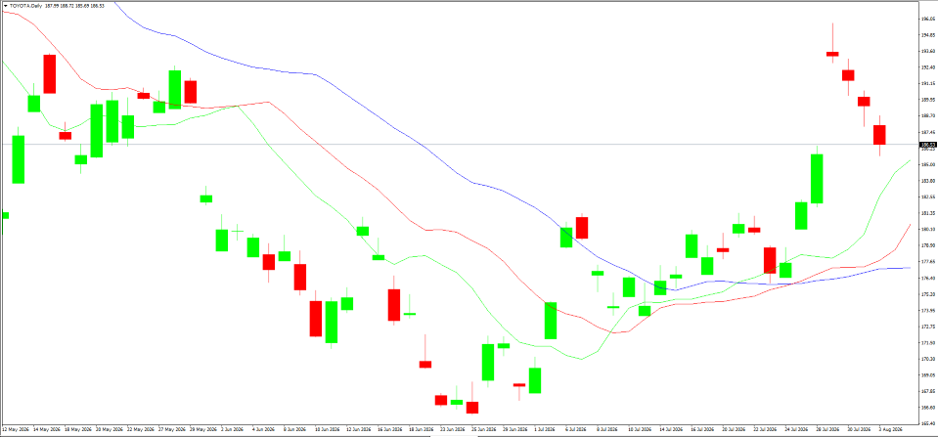
The stock decline reflects concerns over slowing profit momentum, rising operational costs, and increasing competition in key markets. While Toyota continues to benefit from its strong financial position and global scale, investors are assessing whether these external pressures could affect future growth—leading many market participants to weigh the core differences between long-term share trading vs investing when navigating short-term market corrections.
For active market participants evaluating corporate earnings announcements, leveraging tools to trade equity movements via CFD shares allows flexibility during both bullish and bearish market cycles.
Yen Weakness Supports Toyota’s Earnings but Creates New Challenges
The weaker Japanese yen remains an important factor influencing Toyota’s financial performance.
As a major exporter, Toyota benefits when overseas revenue earned in foreign currencies becomes more valuable after conversion into yen. With significant international sales and many costs recorded in yen, currency movements can provide support to reported earnings.
However, the weaker currency also creates challenges by increasing the cost of imported materials, components, and energy. These higher input costs have added pressure to operating expenses and reduced some of the benefits from favourable exchange rates. Understanding how exchange rate swings impact multinational bottom lines requires mastering key foreign exchange fundamentals and essential forex terms all traders should know.
The yen’s weakness has been closely linked to differences in monetary policy between Japan and the United States. While the Bank of Japan maintained relatively accommodative policy, the Federal Reserve kept interest rates at higher levels, encouraging capital flows towards the US dollar.
BOJ-Fed Policy Gap Continues to Drive Currency Pressure
The divergence between Japanese and US monetary policy has remained a key driver of yen movements across major crosses, including pairs like CAD/JPY and USD/JPY.
The prolonged interest rate gap between the Bank of Japan and Federal Reserve contributed to sustained pressure on the Japanese currency, prompting Tokyo authorities to intervene in foreign exchange markets.
Japan’s Finance Ministry confirmed that it conducted a coordinated yen-buying operation with the US Treasury, marking a rare joint move between the two allies to limit sharp currency fluctuations.
Tokyo has also signalled that it remains prepared to act again if necessary, stating that it “will not hesitate to conduct further coordinated interventions in the future” while maintaining close communication with the US Treasury. For traders reacting to central bank headlines, executing systematic strategies on high-volatility events using 5 steps to trade forex on news releases is essential for staying ahead of sudden policy shifts.
Although the intervention helped stabilise the yen temporarily, the broader direction of the currency will continue to depend on monetary policy expectations, inflation trends, and future decisions from both central banks.
China Slowdown and EV Competition Challenge Toyota’s Growth
China remains one of Toyota’s biggest challenges as competition in the automotive industry intensifies.
The country has historically been a major growth market for global automakers, but slowing economic activity and rapid changes in consumer preferences have created new pressure.
Toyota’s first-half sales in China fell 17% year-on-year to 694,700 units, marking a fifth consecutive month of decline. The decline comes as Chinese manufacturers rapidly expand their new energy vehicle (NEV) offerings and gain market share.
Toyota’s hybrid-focused strategy has provided strength in markets such as the US and Europe, where hybrid demand remains resilient. However, the rapid growth of Chinese EV makers has increased competitive pressure and forced Toyota to reassess its electrification strategy in China.
Trade tensions between China and Western economies have also added uncertainty to the operating environment.
Toyota Results Reflect Broader Global Economic Challenges
Toyota’s latest results highlight the wider challenges facing multinational companies operating in an increasingly complex environment.
Corporate performance is increasingly influenced by monetary policy, currency movements, geopolitical risks, and technological transformation.
For exporters, currency movements can provide support by improving overseas earnings, but they can also create challenges through higher import costs and increased operational expenses.
Future changes in global interest rate expectations, particularly from the Federal Reserve and Bank of Japan, could influence currency markets and affect companies with significant international operations such as Toyota.
Toyota Outlook: Strong Fundamentals Face a More Complex Environment
Toyota’s recent performance does not necessarily indicate structural weakness. The company continues to benefit from its global scale, strong financial position, and leadership in hybrid vehicles.
However, maintaining its competitive position will require Toyota to adapt to a rapidly changing automotive industry, including rising EV competition, currency volatility, and shifting consumer demand.
The company’s ability to balance its hybrid strength with accelerating electrification efforts will remain a key factor in determining its long-term growth outlook.
Frequently Asked Questions
Why did Toyota’s quarterly profit decline?
Toyota’s quarterly profit declined due to higher operating costs, supply chain pressures, weaker market conditions, and currency-related challenges. Operating profit fell 9% to 1.06 trillion yen in the April-June quarter.
Why did Toyota raise its annual profit forecast despite weaker quarterly results?
Toyota raised its full-year operating profit forecast to 3.4 trillion yen as management expects favourable currency movements, strong vehicle demand, and operational resilience to support earnings.
How does a weaker yen affect Toyota’s earnings?
A weaker yen benefits Toyota because overseas revenue becomes more valuable when converted back into yen. However, it also increases the cost of imported materials, energy, and components.
Why is Toyota facing pressure in China?
Toyota faces stronger competition from Chinese EV manufacturers, slower market growth, and changing consumer preferences. Its first-half China sales declined 17% year-on-year as local NEV brands gained market share.
Is Toyota still competitive in the EV market?
Toyota remains a global leader in hybrid vehicles, which continue to see strong demand in major markets. However, the company faces increasing pressure to accelerate its EV strategy as competition grows.
What factors could affect Toyota’s future stock performance?
Investors will continue monitoring yen movements, Bank of Japan and Federal Reserve policy, China’s automotive market, EV competition, global vehicle demand, and Toyota’s ability to maintain profitability in a changing industry.
Start trading now — click here to create your real VT Markets account.








