





You’ve spotted it on a broker’s watchlist sitting right next to EURUSD and GBPUSD, but XAUUSD looks nothing like a normal currency pair at first glance. It isn’t one, not exactly. Understanding XAUUSD meaning is the first step to grasping how the world actually prices gold and why this single ticker moves markets every time a central bank speaks.
This guide covers what is xauusd, breaks down the code itself, walks through the main drivers behind xauusd price action, and finishes with a practical framework for trading xauusd. Written as an evergreen, informational reference for anyone curious about how gold and the US dollar interact.
Key Takeaways
- XAUUSD shows how many US dollars are needed for one troy ounce of gold — if XAUUSD reads 2,400, one ounce costs $2,400.
- XAU USD is one of the most actively traded instruments in global financial markets, used by traders, investors, and central banks alike to hedge inflation, manage risk, or speculate on price swings.
- The pair is driven mainly by interest rates, dollar strength, inflation data, and geopolitical events — not just jewellery demand or mine supply.
- Trading gold via XAUUSD differs fundamentally from owning physical gold: you speculate on price changes rather than holding coins or gold bars.
- Gold reached an all-time high of $5,602.23 on 29 January 2026, underscoring just how strongly economic uncertainty and shifting interest rates have supported the metal through this cycle.
- This article covers how XAUUSD works as a currency pair, what moves gold prices, and practical steps for anyone considering trading XAUUSD for the first time.
What Is XAUUSD? Understanding the Gold-Dollar Pair
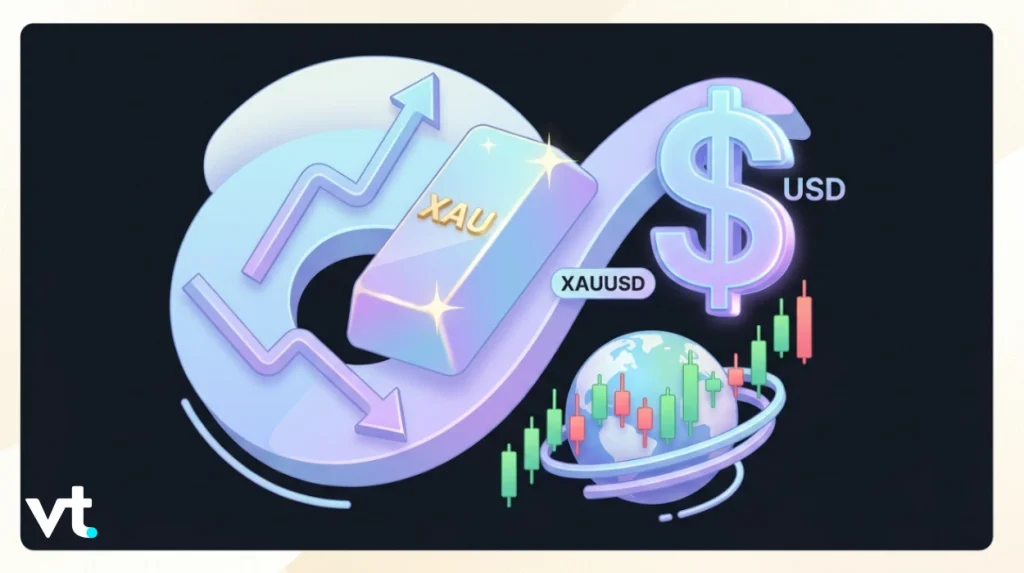
XAUUSD is the price of one troy ounce of gold quoted in US dollars, tracked widely across global financial markets. If XAUUSD sits at 2,350, one troy ounce of gold costs 2,350 US dollars.
Traders often say “XAUUSD” or “xau usd” interchangeably when referring to spot gold versus the dollar. XAU USD is highly liquid and among the most traded instruments on forex platforms, sitting alongside major pairs like EURUSD and GBPUSD on most brokers’ watchlists. It’s open for trading nearly 24 hours a day on weekdays, from Sunday evening to Friday evening US Eastern Time. VT Markets’ beginner’s guide to gold trading offers a broader starting point if this is your first time approaching the metal.
XAUUSD Meaning: Breaking Down the Code
XAU stands for one troy ounce of gold — the “AU” comes from “aurum”, the Latin word for gold. The leading “X” follows ISO 4217 convention, where “X” indicates a non-sovereign asset like a precious metal rather than a country’s currency. The same prefix appears in silver (XAG), platinum (XPT), and palladium (XPD).
USD represents the United States Dollar as the counter currency. Together, XAUUSD works like a currency pair: XAU is the “base” (the thing you buy), and USD is the “quote” (the price you pay). A quick way to read it: XAUUSD = 2,000 means you pay $2,000 for 1 oz of gold. When the number rises, gold is getting more expensive in dollar terms.
XAUUSD vs Physical Gold: What’s the Difference?
You can gain gold exposure two ways: owning physical gold or trading XAUUSD in financial markets.
| Feature | XAUUSD Trading | Physical Gold |
|---|---|---|
| Ownership | No, derivative contract | Yes — tangible metal |
| Storage/insurance | None | Required |
| Short selling | Yes | Not practical |
| Execution speed | Milliseconds | Hours to days |
| Counterparty risk | Broker-dependent | None (you hold it) |
| Best for | Active traders, short-term speculation | Long-term wealth preservation, investing |
Physical gold means coins (like 1 oz American Eagles), gold bars, and sometimes jewellery, with ownership requiring storage, insurance, and purity verification — typically 24 karat or .9999 fineness. Investors seeking portfolio diversification and a long-term store of value often prefer physical gold, while active traders choose XAUUSD to trade gold price swings with leverage.
Why Is Gold Quoted in US Dollars?
Gold is gold quoted in US dollars worldwide largely because the dollar has been the primary reserve and settlement currency since the Bretton Woods agreement of 1944. After President Nixon ended dollar-gold convertibility in 1971, gold’s price began floating freely, but the dollar remained the standard quoting unit.
The US holds the largest gold reserves globally at 8,133 tonnes, reinforcing the dollar’s role in gold pricing. Using the dollar as the quote currency lets markets compare gold prices across countries and exchanges without conversion headaches. Central banks, institutional investors, and retail traders all monitor XAUUSD as their benchmark — gold can be quoted in other fiat currencies (XAU/EUR, XAU/JPY), but those pairs carry far less liquidity.
Main Factors That Move XAUUSD Prices
XAUUSD is driven by macroeconomic data, financial conditions, and shifts in risk appetite — not just jewellery demand or mine supply.
Interest Rates and Federal Reserve Policy
Higher interest rates raise the opportunity cost of holding gold, which pays no yield, so gold prices often react inversely to rate changes. When the Federal Reserve cuts rates, gold tends to rise because the cost of holding it drops.
Inflation and Purchasing Power
Gold is widely used as a hedge against inflation. Rising inflation expectations push investors toward gold to preserve purchasing power, lifting XAUUSD as a result.
Dollar Strength and Currency Markets
XAU USD typically has an inverse relationship with the stronger dollar — a firmer dollar can reduce gold demand, since gold becomes pricier for holders of other currencies. The Dollar Index often moves inversely to XAUUSD, and fiscal deficits or sovereign debt concerns filter through to gold pricing as well.
Geopolitical Events and Safe Haven Demand
Geopolitical events — wars, sanctions, and political crises — trigger safe haven flows into gold. Between September 1978 and January 1980, gold surged from around $217/oz to $850/oz amid oil shocks and geopolitical events. More recently, gold reached its all-time high of $5,602.23 on 29 January 2026, reflecting sustained economic uncertainty and shifting rate expectations. Central bank gold purchases have also grown in recent years, with China, India, and Russia among those increasing reserves.
How XAUUSD Works as a Currency Pair
Although gold is technically a precious metal rather than a currency, XAU USD is traded like a traditional currency pair on forex platforms — you buy or sell gold in dollars the same way you’d trade EURUSD or GBPUSD.
Brokers quote bid/ask prices — for example, 2,345.20 / 2,345.80 means you sell at 2,345.20 and buy at 2,345.80, with the $0.60 spread as your basic transaction cost. Contract sizing varies by broker; a common standard lot equals 100 troy ounces, meaning a $1 move in gold produces a $100 change in account value. Leverage for XAUUSD typically runs 1:20 to 1:50 depending on regulatory jurisdiction, magnifying both gains and losses. Traders can go long (buy XAUUSD, expecting gold to rise) or go short (sell, expecting gold to fall) — a flexibility many traders prefer over holding physical gold directly.
Technical Analysis of XAUUSD: Charts and Indicators
Many traders use chart analysis and technical indicators to time entries and exits in XAUUSD.
- Support, resistance, and trends: round numbers like $3,000/oz often act as key resistance or key support, with traders marking prior highs and lows to define broader direction.
- Moving averages: the 50-day and 200-day simple moving averages are widely followed — a golden cross signals bullish momentum and a death cross the opposite.
- Momentum oscillators: RSI, MACD, and stochastic indicators help identify overbought or oversold conditions, with RSI above 70 suggesting potential exhaustion and below 30 suggesting a possible reversal.
- Candlestick patterns: hammers, shooting stars, and doji formations appear near turning points, carrying more weight at established support or resistance levels.
Technical signals tend to work best when combined with macro awareness — entering purely on a chart pattern minutes before a CPI release or FOMC decision can lead to slippage and unexpected volatility, so a neutral buy approach that waits for both technicals and fundamentals to align is often more sensible than reacting to either alone.
How to Trade XAUUSD in Practice
A practical framework for anyone considering trading gold via XAUUSD:
- Choose a broker: pick a well-regulated broker offering XAUUSD with transparent spreads, clear margin rules, and reliable execution.
- Set up your account: open a demo account first, define maximum risk per trade (1–2% of equity), and set daily loss limits based on your own risk tolerance.
- Pick a trading style: decide whether you’re a day trader, swing trader, or position trader, and match your chart timeframe accordingly.
- Combine analysis: watch interest rate expectations, the dollar, bonds, and geopolitical headlines, then use charts to refine entries and exits.
- Manage risk: gold can move $20–$40 in a single session, so set stops based on volatility rather than arbitrary pip counts, and always use take-profit orders.
- Test first: practise on demo accounts or with very small capital before scaling, keeping a trade journal to track what actually works.
VT Markets’ complete guide to trading gold covers this same framework with additional platform-specific detail.
Cautions to Note When Trading XAUUSD
- Gold’s volatility against the dollar can be higher than many major currency pairs, so leverage should be used cautiously, particularly by newer traders.
- During liquidity squeezes, forced selling across stocks and commodities can temporarily pull gold lower even during genuine crises, despite its usual role as a safe haven asset — a pattern worth remembering rather than assuming gold always rises on bad news.
- XAUUSD carries swap and overnight financing costs that differ from gold ETFs, which instead carry management fees and possible tracking error — worth comparing before deciding which structure suits your goals.
- Entering trades right before major US releases like nonfarm payrolls or FOMC decisions increases the chance of slippage; beginners may prefer to sit out these windows until they understand how XAUUSD behaves during high-volatility conditions.
Best Time to Trade XAUUSD
XAUUSD trades almost 24 hours on weekdays, but liquidity and volatility vary meaningfully by session.
| Session | Characteristics |
|---|---|
| London–New York overlap (13:00–17:00 GMT) | Tightest spreads, strongest moves |
| Asian session (Tokyo/Sydney) | Generally quieter, occasional sharp moves from Asia-Pacific headlines |
| Around major US data (NFP, CPI, FOMC) | Explosive moves, higher slippage risk |
It’s also worth avoiding the daily rollover window and thin Friday-close liquidity, both of which can distort pricing briefly without reflecting genuine market demand.
Start Online CFD Trading with VT Markets Today
If you are ready to put your understanding of XAUUSD meaning to work in live markets, VT Markets provides access to tools and platforms to help you get started. Trade on powerful platforms like MetaTrader 4 (MT4) and MetaTrader 5 (MT5), designed for speed, reliability, and advanced trading features — exactly what you need when gold prices and the us dollar move fast around central bank decisions.
New to trading? Practise risk-free with a VT Markets demo account before committing to a live account—ideal for simulating reactions to XAUUSD volatility across currency pairs, indices, and commodities without financial risk.
Open your live account with VT Markets today and access secure, transparent, and competitive CFD trading across some of the world’s most popular markets.
Frequently Asked Questions About XAUUSD
1. What is XAUUSD and what does it mean?
XAUUSD is the price of one troy ounce of gold quoted in US dollars — the XAUUSD meaning breaks down to XAU (gold) traded against USD (the dollar), functioning like any other currency pair on a trading platform.
2. Is XAUUSD the same as owning physical gold?
No. Trading XAUUSD gives exposure to gold’s price in US dollars but grants no ownership of coins, gold bars, or jewellery — it’s a derivative contract, whereas physical gold involves storage, insurance, and purity verification.
3. What moves the XAUUSD price the most?
Interest rates, dollar strength, inflation data, and geopolitical events are the primary drivers — gold prices often rise when interest rates fall, inflation expectations climb, or economic uncertainty pushes investors toward a safe-haven asset.
4. Can beginners trade XAUUSD safely?
Beginners can trade XAUUSD, but it’s sensible to start with a demo account or very small positions, learn how gold reacts to interest rate news and dollar moves, and apply strict risk controls before committing meaningful capital.








