





Key Takeaways
- Venture capital (VC) is a form of private equity financing directed at high-potential, early stage companies in exchange for an equity stake.
- Global VC funding reached approximately USD $285 billion in 2025, with AI, climate-tech, and biotech leading deal flow.
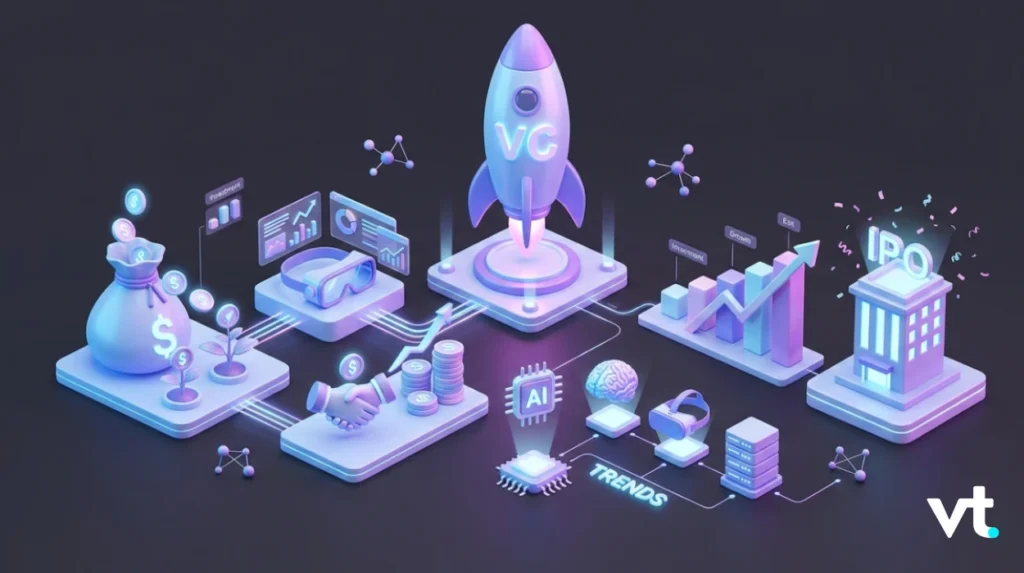
- The VC lifecycle moves from seed funding → Series A → Series B/C → exit via acquisition or initial public offering (IPO).
- Key players include venture capitalists, angel investors, limited partners (such as pension funds and endowments), and general partners.
- VC is distinct from bank loans — founders give up an ownership stake rather than taking on debt.
- Understanding how venture capital works gives traders insight into emerging companies before they go public.
The Venture Capital Definition: More Than Just Money
At its core, the venture capital definition is straightforward: it is a type of private equity financing in which investors — commonly called venture capitalists — inject capital into early stage startups or emerging companies that demonstrate high growth potential. In return, they receive an equity stake, meaning they become partial owners of the business.
Unlike bank loans, which require collateral and repayment schedules, VC funding is risk capital. Investors bet on a company’s vision, its management team, and the size of the addressable market. If the company fails — and statistically, many do — the investor loses their capital. If it succeeds, the returns can be extraordinary.
The venture capital definition also encompasses the broader ecosystem: the VC firms that raise and deploy capital funds, the portfolio companies they back, the limited partners who supply the capital, and the infrastructure of deal-making, due diligence, and mentorship that surrounds each investment.
“Venture capital is the fuel that turns a compelling business idea into a category-defining company.” — A widely cited description in the venture capital industry.
A Brief History: From Post-War Roots to a $285B Global Industry
Many people are surprised to learn that the modern venture capital industry traces its origins to the years following World War II. In 1946, American Research and Development Corporation (ARDC) became one of the first institutional VC firms, investing in technology companies commercialising wartime innovations.
The model truly took off in Silicon Valley during the 1970s and 1980s, with firms backing then-unknown companies such as Apple and Intel. By the dot-com era of the late 1990s, VC funding had exploded — and subsequently contracted sharply after the 2000 crash. The industry rebuilt itself with more rigorous investment decisions and governance frameworks.
Today, firms such as Sequoia Capital, Andreessen Horowitz, and Benchmark are household names in the startup world. According to PitchBook and the National Venture Capital Association (NVCA), global VC deal flow exceeded USD $285 billion across more than 32,000 deals in 2025 — with the United States, China, and the UK accounting for the largest share of VC investments.
How Does Venture Capital Work? The Full Lifecycle Explained
Step 1 – Raising the Fund
Before a VC firm invests a single dollar, it must raise capital itself. VC firms raise money from limited partners (LPs) — institutional investors such as pension funds, university endowments, corporate pension funds, family offices, and high-net-worth individuals. A general partner manages the fund and makes investment decisions, while LPs provide most of the capital but have limited liability and limited say in day-to-day operations. Larger venture capital funds — and increasingly even larger venture funds — can raise north of USD $1 billion per fund.
Step 2 – Sourcing Deals
Once a fund is closed, VC firms begin building their deal flow — the pipeline of potential investments. Deals arrive via warm referrals, accelerator networks, industry conferences, and direct outreach. Competitive VC firms may review thousands of pitches a year to make only a handful of investments. Sequoia Capital, for example, is renowned for its disciplined approach to sourcing and evaluating promising startups.
Step 3 – Due Diligence
Before any capital is deployed, VC firms conduct rigorous due diligence: evaluating the business model, business plan, market size, competitive landscape, intellectual property, management team, and financials. For early stage companies with a limited operating history, much of this assessment is forward-looking — assessing potential rather than proven performance.
Step 4 – Making the Investment
Once a deal is approved, the VC firm invests in exchange for preferred equity. The first investment may be modest — a seed funding round of a few hundred thousand dollars — but follow-on rounds (Series A, B, C, and beyond) can run into hundreds of millions. The equity infusion gives the company the runway it needs to hire employees, develop its product, enter new markets, and fund growth.
Step 5 – Active Ownership
Unlike passive shareholders, venture capitalists actively support their portfolio companies. This includes board representation, introductions to customers and partners via strategic partnerships, guidance on talent acquisition, and help with subsequent funding rounds. This hands-on model is a key part of how venture capital works in practice.
Step 6 – The Exit
Venture capitalists ultimately need to realise their returns. The two most common exit routes are an acquisition by a larger company or a public listing via an initial public offering (IPO). A third route — a secondary sale to another investor — is growing in prevalence. It is at exit that the true value of VC money is crystallised, either delivering outsized returns or confirming the risks of venture capital investment.
Venture Capital Funding Stages at a Glance
| Stage | Typical Round Size | Company Maturity | Lead Investors |
|---|---|---|---|
| Pre-Seed | $50K – $500K | Idea / prototype | Founders, friends & family, angel investors |
| Seed | $500K – $3M | Early traction | Angel investors, seed-stage VC firms |
| Series A | $3M – $20M | Product-market fit | Early stage VC firms |
| Series B | $20M – $100M | Scaling | Growth-stage venture firms |
| Series C+ | $100M+ | Expansion / pre-IPO | Larger venture funds, private equity firms |
| Exit (IPO / M&A) | Varies | Mature / established | Public markets or acquirers |
Who Are the Key Players in Venture Capital?
Venture Capital Firms (VC Firms)
These are the professional organisations that manage venture capital funds on behalf of their limited partners. Well-known VC firms include Sequoia Capital, Accel, Lightspeed, and Index Ventures. They vary enormously in scale — from boutique venture firms managing $50 million to mega-funds managing tens of billions across multiple companies and geographies.
Angel Investors
Angel investors are typically high-net-worth individuals who invest their own money at the pre-seed or seed stage — often before institutional VC firms are willing to engage. Angel investments tend to be smaller and more personal in nature. Many successful startup founders become angel investors themselves after their exit, creating a flywheel effect in the ecosystem. According to the NVCA, angel investors in the United States alone deployed an estimated USD 22 billion in early-stage funding in 2025.
Limited Partners (LPs)
Limited partners are the institutional and private investors who supply the bulk of institutional capital to VC funds. They include pension funds, sovereign wealth funds, insurance companies, university endowments, and family offices. Their goal is to achieve returns superior to traditional asset class options, accepting the illiquidity and high risk that VC entails in exchange for the potential of venture-level returns.
General Partners (GPs)
The general partner of a VC fund is the professional investor or team responsible for sourcing deals, conducting due diligence, making investment decisions, and managing portfolio companies. GPs typically contribute a small percentage of the fund’s capital themselves — aligning their incentives with LPs. They earn a management fee (usually 2%) and a performance fee called “carry” (typically 20% of profits).
Venture Capital vs. Other Funding Sources: A Comparison
| Funding Type | Source of Capital | Repayment Required? | Equity Given Up? | Best For |
|---|---|---|---|---|
| Venture Capital | VC firms / venture capitalists | No | Yes | High-growth early stage startups |
| Angel Investment | Individual angel investors | No | Yes (smaller stake) | Pre-seed / seed stage |
| Bank Loans | Commercial banks | Yes (+ interest) | No | Established companies with assets |
| Private Equity | Private equity investors / private equity firms | No | Yes (often majority) | More mature companies, buyouts |
| Bootstrapping | Founder’s own money | No | No | Lean startups valuing full control |
A key distinction is the nature of the capital. Bank loans must be repaid regardless of business performance — a crushing burden for an early-stage company with no revenue. Venture capital VC funding, by contrast, is “patient capital” that only pays off at exit. The trade-off is the ownership stake: founders who take on multiple rounds of VC funding may find themselves holding a minority position in their own company by the time of an IPO.
What Makes Venture Capital High Risk — and High Reward?
It is a widely cited statistic in the venture capital industry that approximately 90% of startups fail. Even among funded companies, only a small fraction will generate returns that exceed the cost of capital. This is why VC firms build diversified portfolios — they expect most startup investments to underperform, but they bank on a handful of venture-backed companies delivering returns of 10x, 100x, or more.
⚠️ Take Note: Venture capital is classified as an alternative asset class with substantially lower liquidity than public equities. VC investments are typically locked up for 7–12 years. If you are considering exposure to venture-style returns as a retail participant — through listed venture vehicles, VC ETFs, or platforms that offer access to early-stage deals — please conduct thorough research and consult a qualified financial adviser. Understanding your risk tolerance is essential before you raise funds or deploy capital in this space.
For the venture capital industry, the reward side is equally compelling. A single investment — say, Sequoia Capital’s early bet on Google — can return an entire fund many times over. This “power law” dynamic is central to how venture capital works as an investment strategy. VC firms are not trying to bat 1,000; they are trying to find the one company that changes a category.
The 2026 Venture Capital Landscape: Key Statistics and Trends
The venture capital industry has undergone significant recalibration since the peak of 2021. After a correction in 2022–2023, VC funding is recovering — driven largely by artificial intelligence, climate technology, and life sciences. Here is a snapshot of where things stand in 2026:
- Global VC funding is projected to reach approximately USD 310 billion in 2026, recovering towards 2021 highs (Source: PitchBook, Q1 2026).
- AI-related venture capital deals accounted for more than 35% of total global VC investments in 2025, a figure expected to grow in 2026.
- The median Series A round in North America reached USD 15 million in 2025, up from $10 million in 2020.
- Larger venture funds — those over USD $1 billion — now represent a growing share of total capital deployed, as even larger venture funds concentrate capital in fewer, more conviction-driven bets.
- The National Venture Capital Association (NVCA) reports that US-based VC firms alone invested over USD 170 billion across more than 15,000 deals in 2025.
- The number of active angel investors globally has surpassed 500,000, supported by the proliferation of angel networks and syndicate platforms.
- Venture capital firms in the Asia-Pacific region — particularly in India, Singapore, and South Korea — have continued to raise money at pace, with regional venture funding reaching USD 55 billion in 2025.
- Investment strategies are shifting: sector-agnostic mega-funds are increasingly giving way to highly specialised VC firms focused on deep tech, defence, and biotech.
Common Investment Strategies Used by Venture Capital Firms
Not all VC firms operate the same way. Their investment strategies vary widely based on the stage of the company’s development they target, the sectors they favour, and the level of involvement they take post-investment. Here are the most common approaches:
- Early Stage Focus: Primarily invests in pre-seed, seed, and Series A rounds. Accepts greater uncertainty in exchange for lower valuations and larger equity positions.
- Growth Stage / Expansion: Targets companies that have demonstrated product-market fit and are scaling. Rounds are larger, and potential investments are evaluated against revenue metrics.
- Sector-Specific: Some VC firms focus exclusively on verticals such as fintech, climate, health tech, or enterprise SaaS. Deep domain expertise is a competitive advantage.
- Corporate Venture Capital (CVC): Large established companies — from Google to Samsung — run their VC arms to gain strategic partnerships with and early access to disruptive technologies.
- Micro-VC / Syndicate Models: Smaller funds, often led by a single general partner, that make smaller cheques into a larger number of early-stage companies.
Stay Ahead of the Market With VT Markets
As venture-backed companies move towards public markets, understanding the forces shaping them gives you a trader’s edge. Explore market analysis, economic calendars, and cutting-edge trading tools with VT Markets — built for every level of expertise.
Beyond the Cheque: What Venture Capital Really Gives Startup Founders
The popular image of venture capital reduces it to a transaction: a VC firm invests cash, and startup founders give away equity. But the reality for most venture-backed companies is far richer. The best VC firms function more like operating partners than passive financiers.
Here is what startup founders typically gain beyond the initial equity infusion:
- Network access: Introductions to potential customers, strategic partnerships, and future investors that would take years to build independently.
- Talent acquisition: Top-tier VC firms maintain talent networks and help hire employees at critical growth stages.
- Operational expertise: Experienced GPs who have seen hundreds of portfolio companies can identify pitfalls before they become crises.
- Follow-on capital: A trusted VC backer signals quality to future investors, making subsequent funding rounds easier to raise capital for.
- Brand credibility: Being backed by a recognised firm like Sequoia Capital or Accel confers legitimacy that helps with sales, hiring, and press coverage.
- Business model refinement: Board-level discussions help startup founders stress-test their assumptions and sharpen their business plan.
Precautions Startup Founders Should Keep in Mind When Pursuing VC
⚠️ Reminder for Founders: Accepting VC funding is not always the right path. The pressure to achieve hyper-growth can distort a company’s natural development trajectory. Before approaching VC firms, founders should evaluate whether they genuinely need outside capital, whether their business model is suited to the returns profile that venture capitalists require, and whether they are comfortable ceding partial control via an equity stake and board seats. Bank loans or revenue-based financing may be preferable in some contexts — particularly for mature companies with predictable cash flows.
How Venture Capital Connects to Public Markets — and Why Traders Should Care
For those active in public financial markets, venture capital is far from an irrelevant abstraction. The pipeline from early-stage funding to IPO means that today’s venture deals are tomorrow’s publicly listed equities. Savvy traders stay up-to-date with VC trends to anticipate which sectors attract capital and which may be overheated.
Several public market dynamics are directly influenced by VC funding activity:
- IPO pipelines: A surge in late-stage VC funding typically signals a robust IPO pipeline 18–36 months later, influencing sector-wide sentiment.
- Tech sector valuations: VC investments set private market benchmarks that ripple through to public established companies in the same sector.
- M&A activity: Portfolio companies that do not reach IPO scale are often acquired by publicly listed corporations, affecting the acquirer’s stock.
- Thematic ETFs: The rise of innovation-focused ETFs means retail investors now have indirect exposure to the performance of venture backed companies post-IPO.
At VT Markets, our Market Buzz tool uses AI to help traders identify emerging themes — including the sectors commanding the most attention from the venture capital industry. Pair that with our Economic Calendar to track the macro conditions that influence VC firm risk appetite and IPO timing.
The Venture Capital Industry Ecosystem: An Overview
The venture capital industry is a complex, interconnected ecosystem. The diagram below illustrates the key relationships:
| Player | Role | Example |
|---|---|---|
| Limited Partners (LPs) | Provide capital to venture capital funds | Pension funds, endowments, family offices |
| VC Firms / General Partners | Manage the fund, source & make vc investments | Sequoia Capital, Andreessen Horowitz |
| Angel Investors | Early stage capital from individuals’ own money | Serial founders, tech executives |
| Portfolio Companies | Receive capital in exchange for equity | Early stage startups → unicorns |
| Accelerators / Incubators | Provide early support, intro to venture deals | Y Combinator, Techstars |
| Private Equity Firms | Acquire or further invest in more mature companies | KKR, Carlyle, Blackstone |
| Public Markets | Provide exit via IPO for investors | NYSE, NASDAQ, LSE |
Frequently Asked Questions (FAQs) About Venture Capital
❓ FAQ 1: What is the difference between venture capital and private equity?
Both are forms of private market investing, but they differ significantly in focus. Venture capital primarily invests in early stage companies and emerging companies with limited operating history — accepting high risk in pursuit of outsized returns. Private equity (and private equity firms) typically target more mature companies or established companies with proven revenue, often using leverage (borrowed capital) to acquire large or controlling stakes. Private equity investors generally seek to restructure and optimise businesses before a sale or IPO, while venture capitalists focus on building companies from the ground up.
❓ FAQ 2: How do venture capitalists make money?
Venture capitalists profit primarily through two mechanisms. First, management fees — typically 2% of the fund’s committed capital per year — cover operational costs. Second, and most importantly, “carried interest” (or “carry”) entitles the general partner to approximately 20% of the fund’s profits above a hurdle rate. This means a VC firm that delivers a 5x return on a $500 million fund could generate tens of millions in carry for its partners. The alignment of interest between GPs and limited partners is central to how venture capital works.
❓ FAQ 3: Can ordinary retail investors access venture capital?
Historically, direct venture capital investment was restricted to institutional investors and ultra-high-net-worth individuals. However, that is changing. Platforms such as AngelList, Seedrs, and Crowdcube allow retail participation in early-stage funding rounds. Additionally, listed vehicles — including VC-focused investment trusts, innovation ETFs, and publicly traded VC firms — offer indirect exposure. That said, the high risk and illiquidity of this asset class mean retail investors should approach it with caution and conduct thorough due diligence before committing capital.
❓ FAQ 4: What is a good way to stay informed about venture capital trends as a trader?
Staying current on the venture capital industry is invaluable for traders who want to anticipate sector rotation and IPO-driven volatility. Reliable sources include the National Venture Capital Association (NVCA) annual reports, PitchBook’s quarterly VC data, Crunchbase for individual venture deals, and publications such as TechCrunch and The Information. For broader market context — including how macro conditions affect VC funding appetites — you can also explore the VT Markets Discover section, which publishes regular market insights for traders of all experience levels.
The Future of Venture Capital: What to Watch in 2026 and Beyond
The venture capital industry is entering a new era. Artificial intelligence is not just a category being funded by VC firms — it is actively reshaping how venture capitalists evaluate potential investments, conduct due diligence, and monitor portfolio companies. AI-powered deal sourcing tools, predictive models for startup investments, and real-time monitoring of company’s development metrics are becoming standard across leading VC firms.
Meanwhile, a generational shift is underway. A new cohort of startup founders—many of whom are second-time entrepreneurs with exits already under their belt—are raising capital with greater sophistication and more leverage. They understand venture deals, negotiate term sheets with confidence, and are less willing to accept onerous terms from even the most prestigious VC firms.
For public market participants, the convergence of the private and public markets is the defining trend. As more vc funding stays private for longer — with companies delaying their initial public offering — the IPO moment carries even greater significance for traders. Venture-backed companies that finally come to market often carry years of compressed value that can be unlocked rapidly — or destroyed — in the first few months of trading.
Whether you are a trader, investor, or simply someone fascinated by the forces shaping the global economy, understanding venture capital — from the venture capital definition all the way through to exit mechanics — gives you a fundamentally clearer picture of how innovation is financed and commercialised.
Ready to Trade the Markets That Matter?
From IPO-driven momentum to sector themes emerging from VC deal flow, the financial markets reward those who understand the full picture. Open an account with VT Markets and access the tools, analysis, and platforms you need to trade with confidence.








