





When financial markets begin to fall, investors often face a difficult choice between protecting their capital and remaining positioned for a potential recovery. Declining stock indices, economic uncertainty and negative market sentiment can make even experienced investors question whether their existing strategies remain appropriate.
However, not every market decline requires the same response. Some downturns reflect temporary shifts in sentiment, while others signal more fundamental changes in economic conditions or corporate performance. Investors who sell too quickly may miss a subsequent recovery, while those who hold without reassessing their exposure could face deeper losses.
Understanding the available options is therefore essential.
Depending on your objectives and market outlook, you may choose to hold existing positions, reduce their exposure, hedge against further declines or remain on the sidelines. Traders anticipating additional downsides may also consider instruments such as contracts for difference (CFDs), traditional short selling and inverse exchange-traded funds (ETFs), although these approaches introduce different risks and costs.
Why Falling Markets Often Trigger Emotional Decisions
Market downturns can amplify the psychological pressures investors experience, particularly when losses accumulate quickly. As portfolio values decline and negative headlines dominate financial news, investors may become increasingly concerned about protecting their remaining capital, sometimes making decisions before fully evaluating the underlying market conditions.
This behaviour is often associated with loss aversion, where the emotional impact of losing money outweighs the satisfaction of an equivalent gain. Investors may consequently sell positions during periods of heightened uncertainty, even when the fundamental reasons for holding those investments have not materially changed.
Fear of missing out can influence decisions in the opposite direction. Some investors rush to buy declining assets because they believe prices have reached attractive levels, overlooking the possibility that deteriorating fundamentals could push valuations lower. Both panic selling and premature buying can result from reacting to short-term movements rather than following a defined investment strategy.
Before deciding how to respond, investors should assess what is driving the decline, whether their original investment thesis remains valid and how much additional volatility they can tolerate. Understanding the differences between bullish and bearish markets can also help investors distinguish between temporary corrections and broader shifts in market direction.
For a deeper explanation of these behavioural factors, explore Panic Selling and FOMO: How Emotions Affect Traders in Falling Markets.
Should You Hold When Markets Are Falling?
For long-term investors, holding through a market decline may be reasonable when the underlying fundamentals of their investments remain intact. Financial markets regularly experience corrections as investors adjust expectations surrounding economic growth, interest rates and corporate earnings, making fundamental analysis an important consideration when assessing whether a falling share price reflects temporary uncertainty or deteriorating business conditions.
Consider an investor holding shares in a profitable company with a strong balance sheet and stable earnings. If the broader equity market declines because of temporary uncertainty surrounding monetary policy, the company’s valuation may fall despite limited changes to its business outlook. Selling immediately could reduce exposure to further losses, but it would also eliminate participation in any subsequent recovery.
Nevertheless, holding should not be confused with ignoring risk. A decline driven by weakening profitability, excessive debt or structural industry challenges may warrant a reassessment of the original investment thesis. Investors should also consider their investment horizon and portfolio concentration, as someone requiring access to capital in the near future may have less flexibility to withstand prolonged volatility.
Rather than holding simply because an investment has already declined, the decision should reflect whether the asset continues to justify its place within the portfolio.
Should You Sell to Protect Your Capital?
Selling can be a reasonable response when market conditions, investment fundamentals or personal financial circumstances have changed. By reducing or exiting existing positions, investors can limit their exposure to further declines while preserving capital that may be deployed elsewhere when opportunities emerge.
For example, an investor with significant exposure to US technology stocks may become concerned about the effect of higher interest rates on growth-stock valuations. Instead of liquidating the entire portfolio, the investor might reduce concentrated positions or rebalance towards other assets, allowing some participation in a potential recovery while managing overall risk.
However, selling an existing investment should not be confused with short selling, which involves establishing a position intended to benefit from declining prices. Understanding the distinction between share trading and investing can help investors recognise why reducing an existing holding and opening a new bearish position involve different objectives and risks.
Suppose a trader shorts 10 shares at $150 each. If the price declines to $130, repurchasing those shares would generate a gross gain of $200 before costs. Conversely, if the price rises to $180, the position would incur a gross loss of $300.
| Scenario | Repurchase price | Gross result |
| Shares fall | $130 | +$200 |
| Shares rise | $180 | -$300 |
Unlike selling an existing holding, traditional short selling introduces borrowing fees, margin requirements and the possibility of short squeezes. Potential losses are also theoretically unlimited because share prices can continue rising, making short selling a fundamentally different decision from reducing portfolio exposure.
Should You Hedge Against Further Market Declines?
Investors who remain confident in their long-term holdings may prefer to retain those investments while seeking protection against temporary market weakness. Hedging provides one possible approach by introducing an additional position intended to offset some of the losses that could arise if the original portfolio declines, allowing investors to manage downside exposure without necessarily liquidating their existing investments.
For instance, an investor holding US equities may expect heightened volatility ahead of a Federal Reserve announcement but remain optimistic about the market over the following year. Rather than selling the underlying shares, the investor could consider establishing bearish exposure through an instrument linked to a relevant stock index.
Several instruments can serve this purpose, including CFDs at VT Markets, inverse ETFs and traditional short selling, although their effectiveness depends on position sizing, costs and how closely the hedge reflects the underlying portfolio.
Using CFDs to Hedge Market Exposure
A contract for difference (CFD) allows traders to speculate on price movements without owning the underlying asset. Unlike traditional short selling, a trader does not need to borrow shares to open a short CFD position, as the contract’s profit or loss is determined by the difference between its opening and closing prices, adjusted for position size and applicable costs.
Consider an investor holding technology stocks who anticipates a temporary decline in the Nasdaq. A short position on a Nasdaq-related CFD could potentially offset some portfolio losses if the index falls, although the hedge would not necessarily move in perfect alignment with the individual stocks held. Traders unfamiliar with the instrument can explore how to trade NAS100 CFDs to better understand its characteristics.
Suppose a hypothetical Nasdaq-related CFD trades at 25,000 points, with the trader opening a sell position equivalent to $1 per index point.
| Market movement | Index level | Gross CFD result |
| Entry | 25,000 | Position opened |
| Falls 300 points | 24,700 | +$300 |
| Rises 300 points | 25,300 | -$300 |
While a decline would benefit the short CFD position, a market recovery would generate losses that could offset gains in the underlying portfolio. Hedging also involves financing costs, margin requirements and potential mismatches between the instrument being traded and the assets being protected.
Where Do Inverse ETFs Fit In?
Inverse ETFs offer another way to gain bearish market exposure without directly short-selling shares. These funds aim to deliver the opposite performance of an underlying index or asset, typically on a daily basis.
For example, VT Markets offers access to instruments linked to inverse ETFs such as
- ProShares UltraShort S&P 500 ETF(SDS): an exchange-traded fund that aims to deliver two times the inverse (-2x) of the daily performance of the S&P 500 Index,
- ProShares UltraPro Short QQQ (SQQQ): a triple-inverse (-3x) exchange-traded fund that aims to deliver three times the opposite (-3x) of the daily performance of the NAS100 Index and
- GraniteShares 2x Short SK Hynix Daily ETF (SKDD):seeks daily investment results corresponding to 2 times the inverse (-200%) of the daily percentage change of the American Depositary Receipts (ADRs) of (SKHY) SK Hynix Inc.allowing traders to gain bearish exposure to broader equity markets or individual stocks.
How Do Inverse ETFs Work? An SDS Example
SDS aims to deliver -2x the daily performance of the S&P 500. This means that if the S&P 500 falls by 1% in a single trading day, SDS is designed to rise by approximately 2%, before fees and expenses. Conversely, a 1% increase in the index would result in an approximately 2% decline in SDS.
| S&P 500 daily movement | SDS target daily movement |
| -1% | 2% |
| -2% | 4% |
| 1% | -2% |
| 2% | -4% |
For example, if SDS is trading at $50 and the S&P 500 falls 2% in one day, SDS would target a 4% gain, bringing its illustrative price to approximately $52. However, because SDS resets daily, its performance over multiple days may differ from twice the inverse of the S&P 500’s cumulative return.
However, inverse ETFs reset daily, meaning their performance over longer periods may differ significantly from the inverse of the underlying asset’s cumulative return. Traders should therefore consider leverage, holding periods and potential losses, particularly when trading ETFs through CFDs.
For more information, explore What Are ETFs?.
Comparing Different Hedging Instruments
Although CFDs, inverse ETFs and traditional short selling can all provide bearish market exposure, they differ in their trading structure, costs and risks. The table below compares the key considerations for each instrument, including how they work, leverage, costs and risks.
| Key Considerations | CFDs | Inverse ETF CFDs | Traditional short selling |
| Structure | Open a short CFD position | Open a long CFD position referencing an inverse ETF | Borrow and sell shares |
| Leverage | Margin-based, varies by instrument | CFD margin, plus any leverage built into the ETF | Margin-based |
| Main costs | Spreads, overnight financing and applicable commissions | Spreads, overnight financing and applicable commissions; ETF expenses reflected in fund performance | Borrowing fees, commissions and margin costs |
| Key risks | Leverage, margin calls and price reversals | Leverage, daily resets, compounding and tracking differences | Short squeezes, borrowing costs and potentially unlimited losses |
For VT Markets traders, short CFDs offer a way to gain bearish exposure across supported markets, while instruments linked to inverse ETFs such as SDS and SQQQ provide an alternative for expressing a bearish view on major US equity indices. However, trading conditions, leverage and product availability vary, and no instrument can guarantee an effective hedge.
Should You Stay Out When Markets Are Uncertain?
Although investors often feel compelled to act during market downturns, remaining on the sidelines can be a deliberate risk-management decision. Periods of elevated volatility may produce unpredictable price movements, particularly when markets are responding to central-bank announcements, inflation reports or geopolitical developments.
Consider a trader expecting gold prices to decline ahead of a Federal Reserve decision. Even if the broader bearish outlook eventually proves correct, an unexpected announcement could trigger a temporary price spike that closes the position at a loss before the anticipated decline develops.
Waiting for clearer conditions may therefore be preferable when market direction is uncertain, spreads have widened or the potential reward does not justify the risk. Maintaining a disciplined trading routine can help investors avoid impulsive decisions, while remaining uninvested preserves flexibility, albeit with the opportunity cost of missing a potential recovery.
The decision to stay out should consequently be viewed as another possible response to market uncertainty rather than an absence of strategy.
Which Approach Makes Sense?
There is no universally appropriate response to a market decline because each decision serves a different purpose. Long-term investors may prioritise maintaining exposure to assets with supportive fundamentals, while those concerned about changing conditions may prefer to reduce risk or hedge existing holdings. Traders seeking short-term opportunities face a different set of considerations, particularly when using leveraged instruments.
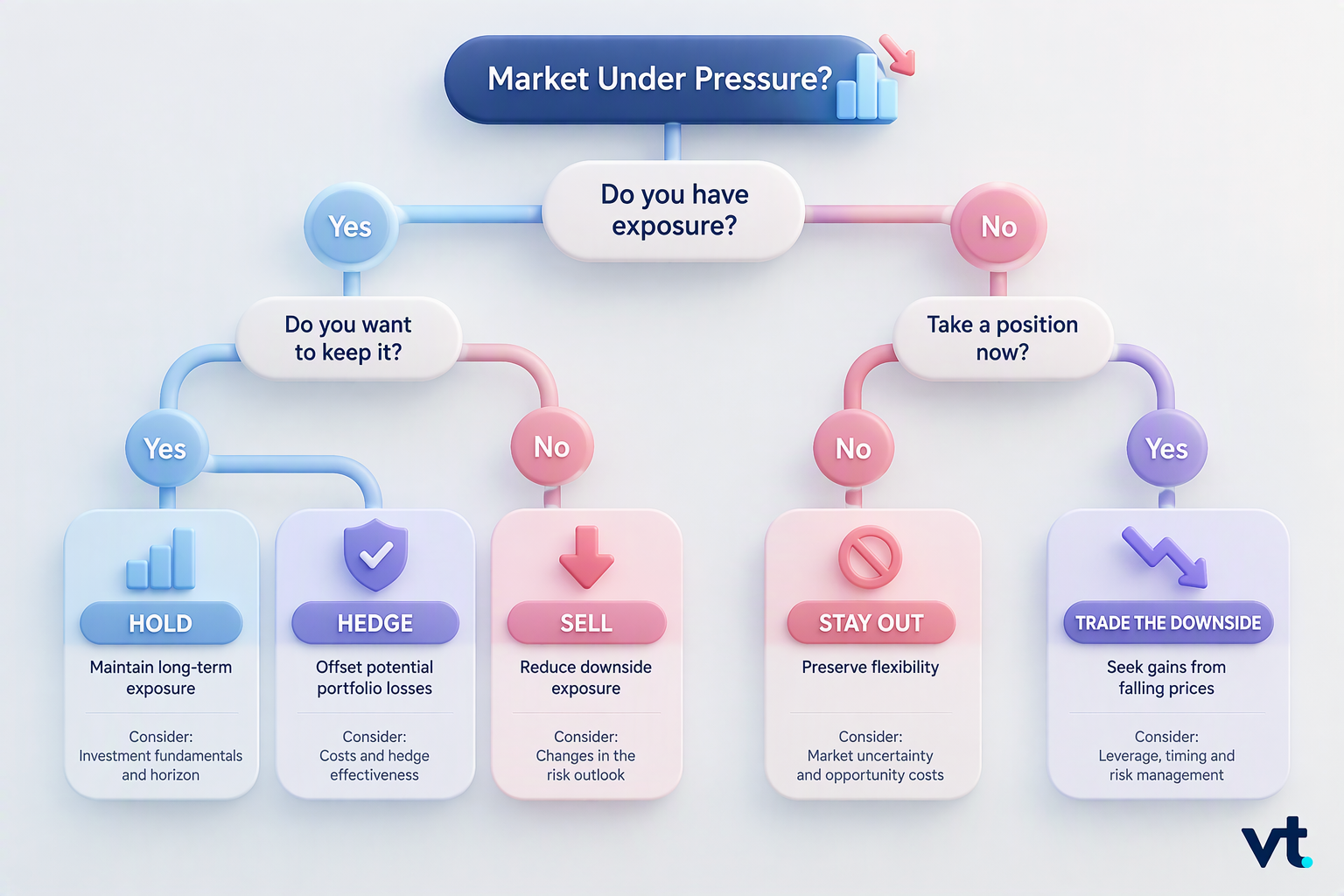
Before choosing an approach, investors should assess what is driving the decline, whether their objectives have changed and how much additional risk they can reasonably accept. The intended holding period, potential trading costs and consequences of an unexpected market recovery should also influence the decision, particularly when short exposure or leverage is involved.
Falling markets can create both risks and opportunities, but the appropriate response depends on an investor’s objectives, existing exposure and assessment of market conditions. Holding may be reasonable when fundamentals remain intact, while selling or hedging can help manage downside exposure when uncertainty increases. Staying out may also be appropriate when conditions do not offer a sufficiently attractive balance between potential reward and risk.
For traders anticipating further declines, CFDs provide a way to establish bearish positions across supported markets, including forex, gold and stock indices. However, leverage and sudden market reversals can amplify losses, making a clearly defined risk-management approach essential.
Frequently Asked Questions
- Should you sell your investments when markets are falling?
Not necessarily. Selling can help reduce exposure to further losses, but it may also mean missing a potential recovery. The decision should depend on your investment horizon, financial objectives and whether the underlying fundamentals have changed.
- Is it better to hold or hedge during a market downturn?
Holding may be appropriate for investors who remain confident in their long-term investments, while hedging can help offset potential short-term losses without selling existing positions. However, hedging introduces additional costs and risks, making it important to assess whether the protection justifies the expense.
- How can traders profit from a falling market?
Traders can potentially benefit from declining prices through traditional short selling, short CFD positions or inverse ETFs. These instruments provide different forms of bearish exposure, although each carries risks, including market reversals, leverage and trading costs.
- What are inverse ETFs, and how do they work?
Inverse ETFs are designed to deliver the opposite performance of an underlying benchmark or asset, typically on a daily basis. Examples available through VT Markets include SDS, SQQQ and SKDD, which provide inverse exposure to the S&P 500, Nasdaq-100 and SK Hynix, respectively. Daily resets mean longer-term returns may differ from the inverse of the underlying asset’s cumulative performance.
- Can CFDs be used to hedge against market declines?
Yes. CFDs allow traders to open short positions on supported instruments, such as stock indices or gold, without owning the underlying assets. A short CFD may help offset losses in an existing portfolio, although leverage, financing costs and imperfect correlations can affect the hedge’s effectiveness.
- Is staying out of the market a good strategy during high volatility?
Staying out can be a reasonable risk-management decision when market direction is unclear or trading conditions are unfavourable. Although remaining on the sidelines may mean missing potential opportunities, it can also help preserve capital and flexibility until conditions become clearer.



