





Key Takeaways:
- A position trading strategy is a long-term approach that aims to capture major market trends over weeks, months, or sometimes years.
- It uses far fewer trades than day or swing trading, blending fundamental analysis for direction with technical analysis for timing.
- The main trade-off is cost. Long holding periods bring overnight financing charges plus exposure to gaps and macro shocks.
- With a MetaTrader 4 and MetaTrader 5 platform like VT Markets, you can run a position trading strategy across forex, indices, gold, and commodities.
Some traders live inside one-minute charts. Others prefer to zoom out, pick a direction, and let time do the heavy lifting. That second group are position traders.
A position trading strategy is built around one simple idea. Big market moves take time, so you hold your trades long enough to capture them. You are not chasing every wiggle. You are following the main trend and staying with it, often for weeks or months.
The catch sits in the title. Long-term moves come with short-term costs. Holding a leveraged CFD position over time means overnight financing, wider stops, and the risk of a sudden gap. Get the balance right and the reward can be worth the patience. Get it wrong and those costs quietly erode your returns.
This guide analyses how a position trading strategy works, how to build one, and how to manage the risks. We will use current figures and simple examples throughout.
What Is a Position Trading Strategy?

So, what is a position trading strategy in plain terms? It is a long-term trading style. You open a position based on a broad market view, then hold it while that view plays out.
Forex is the natural home for this approach. It is the largest and most liquid market on earth.
According to the Bank for International Settlements 2025 Triennial Survey, average daily forex turnover reached about 9.6 trillion US dollars in April 2025.
That was up roughly 28% from 7.5 trillion three years earlier. Deep liquidity like this helps long-term trends form and hold.
Position traders care little about a single day’s noise. They care about the direction of the next few months.
How a Position Trading Strategy Works
A position trading strategy works in a few clear steps:
- Form a view. You decide the likely long-term direction using fundamental analysis such as interest rates, growth, and earnings.
- Time the entry. You use technical analysis, such as moving averages and trend lines, to enter at a sensible point.
- Hold through the noise. You stay in the trade during small pullbacks, as long as your original view still stands.
- Exit with a plan. You close when the trend breaks, your target is hit, or the fundamentals change.
The result is a low-frequency style. You might place only a handful of trades a year. Each one aims for a large move rather than a quick scalp.
Who a Position Trading Strategy Suits
This style is not for everyone. A position trading strategy tends to suit traders who:
- Cannot watch charts all day and prefer a slower pace.
- Have the patience to hold through short-term swings.
- Can accept larger open drawdowns without panic.
- Think in terms of macro themes, not minute-by-minute price action.
If you need constant action, this approach may frustrate you. If you value calm and structure, it can be a strong fit.
Position Trading vs Buy and Hold
Position trading is often confused with buy and hold investing. They share patience, but they differ in important ways.
| Feature | Position Trading | Buy and Hold |
| Direction | Long or short | Long only |
| Instrument | Often CFDs with leverage | Usually the underlying asset |
| Exit plan | Defined rules and stops | Rarely a fixed exit |
| Timing | Uses technical analysis | Little to no timing |
| Holding period | Weeks to months, sometimes years | Years to decades |
| Overnight costs | Yes, financing applies | None for owned assets |
The key point is control. A buy and hold investor rides out almost everything. A position trader sets rules, can profit in both directions, and manages risk actively.
How to Build a Position Trading Strategy
Building a solid position trading strategy is a process, not a guess. Four pillars hold it together: your market, your analysis, your rules, and your risk.
Choosing Your Market
Start with liquid, trending markets. These give cleaner trends and lower trading costs. Popular choices include:
- Forex majors such as EUR/USD and USD/JPY.
- Major stock indices like the US 500 or the US Tech 100.
- Gold and other commodities that follow long macro cycles.
Access is a priority too. A platform such as VT Markets on MetaTrader 4 and MetaTrader 5 lets you trade all of these from one account, with the charting tools a long-term trader needs.
Combining Fundamental and Technical Analysis
The strongest long-term traders blend two lenses.
- Fundamental analysis sets the direction. Think interest-rate cycles, inflation, growth, and company earnings.
- Technical analysis sets the timing. Think trend lines, support and resistance, and long-period moving averages.
Here is a simple way to picture it:
Fundamentals tell you which way the river is flowing. Technicals help you step in without getting your feet wet.
Defining Entry and Exit Rules
Vague plans lead to emotional decisions. Clear rules prevent that. A basic rule set might look like this:
- Entry: price trades above its 200-day moving average and breaks a recent high.
- Add-on: an optional second entry on a pullback to the 50-day moving average.
- Exit: price closes below the 200-day moving average, or the fundamental view changes.
- Target: a defined reward-to-risk ratio, often 3 to 1 or better.
Write your rules down. A position trading strategy example on paper is far easier to follow than one held loosely in your head.
Position Sizing and Risk Parameters
Long horizons need wider stops. Wider stops mean smaller positions. That is the trade-off. Use a simple formula:
| Position size = Risk amount ÷ (stop distance × value per point) |
Worked example:
- Account: USD10,000
- Risk per trade: 1 percent, or USD100
- Stop distance: 500 pips, wide enough to survive long-term noise.
- To risk only 100 dollars over 500 pips, each pip can be worth USD0.20
- On a pair where a standard lot is USD10 dollars per pip, that means about 0.02 lots.
The lesson is clear. The wider your stop, the smaller your position must be to keep risk fixed.
Types of Position Trading Strategy
There is no single best position trading strategy. The right one depends on your market and your personality. Here are four common types.
1. Trend-Following
The classic approach. You identify an established trend and ride it.
- Enter in the direction of the higher-timeframe trend.
- Add on shallow pullbacks that respect the trend.
- Trail your stop as the move extends.
2. Breakout
You wait for price to break out of a long-term range or key level.
- Mark a clear multi-month high or low.
- Enter when price breaks and holds beyond it.
- Confirm with rising volume or momentum where possible.
3. Fundamental and Macro-Driven
Here the trade is built on a big-picture theme, such as:
- A rate-cutting cycle that weakens a currency.
- Safe-haven demand lifting gold during uncertainty.
- A structural shift in the supply and demand of a commodity.
Gold is a live example:
Gold crossed $3,000 an ounce in March 2025. Then, it set a record near $5,597 in late January 2026, driven by central-bank buying, strong ETF plus institutional demand, and geopolitical stress.
A macro-driven position trader who read that theme early had months to act on it.
4. Moving Average Based
Some traders let moving averages do the talking.
- A golden cross, where the 50-day crosses above the 200-day, can signal a new long-term uptrend.
- Price holding above the 200-day moving average keeps you in the trade.
- A decisive close below it can be your exit.
Best Timeframes and Indicators for Position Trading
A position trading strategy lives on higher timeframes. The indicators are chosen to filter noise, not chase it.
Timeframes Position Traders Use
Position traders work mainly from the daily and weekly charts. Some also check the monthly chart for the bigger picture.
- Weekly chart: sets the primary trend.
- Daily chart: fine-tunes entries and exits.
- Monthly chart: confirms the long-term backdrop.
Lower timeframes are used only for a cleaner entry, never for the main decision.
Key Indicators (Long-Period MAs, MACD, RSI)
A few reliable tools do most of the work:
- Long-period moving averages (50, 100, and 200-day) to define trend direction.
- Moving Average Convergence Divergence (MACD) to gauge trend strength and momentum shifts.
- Relative Strength Index (RSI) on the weekly chart to spot stretched, overbought or oversold conditions.
- ATR, or Average True Range, to size stops around normal volatility.
Fewer, well-understood indicators beat a cluttered chart every time.
How Long Position Traders Hold
Holding periods vary, but the pattern is consistent.
- Shorter position trades: a few weeks.
- Typical trades: one to six months.
- Theme-driven trades: a year or more.
The exit is decided by the trend and the thesis, not by the calendar.
Managing Risk in Position Trading
Risk control is where a position trading strategy is won or lost. Long holds magnify both profit and cost.
Setting Stop Losses Over Long Horizons
Tight stops get knocked out by normal noise. Long-term traders need room to breathe.
- Place stops beyond obvious support or resistance.
- Size them with ATR so they reflect real volatility.
- Consider a trailing stop to lock in gains as a trend matures.
A wider stop is not a bigger risk if you size the position correctly. Risk is set by stop distance and size together, not by the stop alone.
Leverage, Margin and Overnight Financing Costs
This is the short-term costs half of our title. CFDs use leverage and margin, and most positions held overnight incur an overnight financing charge, also called a swap. Over months, these add up.
Worked example of overnight financing costs:
- You hold a long gold CFD of 10 ounces. With gold near 4,075 dollars, the notional value is about 40,750 dollars.
- Assume an illustrative daily financing charge of 0.02 percent of notional, roughly 8.15 dollars per day.
- Over 30 days, that is about 245 dollars. Over 90 days, about 734 dollars.
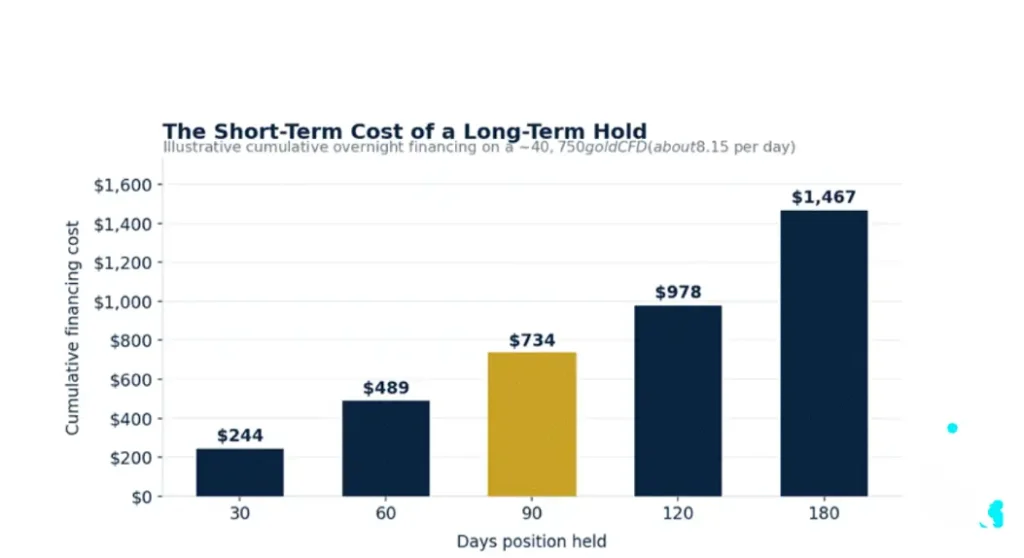
That cost is the price of patience. It does not make position trading wrong. It simply means your target move must be large enough to clear it comfortably. This is exactly why long-term traders aim for big trends, not small ticks.
Pro tip:
On VT Markets, you can view the current swap rate for each instrument on the platform before you open a position, so overnight costs stay transparent. Bear in mind rates update regularly.
Gap and Macro-Shock Exposure
Markets do not always move smoothly. They gap.
- Weekend gaps can jump straight past a normal stop.
- Central-bank decisions can reprice a market in seconds.
- Geopolitical shocks can trigger sharp reversals.
Gold shows both sides of this:
Gold hit a record near $5,597 in late January 2026, then eased to around $4,120 an ounce by mid-July 2026, as the January crisis cooled and rate expectations shifted, though renewed US-Iran tension has kept prices volatile.
A trader who bought the very top faced a heavy drawdown, even though the year-on-year trend was still up around 23 percent. The lesson is simple. Size for the shock you did not see coming, and use guaranteed stops where they are available.
Position Trading vs Swing Trading vs Day Trading
Trading styles differ mainly by time. Seeing the full spectrum helps you pick your lane.
| Factor | Day Trading | Swing Trading | Position Trading |
| Holding period | Minutes to hours | Days to weeks | Weeks to months+ |
| Chart focus | 1-min to 1-hour | 4-hour to daily | Daily to weekly |
| Trades per year | Hundreds or more | Dozens | A handful |
| Overnight costs | None | Some | Highest |
| Daily time needed | High | Medium | Low |
| Main skill | Speed | Timing | Patience |
Position vs Swing
Swing trading captures moves that last days to a few weeks. Position trading holds for far longer, riding the primary trend rather than the swings inside it. Swing traders trade more often. Position traders trade bigger themes, less often.
Position vs Day
Day trading closes every position before the market shuts, so there are no overnight costs and no gap risk. Position trading is the opposite. It accepts overnight financing and gap risk in exchange for capturing much larger moves with far less screen time.
Which Style Fits Your Goals and Time
Ask yourself three honest questions:
- How much time can you give the markets each day?
- How well do you handle open profit and loss swings?
- Do you prefer many small wins or a few larger ones?
If you have little screen time and plenty of patience, a position trading strategy likely fits you best.
Which Markets Suit Position Trading?
Not every market rewards patience equally. The strongest candidates trend clearly and stay liquid.
Forex
Currencies move on interest-rate cycles and economic trends, which can run for months. With daily turnover near 9.51 trillion dollars, forex offers the liquidity that long-term trends need. Retail traders make up only about 2.5 percent of that volume, so you are trading alongside deep institutional flow.
Stocks and Indices
Individual shares follow earnings cycles and sector rotation. Stock indices tend to trend over the long run, which suits position trading well. Indices also spread risk across many companies, softening the impact of any single-stock shock.
Gold and Commodities
Gold and commodities move on long macro cycles, supply and demand, and safe-haven demand. Gold’s climb past 3,000 dollars in 2025 to a record near 5,597 dollars in early 2026 shows how powerful these themes can be. Commodities can be volatile, so position sizing matters even more here.
Pros and Cons of Position Trading
Every strategy has a trade-off. A position trading strategy is no exception.
Advantages
- Less screen time: You are not glued to charts all day.
- Lower stress: You ride the trend instead of every tick.
- Fewer trades: That means fewer spreads and commissions.
- Large potential moves: You aim to capture the meat of a trend.
- Clear structure: Rules replace impulse.
Risks and Drawbacks
- Overnight financing costs build up over long holds.
- Capital is tied up for weeks or months.
- Gaps and macro shocks can hurt before a stop triggers.
- Large open drawdowns test your patience.
- Patience itself is a skill, and it takes time to build.
A quick word for beginners:
Is position trading good for beginners? It can be, because the slower pace reduces pressure and rushed decisions. Even so, the wide stops and overnight costs mean beginners should start small, ideally on a demo account, and learn risk management first.
Frequently Asked Questions (FAQs)
Q1: What is a position trading strategy?
A position trading strategy is a long-term approach that aims to capture major market trends over weeks, months, or sometimes years. It uses fundamental analysis to set direction and technical analysis to time entries and exits, with far fewer trades than day or swing trading.
Q2: How does position trading work?
You form a long-term view on a market, enter in the direction of the main trend, then hold through minor pullbacks while that view still holds. You exit when the trend breaks, your target is reached, or the fundamentals change.
Q3: What timeframes do position traders use?
Position traders work mainly from daily and weekly charts, and often check the monthly chart for the bigger picture. Lower timeframes are used only to fine-tune an entry, not to make the main decision.
Q4: Is position trading suitable for beginners?
It can be, because the slower pace reduces emotional, rushed trading. However, beginners should respect the wider stops and overnight costs. Starting on a demo account and mastering risk management first is the safer path.
Q5: How long do position traders hold a trade?
Most trades last from a few weeks to several months. Strong, theme-driven trades can run for a year or more. The exit is guided by the trend and the underlying thesis, not by a fixed date.
Start Your Position Trading Strategy With VT Markets
A position trading strategy rewards patience, structure, and good risk control. It lets you focus on the big moves that matter, without the pressure of watching every tick. The trade-off is cost and time, so your edge comes from planning, not luck.
The smart way to begin is to practise first. Test your rules, size your positions, and get comfortable with overnight costs before you commit real capital. A demo account on MetaTrader 4 or MetaTrader 5 is the perfect training ground.
With VT Markets, you can build and run a position trading strategy across forex, indices, gold, and commodities, all from one platform with the tools long-term traders rely on. Open your account today and start trading the trends that count.








