





Key Takeaways
- OpenAI is a leader in AI innovation, driving advancements in GPT models, reinforcement learning, and robotics, establishing itself as a dominant force in the AI industry.
- The company’s valuation has surged from $28 billion in 2023 to $852 billion by Q1 2026, reflecting rapid growth and increasing market share.
- Revenue is generated through multiple streams, including API licensing, subscription services like ChatGPT Plus, and strategic partnerships, particularly with Microsoft.
- OpenAI is preparing for its IPO on December 31, 2026 and its drawing significant investor interest.
- Strategic partnerships with Microsoft, along with integration into Azure, have been pivotal to OpenAI’s growth, significantly contributing to its revenue.
Artificial Intelligence (AI) is revolutionising industries globally, driving innovation and enhancing efficiency across sectors like healthcare and entertainment. As AI adoption continues to rise, investors are increasingly interested in understanding the potential of AI-driven companies.
This article delves into OpenAI’s journey, its technological advancements, and why it could be an appealing investment opportunity.
What is OpenAI?
OpenAI is an AI research company focused on advancing Artificial General Intelligence (AGI) for a wide range of industries. Founded in 2015 by Elon Musk, Sam Altman, and others, OpenAI began as a non-profit but transitioned to a ‘capped-profit’ model to secure funding for its rapid growth. Despite the transition, OpenAI continues to prioritise its societal impact alongside technological innovation.
What Makes OpenAI Stand Out
OpenAI has made remarkable strides in AI, particularly with its groundbreaking technologies. These innovations have transformed multiple industries, setting OpenAI apart as a leader in the AI field.
Below are the key technologies behind OpenAI’s success:
1. GPT Models (Generative Pre-trained Transformers)
OpenAI’s GPT models have revolutionised natural language processing (NLP). These models can generate human-like text with remarkable coherence, creativity, and context awareness.
They are widely used for:
- Writing assistance: Automating content generation, article writing, and more.
- Language translation: Facilitating real-time translation between languages.
- Customer service: Powering chatbots and virtual assistants to improve customer interactions.
- Code generation: Assisting programmers by generating code snippets and solving programming tasks.
What sets GPT models apart is their ability to generate contextually relevant, coherent text that can even mimic creativity. This innovation has propelled OpenAI to the forefront of AI development.
2. Reinforcement Learning
In addition to its GPT models, OpenAI has made significant advances in reinforcement learning, where AI learns by interacting with its environment and receiving feedback. This method enables systems to improve their performance over time, making it highly effective in dynamic and complex environments.
Example:
OpenAI’s Dota 2 AI (OpenAI Five) is one of the most notable examples of reinforcement learning. It trained by playing millions of games against itself and human players, learning strategies and adapting to in-game scenarios in real time. The AI ultimately defeated professional human teams, demonstrating the power of reinforcement learning in complex decision-making environments like gaming and beyond.
3. Robotics and Computer Vision
OpenAI has expanded its research to include robotics and computer vision, enabling machines to perceive and interact with their physical environment. By incorporating visual understanding and motor skills into AI models, OpenAI is enabling new possibilities in automation and intelligent machines.
Example: OpenAI’s Robotic Hand has demonstrated exceptional dexterity by solving a Rubik’s Cube using just one hand. This achievement in robotic manipulation is a milestone for AI’s ability to perform physical tasks with high precision. Moreover, OpenAI’s work in computer vision is making strides in autonomous driving, where AI models interpret and respond to visual data from cameras and sensors to navigate safely.
OpenAI Pathways to IPO
Currently, OpenAI remains a private company, with its stock not available for public trading. The company is preparing for an Initial Public Offering (IPO) scheduled for December 31, 2026, drawing significant attention from investors.
Once OpenAI becomes publicly traded, several key factors will influence its stock price:
- Ongoing technological advancements and product innovation.
- Broader AI market adoption across various industries.
- Financial performance growth, driven by diverse revenue streams, including API licensing and strategic partnerships.
OpenAI’s Revenue Over the Years
OpenAI has experienced substantial growth in recent years. From a valuation of $28 billion in 2023, the company reached an estimated $852 billion by Q1 2026, showcasing its dominance in the AI market. This rapid increase is attributed to the company’s innovative AI technologies, strategic partnerships with major players like Microsoft, Amazon, and Nvidia, and its ability to attract significant investments.
In 2026, OpenAI raised $122 billion in its largest funding round, further solidifying its position as a leader in the AI industry. This funding supports its mission to develop a unified AI superapp and expand its AI solutions across multiple sectors. The company’s strong valuation trajectory highlights its ability to capitalise on growing demand for AI, positioning itself for continued success.
Here’s a breakdown of OpenAI’s valuation growth:
| Date | Valuation | Key Developments |
| April 2023 | $28 billion | Initial valuation, driven by GPT-3 and early partnerships. |
| January 2024 | $86 billion | Growth spurred by expanding technology and market reach. |
| October 2024 | $157 billion | Continued expansion into industries and product offerings. |
| March 2025 | $300 billion | Growth due to demand for AI solutions and GPT-4 success. |
| October 2025 | $500 billion | Deepened partnerships and successful funding rounds. |
| April 2026 | $852 billion | Record funding further solidifies OpenAI’s leadership in the AI sector. |
This impressive trajectory highlights OpenAI’s ability to leverage increasing AI demand and its commitment to driving innovation across sectors.
Should You Invest in OpenAI stock?
Investing in OpenAI presents a unique opportunity, given the company’s strong market position, groundbreaking technology, and potential for future growth.
As it continues to lead the AI industry, there are 3 key reasons why it may be an attractive addition to an investment portfolio:
1. Industry Leadership and Technological Innovation
OpenAI is widely recognised as a leader in AI technology, particularly in natural language processing (NLP) and generative AI. Its models, such as GPT-3 and GPT-4, have set new standards in the AI field by being able to generate human-like text and solve complex problems. This has opened the door for AI to be integrated into countless industries, from healthcare and customer service to content creation and programming.
The company’s continuous innovation and advancements in AI have positioned it at the forefront of this technology, and this leadership in the AI space offers significant potential for long-term growth. As more industries adopt AI to enhance efficiency and streamline operations, OpenAI is well-positioned to lead these changes, creating value for both businesses and investors.
2. Strong Growth Potential and Expanding Market Demand
The demand for AI solutions is surging globally, and OpenAI is strategically positioned to capitalise on this growth. In just a few years, the company has seen its valuation soar, with the AI market projected to keep expanding as AI continues to revolutionise various sectors.
OpenAI’s technologies are already deeply integrated into key industries such as healthcare, finance, and customer service, and as AI adoption accelerates, its market presence is expected to grow even further. The company’s ability to scale and adapt to new markets makes it a compelling opportunity for investors eager to tap into the future of AI innovation.
3. Diverse Revenue Streams and Strategic Partnerships
OpenAI’s business model is not reliant on just one revenue stream, making it more financially stable than companies that depend on a single source of income. The company generates revenue through multiple channels:
- Licensing Technology and API Access: OpenAI licenses its advanced AI models to enterprises, enabling businesses to integrate cutting-edge AI into their operations. This is particularly important in sectors like healthcare, finance, and customer service, where AI adoption is accelerating.
- Subscription Services: OpenAI offers several subscription models, the most significant of which is ChatGPT Plus ($20/month), which has approximately 15 million active subscribers as of mid-2025. Additionally, there are ChatGPT Pro ($200/month) and ChatGPT Team ($25-30/user/month) for power users and businesses. ChatGPT Enterprise, priced customarily above $60/user/month, targets larger business customers, providing significant recurring revenue.
- Enterprise Deployments and Strategic Partnerships: OpenAI’s partnership with Microsoft is a major revenue contributor, particularly through licensing arrangements and the use of Microsoft Azure. In the long term, OpenAI has forecasted a shift in revenue sharing with Microsoft, which could result in over $50 billion in additional retained revenue by 2030. OpenAI has also made substantial commitments to purchase services from Microsoft, further strengthening this strategic alliance.
- Emerging Revenue Streams: OpenAI is exploring new monetisation avenues, such as advertising and e-commerce referrals within its free tiers, although these are still in the early stages. Additionally, the company’s announcements for developer ecosystem monetisation through products like the Apps SDK and AgentKit signal future revenue opportunities.
This diversified model ensures that OpenAI remains financially resilient, while also creating ample room for future growth across multiple market segments. By targeting both individual users and enterprise clients, OpenAI is building a robust and sustainable revenue base.
4 Ways to Invest in OpenAI
OpenAI offers several pathways for investors to gain exposure to its remarkable growth. Though you cannot buy OpenAI stock directly at this time, there are multiple ways to invest in its technologies and future.
Here’s a look at the available options:
1. Buy Shares from Existing Shareholders Through Secondary Marketplaces
You can buy shares in private companies like OpenAI through secondary marketplaces. These platforms provide a way for private company shares to be bought and sold before the company goes public.
How it Works:
- Secondary marketplaces like Hiive and Forge connect existing shareholders (like OpenAI employees, venture capitalists, or angel investors) with accredited investors.
- When shares are available, buyers and sellers agree on a price, and the platform facilitates the transaction.
- These platforms provide access to shares in companies like OpenAI, which remain privately owned but are poised for a potential IPO.
Requirements to Participate:
To be eligible to buy shares, you must meet the criteria of an accredited investor, which typically means:
- Earning at least $200,000 per year individually or $300,000 jointly.
- Having a net worth exceeding $1 million, excluding your primary residence.
- Holding a Series 7, 65, or 82 financial license if you are a financial professional.
If you meet these requirements, you can sign up on platforms like Hiive or Forge to explore investment opportunities with OpenAI.
Why It’s Beneficial:
- You can potentially get in on OpenAI’s success before it becomes available to the general public through an IPO.
- The opportunity allows for early-stage participation in one of the leading AI companies, which is expected to grow significantly over the coming years.
2. Invest via the Fundrise Innovation Fund
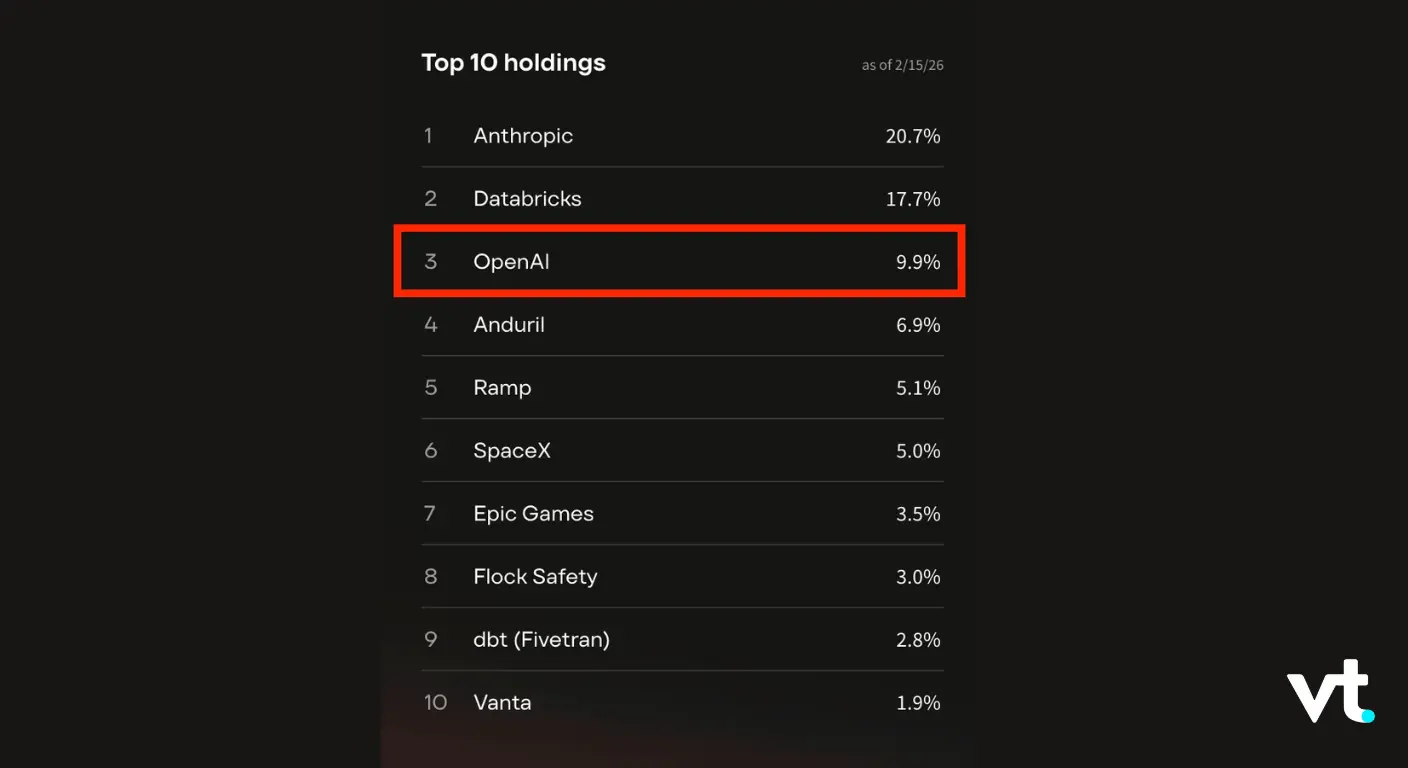
For investors looking to indirectly invest in OpenAI, the Fundrise Innovation Fund (VCX) offers an attractive opportunity. This publicly listed venture capital fund focuses on disruptive technologies and has significant stakes in private companies, including OpenAI.
How it Works:
- Fundrise VCX has a 9.9% stake in OpenAI as of Q1 2026. The fund invests in companies advancing fields like machine learning, data infrastructure, and artificial intelligence, making OpenAI a natural inclusion in its portfolio.
- By investing in the Fundrise Innovation Fund, you gain exposure to OpenAI’s growth without having to buy shares in the company directly. Instead, you’re investing in the fund, which holds shares in OpenAI along with other tech-focused companies.
Why It’s Beneficial:
- You can gain indirect exposure to OpenAI by investing in a publicly traded fund, which provides diversification across multiple tech companies, including OpenAI.
- The Fundrise Innovation Fund focuses on high-growth tech sectors, meaning its investments are aligned with future trends, including AI and machine learning.
3. Invest Through the ARK Venture Fund
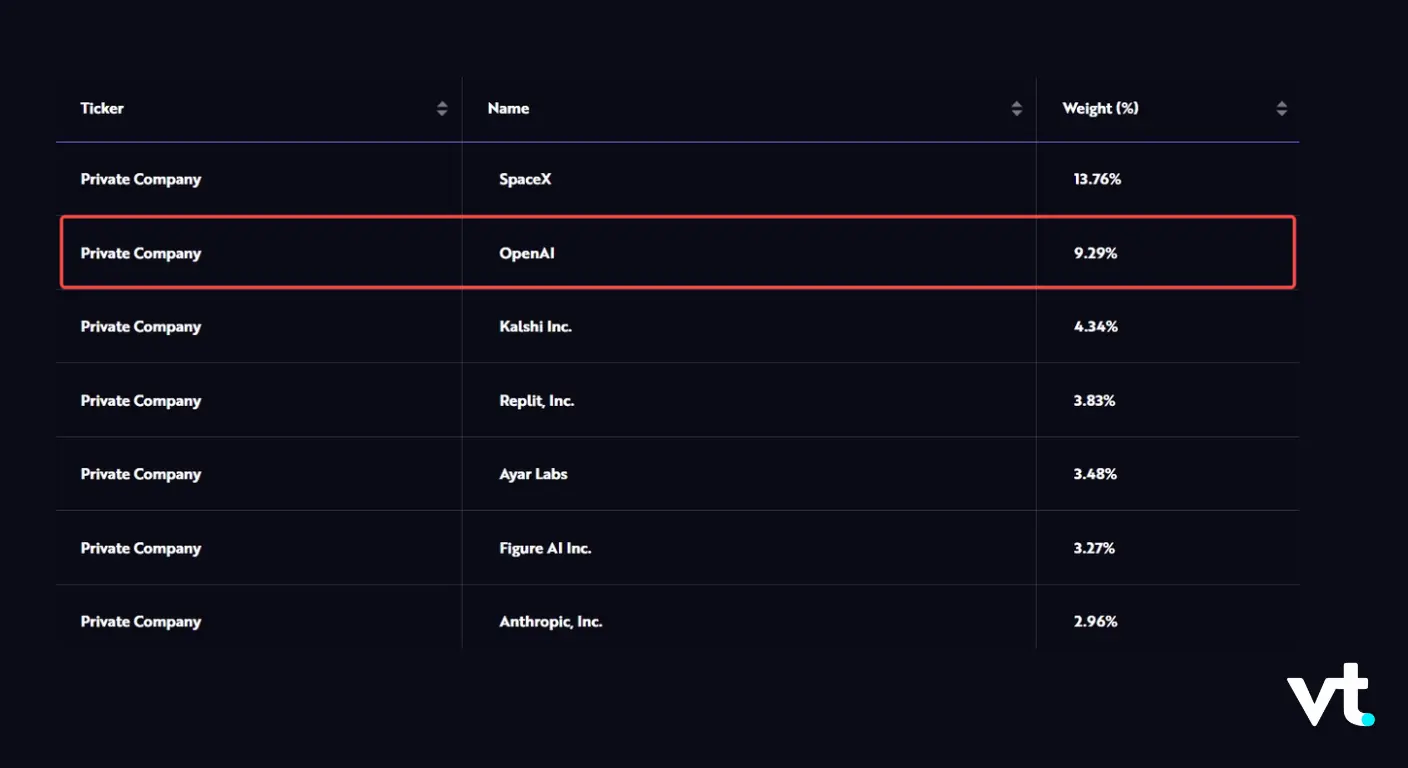
The ARK Venture Fund is another way to gain exposure to OpenAI. Managed by ARK Invest, this fund focuses on companies that are driving disruptive innovation, and OpenAI is one of its largest holdings.
How it Works:
- The ARK Venture Fund invests in a mix of public and private companies, with OpenAI making up 9.29% of the portfolio. This means when you invest in the ARK Venture Fund, you indirectly invest in OpenAI, as well as other disruptive tech companies such as SpaceX and Anthropic.
- The fund is actively managed and seeks to identify high-potential startups in sectors like artificial intelligence, robotics, and automation.
Why It’s Beneficial:
- Investing in the ARK Venture Fund gives you a diversified portfolio that includes OpenAI and other high-growth companies. This reduces the risk of concentrating all investments in a single company or technology.
- The fund’s focus on disruptive innovation aligns with OpenAI’s leadership in the AI space, making it an attractive option for those looking to capture the long-term value from companies at the forefront of technological advancements.
4. Invest in OpenAI’s Strategic Partners
If you want to gain exposure to OpenAI without investing in the company directly, another option is to buy shares in companies that have strategic partnerships with OpenAI, such as Microsoft and Nvidia. Both companies have deep ties to OpenAI, which makes them indirect investment options.
How it Works:
- Microsoft has invested heavily in OpenAI, including a $10 billion investment in 2023, which gives Microsoft a stake in OpenAI’s success. Microsoft’s integration of OpenAI’s technology into products like Azure and Copilot makes it a key player benefiting from OpenAI’s growth.
- Nvidia, which supplies the GPUs that OpenAI uses for its training models, is also a major benefactor of OpenAI’s technology. As OpenAI continues to scale, Nvidia’s role in providing the hardware behind AI models positions it to benefit from increased demand for AI-powered solutions.
Why It’s Beneficial:
- Investing in Microsoft or Nvidia provides indirect exposure to OpenAI’s growth, while also gaining from their strong financials and leadership in the AI space.
- Both Microsoft and Nvidia are well-established companies with strong market positions. As such, they offer a more stable investment than investing in a newer, privately held company like OpenAI directly.
Risks to Consider When Investing in OpenAI
While OpenAI offers exciting growth opportunities, it’s crucial to carefully assess the risks involved before making any investment decisions. AI is an emerging and rapidly evolving sector, and with innovation comes a range of uncertainties and challenges.
Below are some key risks that investors should be aware of when considering OpenAI as part of their portfolio:
1. Regulatory Risks
As AI technology continues to advance and become more integrated into various industries, it is increasingly likely that governments worldwide will introduce new regulations to control its use and impact. This could affect how OpenAI operates, especially in areas like data privacy, ethics, and transparency.
For instance:
- Data Privacy: AI systems, particularly language models like those developed by OpenAI, process vast amounts of personal data. Governments may introduce stricter regulations on how data is collected, stored, and used, potentially impacting OpenAI’s ability to operate in certain regions or industries.
- Ethical Considerations: As OpenAI’s models become more advanced, ensuring ethical decision-making becomes more important. There is growing concern around AI models perpetuating bias, misinformation, or unethical content. OpenAI will likely face increasing scrutiny to ensure its AI systems are used responsibly and ethically.
- Transparency in AI: Transparency in AI decision-making is another critical area. With AI models influencing decisions in everything from finance to healthcare, regulators may require companies like OpenAI to demonstrate how their systems work, the data they use, and how they reach conclusions. Meeting these regulatory demands could result in higher operational costs and slow down the pace of innovation.
As OpenAI expands its global reach and adoption, it will need to stay ahead of regulatory changes and potentially face legal challenges in jurisdictions with different laws surrounding AI.
2. Competitive Landscape
The AI market is highly competitive, and OpenAI faces fierce competition from both established technology giants and emerging startups. Companies like Google, Amazon, IBM, and Anthropic are investing heavily in AI research, and many are developing their own advanced models to rival OpenAI’s offerings.
The challenges include:
- Innovation Race: While OpenAI is a leader in the field, it must continuously innovate to maintain its competitive edge. Tech giants like Google with its Bard chatbot and Anthropic with its Claude models are constantly working on competing technologies that could challenge OpenAI’s dominance.
- Market Share Pressure: Larger players like Amazon, with their AWS cloud infrastructure, can also afford to offer AI services at a competitive price, potentially making it difficult for OpenAI to maintain a profitable market share in the long term.
- Emerging Startups: New AI startups, especially those in specialised fields, may find niches where they can outperform OpenAI’s broad focus. These agile competitors can innovate quickly and capture significant market segments, challenging OpenAI’s ability to stay ahead.
While OpenAI has established itself as a leader in the field, maintaining that leadership requires constant innovation, strategic partnerships, and a solid product pipeline. The competitive environment could put downward pressure on OpenAI’s market share or even its long-term growth prospects.
3. Technological Obsolescence
The AI landscape is evolving rapidly, and technological obsolescence is a significant risk. While OpenAI’s current GPT models like GPT-3 and GPT-4 are cutting-edge, the pace of technological development in AI means that new advancements could quickly render its existing models outdated.
Potential challenges include:
- Rapid Advancements in AI: New breakthroughs, such as quantum computing, could offer far greater processing power than current AI models are able to harness. This could result in OpenAI’s current models being replaced by newer, more efficient systems developed by competitors or even OpenAI itself.
- AI Model Updates: OpenAI will need to continuously update and improve its models to stay relevant. This includes enhancing performance, expanding capabilities, and addressing emerging issues like AI bias and safety. Failing to do so could harm OpenAI’s ability to maintain market leadership.
- Intellectual Property (IP) Risks: The AI field is prone to IP disputes, with competitors and new entrants frequently challenging patents or creating competing models based on similar technologies. OpenAI’s proprietary models could be at risk of being copied or improved upon by rivals, reducing its competitive advantage.
OpenAI’s ability to remain a leader in the industry will depend on its ability to stay ahead of the technological curve. This includes constant research and development investments, strategic partnerships, and acquiring talent capable of driving future breakthroughs.
The Future of OpenAI
As OpenAI continues to push the boundaries of artificial intelligence, the future holds endless possibilities.
With rapid advancements in AI and machine learning, industries like finance, healthcare, and technology are about to experience major changes.
In the end, OpenAI’s innovations are not just changing how we interact with AI but also shaping how markets adjust and grow in response to these changes.
To dive deeper into the future of AI and its market impact, explore our comprehensive guides:
- AI Stock Investing: The Complete AI Value Chain Guide for Traders
- OpenAI vs Gemini: The Battle Shaping AI Markets
- Tech Landscape Being Reshaped in AI Race
- AI Stock Trading in Canada: Bots and Strategies
Ready to Capitalise on the Future of AI?
Open a live account with VT Markets today and gain access to the tools, insights, and support you need to navigate the evolving AI landscape and make informed trading decisions.
Frequently Asked Questions
1. What is OpenAI and how does it work?
OpenAI is an AI research company specialising in developing advanced AI models, including the widely recognised GPT series. These models learn from vast datasets to perform various tasks, such as answering questions, generating text, and solving complex problems.
2. What makes OpenAI different from other AI companies?
OpenAI distinguishes itself by focusing on developing advanced AI models that push the boundaries of natural language processing, reinforcement learning, and robotics. Unlike many of its competitors, OpenAI prioritises aligning its technology with societal benefits and addressing real-world challenges through its solutions.
3. How Can I Buy OpenAI Stock?
Currently, OpenAI is a privately held company, meaning it is not publicly traded, and there is no ticker symbol available for purchase on the stock market. However, there are a few ways to gain exposure to OpenAI before it goes public:
- Secondary Marketplaces: You can buy shares from current investors on platforms like Hiive or Forge. However, you must be an accredited investor to participate, meaning you need to meet specific financial criteria.
- Investing in Venture Funds: Some publicly available venture funds, like the ARK Venture Fund or Fundrise Innovation Fund, include OpenAI in their portfolios, offering indirect exposure.
- Strategic Partnerships: Investing in companies with strong ties to OpenAI, like Microsoft or Nvidia, can provide exposure as these partnerships fuel OpenAI’s growth and innovation.
While direct investment in OpenAI stock isn’t possible yet, these avenues allow for participation before the company’s IPO.
4. Is OpenAI Publicly Traded?
No, OpenAI is not a publicly traded company at this time. It remains a private company and is preparing for its Initial Public Offering (IPO) expected to take place on December 31, 2026. Until then, you will need to explore alternative investment options like secondary marketplaces, venture funds and strategic partnerships to gain exposure to OpenAI’s growth.
5. Is It Possible To Invest In OpenAI Through ETFs or Mutual Funds?
At present, OpenAI is not directly included in most exchange-traded funds (ETFs) or mutual funds due to its status as a private company. However, you can gain indirect exposure by investing in funds that hold stakes in OpenAI, such as secondary marketplaces, venture funds and strategic partnerships, which include OpenAI as one of their key holdings.
6. Is OpenAI working with any major companies?
Yes, OpenAI has strategic partnerships with major tech companies, most notably Microsoft and Nvidia. Microsoft has invested heavily in OpenAI and uses its AI technology across its products, including in Azure cloud services. Nvidia provides the necessary hardware, including graphics processing units (GPUs), for OpenAI’s AI models, making it a key player in supporting OpenAI’s research and development.
7. What is the future of OpenAI?
OpenAI is set to continue leading the AI field, with its goal of developing AGI. The company will focus on expanding its technology into more industries, including healthcare, finance, and robotics. As AI adoption grows, OpenAI’s ongoing innovation and partnerships will fuel its growth, making it a key player in shaping the future of AI technology.
8. What will OpenAI’s stock price be when it goes public?
As OpenAI has not yet gone public, its stock price is not yet determined. The price will likely be influenced by various factors, including its technological innovations, growth prospects, financial performance, and market conditions at the time of its IPO. Investors will have to wait for the company to release its IPO filing to get more insight into the expected price range.










