






Key Points
- The Nikkei 225 fell sharply on Thursday, dropping below 67,000 as Japanese equities reversed gains from the previous two sessions.
- Semiconductor and technology shares led the decline as traders reassessed AI-related valuations across Asia.
- SoftBank Group, Tokyo Electron, Advantest, Kioxia and Fujikura were among the major names under pressure.
- Middle East tensions and higher oil prices added to inflation concerns, limiting the relief from softer US producer inflation data.
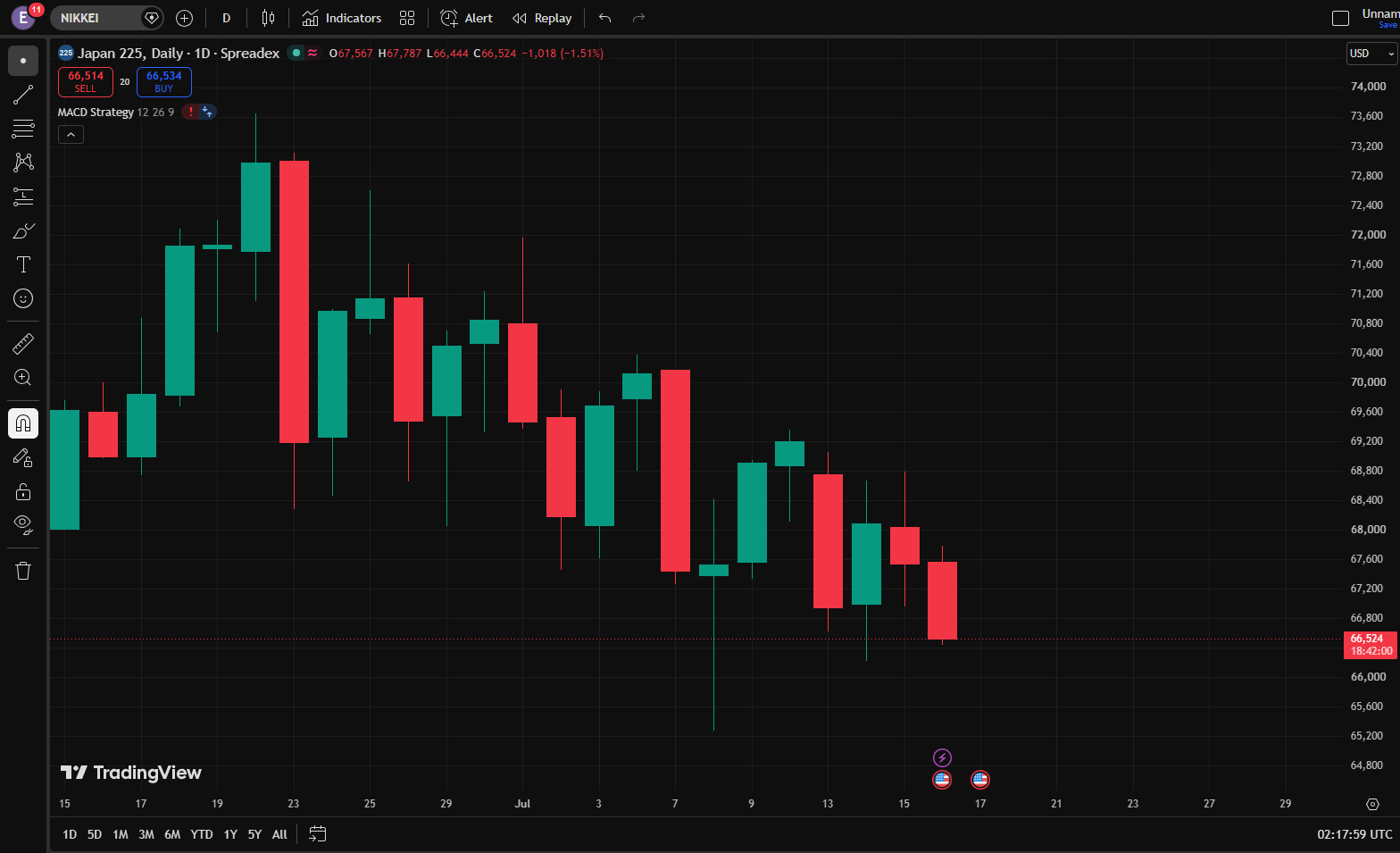
- The Nikkei 225 daily chart places first resistance near 67,000, while 66,444 is the immediate support level to monitor.
The Nikkei 225 fell sharply on Thursday as renewed selling in semiconductor and technology shares weighed on Japanese equities.
The benchmark index dropped below 67,000, reversing gains from the previous two sessions despite broadly positive cues from Wall Street overnight. The move reflected a broader pullback across Asian technology shares as traders questioned whether the AI-driven rally can continue to justify elevated valuations.
The decline left the Nikkei near the lower end of its latest trading range, with chip-related shares and index heavyweights driving most of the pressure.
Why Traders Are Watching
The Nikkei 225 is being shaped by three major themes: semiconductor weakness, AI valuation concerns and geopolitical risk.
Japanese technology shares had benefited from strong interest in artificial intelligence, data centres and advanced chip demand. After a sharp rally, the sector has become more vulnerable to profit-taking and valuation concerns.
Semiconductor-linked stocks were among the biggest drags. SoftBank Group, Tokyo Electron, Advantest, Kioxia and Fujikura all came under pressure as selling spread across Asian chip shares.
At the same time, rising Middle East tensions kept oil prices elevated. Higher energy prices can revive inflation concerns, complicate the interest-rate outlook and reduce demand for risk-sensitive assets.
Chip Shares Lead the Decline
The sharpest weakness came from Japan’s technology and semiconductor names.
Tokyo Electron and Advantest fell as chip-equipment shares tracked the broader regional sell-off. Kioxia and Fujikura also declined, while SoftBank Group added pressure as one of the index’s major heavyweights.
The sector remained sensitive to global chip sentiment after ASML’s latest update kept attention on AI-related demand, equipment pricing and the strength of semiconductor capital spending. While ASML shares rose ahead of earnings on hopes of a potential sales boost, the wider market reaction showed that investors are becoming more selective after the sector’s sharp rally.
The move matters because Japan’s equity market has become increasingly tied to the AI and semiconductor cycle. When chip shares weaken, the Nikkei 225 can come under pressure even if some other sectors remain resilient.
Traders are now watching whether upcoming chip-sector earnings can restore confidence in the AI buildout. Strong guidance may help stabilise sentiment, while cautious commentary could deepen the pullback.
Automakers Help Limit Losses
Automaker shares helped limit some of the broader market weakness.
Toyota and Honda traded higher during the session, supported by the weaker yen and exporter demand. A softer yen can improve overseas earnings when converted back into Japanese currency.
However, gains in automakers were not enough to offset the decline in technology, financial and semiconductor-related shares.
The US dollar traded in the lower 162 yen range, keeping currency movement in focus for exporters. Further yen weakness may support some export names, but it can also increase import and energy-cost pressure for Japan.
Middle East Risks Add Pressure
Geopolitical risk remained another source of market caution.
US-Iran tensions kept oil prices elevated and raised concerns about energy supply through the Strait of Hormuz. Japan relies heavily on imported energy, so sustained oil strength can increase costs for companies and consumers.
Higher oil prices may also keep inflation expectations elevated, even after softer US producer inflation data reduced some near-term Federal Reserve rate-hike concerns.
For the Nikkei 225, this creates a mixed backdrop. Softer US inflation data may ease some pressure from interest-rate expectations, but oil-driven inflation risks and technology selling remain active.
Key Trading Levels
| Level | What Traders Are Watching |
| 70,000 | Psychological recovery level if momentum improves |
| 69,200 | Recent rebound resistance area |
| 68,800 | Secondary resistance from the latest recovery attempt |
| 67,800 | Latest session high area |
| 67,000 | First recovery level and psychological reference |
| 66,524 | Current chart area |
| 66,444 | Latest session low and immediate support |
| 66,000 | Psychological support below the current range |
| 65,200 | Recent swing-low area |
| 64,800 | Broader downside reference |
The Nikkei 225 daily chart shows price trading near 66,524 after opening around 67,567. The latest session high stood near 67,787, while the low was approximately 66,444.
The index remains under pressure after failing to hold above 67,000. This level is now the first short-term recovery point to monitor.
A move back above 67,000 could bring 67,800 into focus. A stronger recovery would require a break above 67,800, followed by 68,800 and 69,200.
On the downside, 66,444 is the first support level to monitor. A break below this area could expose 66,000.
Bullish and Bearish Setups
| Setup | Trigger | Potential Market Reaction |
| Stabilisation Attempt | Hold above 66,444 | Nikkei 225 may consolidate after the sell-off |
| Bullish Recovery | Reclaim 67,000 | Price may retest 67,800 |
| Recovery Extension | Break above 67,800 | Attention may shift towards 68,800 |
| Stronger Breakout | Daily close above 69,200 | The 70,000 level may return into focus |
| Bearish Continuation | Fall below 66,444 | Price may retest 66,000 |
| Deeper Breakdown | Break below 66,000 | Downside may extend towards 65,200 and 64,800 |
The bullish recovery depends on the Nikkei 225 reclaiming 67,000 and holding above that level. This would suggest that selling pressure is starting to stabilise after the sharp decline.
A confirmed move above 67,800 would strengthen the recovery setup and bring 68,800 into focus. If buyers clear 69,200, the psychological 70,000 level becomes the next major resistance.
The neutral scenario is consolidation between 66,444 and 67,800. This would suggest that traders are waiting for clearer signals from semiconductor shares, oil prices, US rate expectations and broader Asian risk sentiment.
The bearish scenario strengthens if the Nikkei 225 falls below 66,444. A confirmed break could bring 66,000 into focus, followed by 65,200 and 64,800.
Disclaimer
The price levels and market scenarios above reflect the author’s view at the time of writing and do not represent financial advice or an official recommendation from VT Markets. Traders should conduct their own analysis and manage risk carefully.
Trade Nikkei 225 CFDs With VT Markets
The Nikkei 225 remains active when semiconductor sentiment, AI-related stocks, yen movement, oil prices and global risk appetite move at the same time.
With VT Markets, traders can access Nikkei 225 CFDs alongside forex, gold, oil, indices, shares, ETFs, bonds and other global CFD markets from one platform. This helps traders follow Japan’s equity market while also monitoring related moves in USDJPY, technology shares, energy prices and broader Asian market sentiment.
Use VT Markets’ charting tools to monitor support, resistance, moving averages and breakout behaviour as the next Nikkei 225 setup develops.
Start trading indices with VT Markets today.
Why Trade Nikkei 225 as a CFD?
Nikkei 225 CFDs allow traders to take a view on rising or falling price movements without owning the underlying index components.
That flexibility can be useful when the index reacts sharply to semiconductor weakness, AI valuation concerns, yen movement, oil prices or global interest-rate expectations.
If the Nikkei 225 breaks above resistance, traders can watch for a recovery setup. If price loses support, traders can monitor downside continuation as momentum weakens.
With VT Markets, traders can follow Nikkei 225 price action in real time and compare it with other major CFD markets through one account.
What to Watch Next
Semiconductor shares will remain the main focus. Traders will be watching whether selling in Tokyo Electron, Advantest, Kioxia, SoftBank Group and other technology-linked names continues or stabilises.
Upcoming chip-sector earnings may also influence sentiment across Asia. Strong guidance could support confidence in the AI buildout, while cautious commentary may increase pressure on richly valued semiconductor shares.
Oil prices and Middle East developments remain another key driver. Further escalation around the Strait of Hormuz could keep energy prices elevated and revive inflation concerns.
US rate expectations should also stay in focus. Softer producer price data reduced near-term Fed concerns, but sustained oil strength could complicate the inflation outlook.
For now, 66,444 to 67,800 is the main short-term range. A confirmed move above 67,800 could bring 68,800 into focus, while a break below 66,444 may expose 66,000.
Frequently Asked Questions
Why did the Nikkei 225 fall?
The Nikkei 225 fell as semiconductor and technology shares came under renewed selling pressure. Investors also became more cautious about AI-related valuations and Middle East risks.
Why are semiconductor shares important for the Nikkei 225?
Semiconductor and technology-related companies have a significant influence on Japanese equity sentiment. Weakness in names such as Tokyo Electron, Advantest, Kioxia and SoftBank Group can weigh heavily on the broader index.
How do oil prices affect Japanese stocks?
Japan imports much of its energy, so higher oil prices can increase cost pressures for companies and consumers. Rising energy prices can also revive inflation concerns and weigh on equity sentiment.
Did softer US producer inflation support the market?
Softer US producer price data reduced some near-term Federal Reserve rate-hike concerns. However, the benefit was limited because technology shares remained under pressure and oil prices stayed elevated.
What are the main Nikkei 225 levels to watch?
Immediate resistance is near 67,000, followed by 67,800 and 68,800. Immediate support is near 66,444, followed by 66,000 and 65,200.
What could help the Nikkei 225 recover?
The Nikkei 225 may recover if semiconductor shares stabilise, oil prices ease, US rate concerns decline or broader Asian risk sentiment improves. A move back above 67,000 would be the first sign of short-term stabilisation.
Start trading now — click here to create your real VT Markets account.








